











Digital Inheritance: Why Crypto Fortunes Disappear and How to Prevent It

Fortunes That Vanish in Plain Sight
For as long as wealth has existed, people have found ways to lose it — not just through bad investments or market crashes, but simply because the wealth could not be found or accessed after its owner was gone. Some of these fortunes belonged to criminals who deliberately obscured their assets. Others belonged to ordinary people whose only mistake was not being organized or trusting the wrong intermediary.
Hiding Assets Too Well
Every year, billions of dollars sit in dormant bank accounts, forgotten by their owners and unknown to their heirs. People move countries, change banks, lose paperwork, or simply fail to tell their families where accounts are held. Governments around the world maintain unclaimed property registries containing everything from savings accounts to insurance payouts and stock holdings. In the United States alone, state treasuries collectively hold tens of billions of dollars in unclaimed assets waiting for rightful owners and heirs to come forward.
In a similar vein, safe deposit boxes were once considered the ultimate place to store family wealth. Yet thousands are abandoned every year because heirs never knew they existed, lacked the necessary paperwork, or could not prove ownership. The valuables inside remain intact, but access to them becomes a bureaucratic puzzle that can take years to solve.
Estate lawyers frequently encounter situations where a person carefully prepares a will but never tells anyone where it is stored. The document exists, but family members cannot locate it after death. In some cases, estates are distributed under default inheritance rules simply because the instructions could not be found in time.
Digital Wealth is Easier to Lose
In 2013, Welsh IT worker James Howells accidentally discarded a hard drive containing the private keys to approximately 8,000 Bitcoin. The coins remain visible on the blockchain today, worth hundreds of millions of dollars, but without the keys they cannot be accessed. More than a decade later, despite repeated attempts to recover the drive from a landfill site, the fortune remains effectively lost.
Crypto assets are controlled by private keys — long strings of characters that serve simultaneously as the password, the vault, and the deed of ownership. If the key is lost, no court order and no legal authority can recover the assets. They exist on the blockchain, visible to anyone, transferable by no one. For all practical purposes they are gone forever.
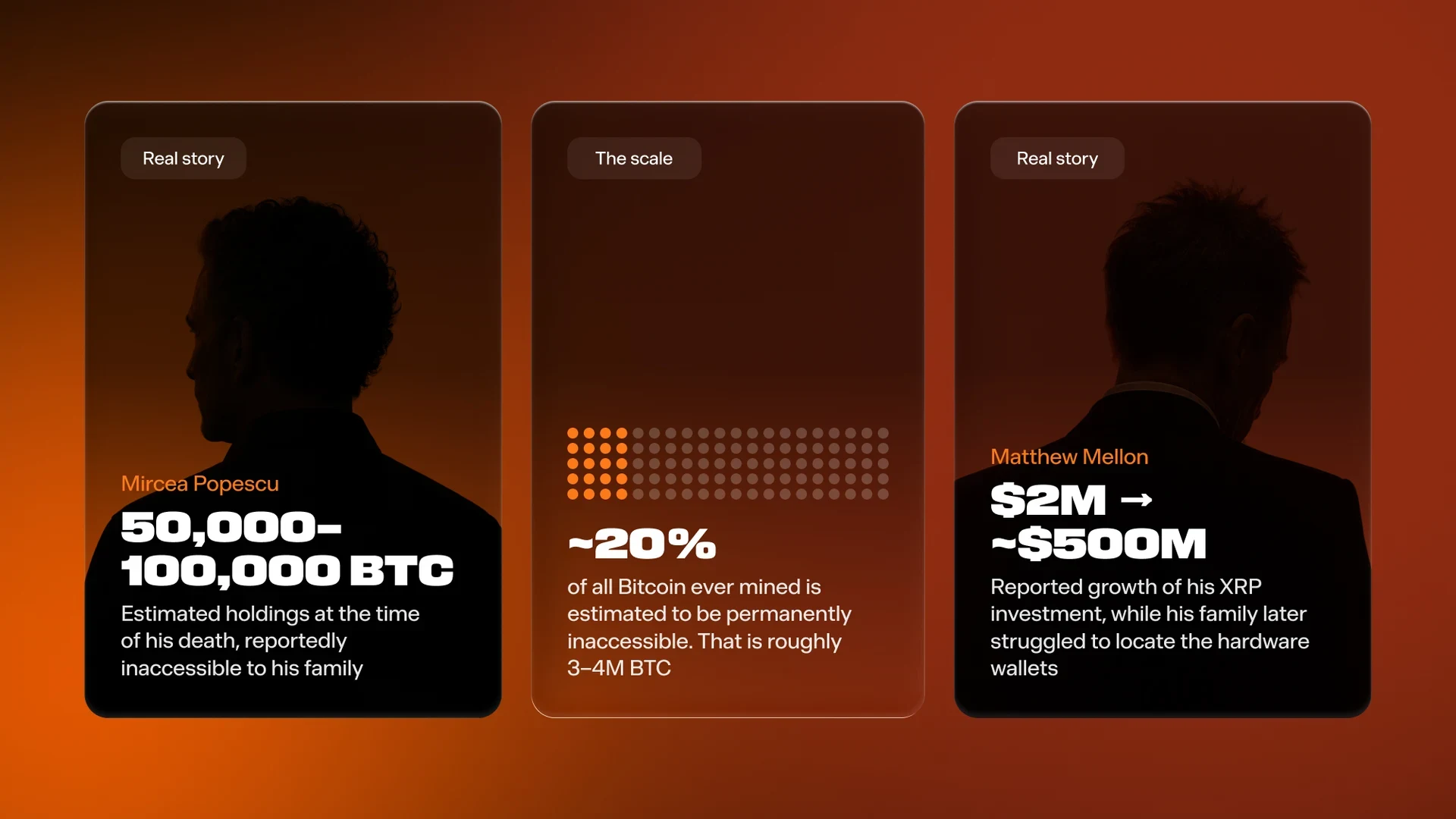
The scale of this problem is staggering. Analysts estimate that between 3 and 4 million Bitcoin — roughly 20% of all Bitcoin ever mined — are permanently lost. At current prices, that represents hundreds of billions of dollars in inaccessible wealth. And as the first generation of major crypto holders ages, the problem is only accelerating.
The most high-profile cases illustrate just how brutal and final this can be:
Mircea Popescu, a Romanian-born early Bitcoin adopter and founder of the MPEx exchange, drowned while swimming off the coast of Costa Rica in June 2021. He was only 41. Conservative estimates place his holdings at 50,000 to 100,000 BTC, worth between $1.75 and $3.5 billion at the time of his death. His family reportedly has no access to his wallets. The coins associated with him have never moved on-chain.
Matthew Mellon, a banking heir from the Mellon dynasty, turned a $2 million investment in XRP into an estimated $500 million. Famously security-conscious, he stored his holdings on multiple hardware wallets and distributed them across unknown physical locations. He spoke openly about the fortune but never documented where the devices were. In April 2018, at 54, he died. His family knew the XRP existed but struggled to locate the hardware wallets. The outcome of any recovery effort has never been publicly confirmed.
The list goes on and on. By some industry estimates, only around 17% of cryptocurrency holders have any form of inheritance plan. The rest are one unexpected event away from their assets becoming permanently inaccessible to the people they would want to have them.
The Seed Phrase Trilemma
Most crypto wallets rely on a seed phrase — typically 12 or 24 words — as the master key to all assets. In theory, this is simple: write down the words and keep them in a safe. In practice, the seed phrase creates an impossible three-way contradiction.
First, the seed phrase must remain secret. Whoever sees it can drain every asset in the wallet instantly and irreversibly. Second, you must not lose it yourself. If the phrase is destroyed in a fire or a flood, your assets are gone. Third, it must be inheritable. When you die, your beneficiaries need to be able to find and use it.
The contradiction is structural: the requirement that nobody else can find the seed phrase directly conflicts with the requirement that your beneficiaries must be able to find it after you are gone. Hide it well enough to be secure, and your heirs may never locate it — the Matthew Mellon problem. Make it accessible enough for inheritance, and you have created a security vulnerability every day you are alive. There are countless stories of crypto lost during divorces and family disputes — including one notable case where a spouse tracked down a seed phrase by reviewing security camera footage from the home.
MPC Wallets Address the Inheritance Problem
The seed phrase trilemma exists because traditional wallets concentrate all access into a single secret. Multi-Party Computation, or MPC, eliminates this single point of failure by design.
In Bron’s MPC wallet, the private key is never assembled in one place. Instead, it is split into three cryptographic shards, distributed across independent parties. No single shard — and no single party — can access or move assets. Any two shards can recreate the third one. Bron itself cannot reconstruct the key or move assets on its own.
This architecture is what makes true digital inheritance possible. Because every shard can be recreated using the other two, the loss of one shard does not mean the loss of the assets. It means a recovery process — one that is in-built in Bron by default, can be triggered in favor of the owner or beneficiaries in case of death or disability.
How Bron’s Digital Inheritance Works
Bron’s digital inheritance is built directly into the MPC architecture that secures every wallet. This design means that the infrastructure that keeps your assets secure during your lifetime is the same infrastructure that helps your beneficiaries regain access after you are gone. This is how it works in practice.
Designate Beneficiaries on Your Terms
You can add and remove beneficiaries at any time, and critically, without them knowing. This matters more than it might seem. Family dynamics are complex, and circumstances change. You may need to remove a beneficiary without disrupting a relationship. The Bron interface lets you manage this privately. You can add as many beneficiaries as you need — multiple children, a spouse, extended family members, trusted associates — there is no limit.
No Unilateral Actions
When there are two or more beneficiaries, every beneficiary must execute the transaction for it to go through. No single person can act alone. This is a fundamental safeguard against fraud, coercion, or premature claims. It ensures that the inheritance process requires consensus among all parties you have chosen.
The 180-Day Security Delay and Guardian Protection
The Bron software places extensive guardrails around the inheritance process to protect you in scenarios where you are still alive but unable to access your account — for example, if you are incapacitated, detained, or simply travelling without access to your device.
When a beneficiary initiates the inheritance process, a mandatory 180-day security delay begins. During this period, all beneficiaries and all guardians are notified that the process has started. Any beneficiary or any guardian can cancel the process at any point during these 180 days, and the process resets. If you, the wallet owner, log in to your account at any point during the delay, the process is also automatically cancelled.
This means that even in the worst-case scenario — malicious beneficiaries attempting to seize assets from a living owner — the guardians serve as an independent check, and the six-month window provides ample time for the situation to be identified and stopped. There are also, of course, in-built protections against malicious guardians from attempting to defraud beneficiaries.
Securing Your Crypto is Not Legal Advice
With all the power of Bron put into the hands of the user, it is important to understand what the wallet does and does not do. Bron provides the software and security architecture you use to keep your assets under your own control and to set up recovery for your beneficiaries. Bron does not provide legal, tax, or estate planning services. Beneficiaries should consult with inheritance and tax lawyers, fulfil all tax obligations, and ensure that assets are distributed in accordance with the applicable inheritance code or the owner’s will.
What Bron ensures is that the assets themselves are not lost. The legal and regulatory framework around those assets is the responsibility of the owner and their advisors. Our role is to provide the tools that keep that wealth accessible when it is needed.
Peace of Mind
It does not matter whether your crypto holdings are worth $10,000 or $10 million. With Bron, you can hold and protect your digital assets with the same infrastructure used by institutional investors who protect billions — MPC security, guardian-based recovery, and digital inheritance — and you can dramatically reduce the risk that those assets become lost or inaccessible if something happens to you.
Digital inheritance is available on every Bron membership tier, starting with Core. There’s no monthly subscription, and you get the peace of mind that your crypto is protected not just from hackers and platform failures, but from the one risk that most people never think about until it is too late: what happens to your digital wealth when you are no longer here to manage it.
History is full of fortunes that disappeared because there was no plan. Do not make it into the textbook, use Bron.
Disclaimer:
This article is for general informational purposes only and is not legal, tax, estate-planning, or financial advice. Bron is self-custodial software: it does not take custody of, hold, control, or access user assets or private keys. Digital inheritance and recovery are software features the user configures and controls; Bron does not act as an executor, trustee, or fiduciary and does not itself transfer or distribute assets — any recovery or inheritance process is carried out by the beneficiaries and guardians the user designates.