











From Corner Shops to Supermarkets — Why DeFi Needs an Upgrade

A supermarket is something all of us instinctively understand. You walk into one shop and can buy milk, bread, chocolate, fruit, meat, and even your shower gel — all in a single trip. It feels obvious, natural, and inevitable. Yet this convenience is a relatively recent invention.
For most of human history, shopping was fragmented. Milk came from a dairy, meat from a butcher, bread from a baker, vegetables from a market stall. Each purchase required a separate stop, separate trust relationships, separate pricing, and separate negotiations. This system worked, but it was inefficient, time-consuming, and inaccessible to many.
The modern supermarket, complete with standardized pricing and the shopping cart, emerged in the early 20th century. One of the earliest examples is Piggly Wiggly, founded in 1916 in the United States by Clarence Saunders. The idea was revolutionary: customers could serve themselves, compare products, and complete all their shopping in one place. The shopping cart followed shortly after, further transforming the experience. What once required an entire morning could now be done in minutes.
The supermarket didn’t change what people bought — it changed how they bought. Today, decentralized finance is at a similar crossroads.
DeFi Today: Shopping Without a Supermarket
Navigating DeFi in 2026 felt like shopping before supermarkets existed.
Imagine you have an asset on the Ethereum blockchain and you want to swap it into USDC. For crypto-native users, this is trivial: you go to Uniswap. But pause for a moment and ask yourself — how many people outside crypto know this? Ask your colleagues. Ask your friends. Ask your parents. Most have never heard of Uniswap.
Now increase the complexity slightly. You hold SOL and want to swap it into USDC on Solana. Now you need to remember that Jupiter, the largest decentralized exchange aggregator on Solana, exists. You must navigate to it, connect the wallet, approve the transaction, and complete the swap.
Next, imagine you are on Tron and need some TRX for gas. You hold USDT on Tron, so you need to swap USDT into TRX. That requires knowing that JustSwap (or SunSwap, depending on the pair and liquidity) is the dominant decentralized exchange on Tron. Did you know that or we already lost you here?
At this point, you may feel confident. You know the “right places.” But this is only the beginning.
When Complexity Becomes a Wall
Let’s introduce another very common real-world scenario. You on-ramp into crypto using a fiat gateway. The on-ramp delivers USDT on Tron. This is not unusual — approximately 50% of all USDT supply currently exists on the Tron blockchain, making it an important network for USDT issuance.
Why Tron? Because it is cheap, fast, and operationally simple for on-ramps. For a non-crypto-native user, all of this feels like irrelevant technical detail. When asked whether settlement on Tron is acceptable, the answer is usually, “Sure — why not?”
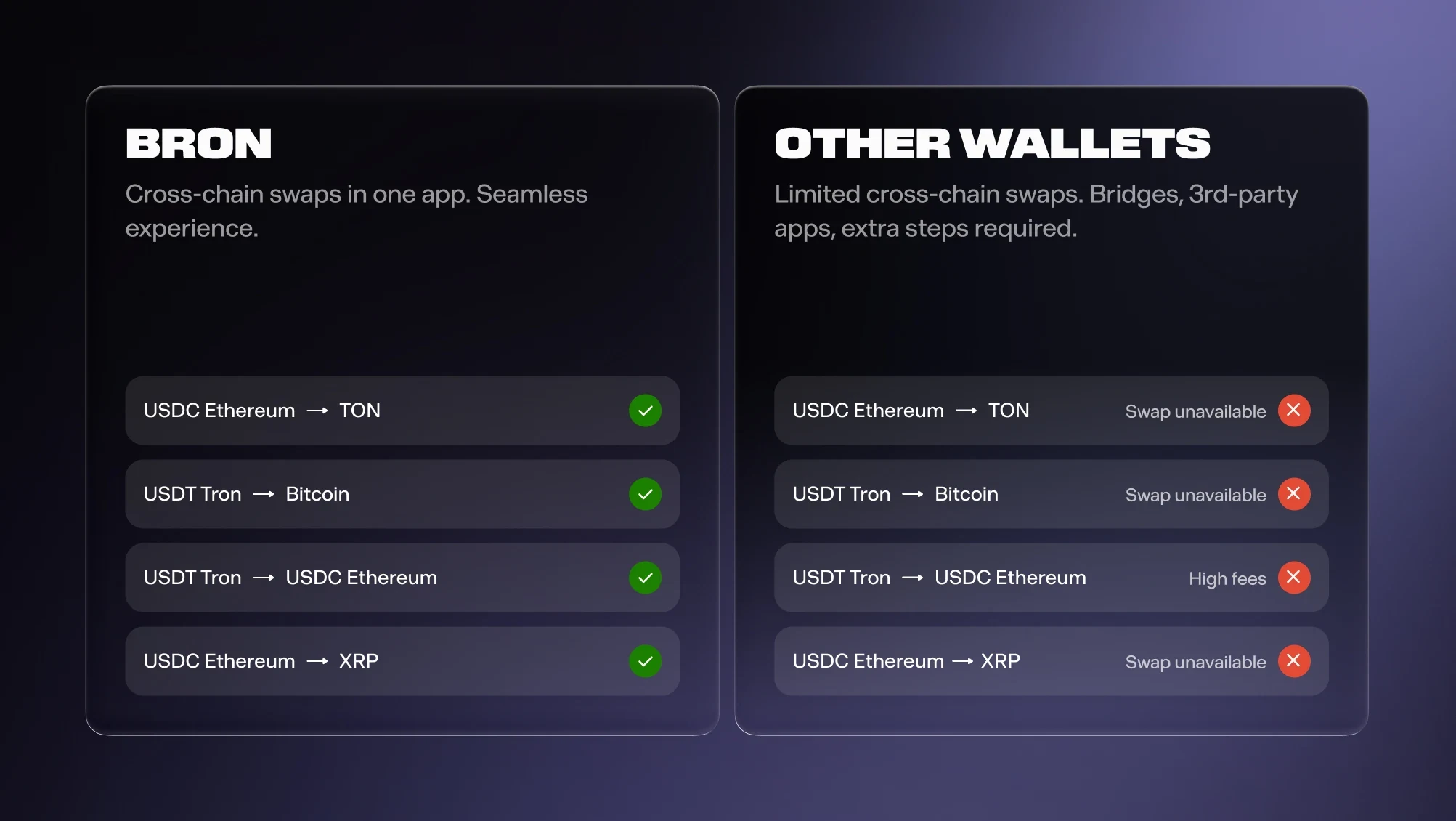
So you got your crypto on Tron and you are ready to explore DeFi. Only to discover that almost all meaningful DeFi activity lives on Ethereum, not Tron. So now what? Welcome to the World of Bridges.
Bridges are protocols that maintain liquidity on multiple blockchains. You send USDT on Tron to the bridge, and it sends you USDT on Ethereum — for a fee.
This is where the experience often turns unpleasant:
- Security risk: If a bridge is hacked while your funds are in transit, the loss is often total.
- High fees: 1% or more are common.
- Liquidity limits: Bridging $1,000 may work fine. Bridging $100,000 often does not.
- Operational friction: Multiple steps, approvals, waiting periods, and unfamiliar interfaces.
- Knowledge barrier: you need to know which bridge out of hundreds to navigate to as each of them serves a specific pair.
Some wallets attempt to simplify this by offering cross-chain swaps internally. But simplicity often comes at a steep price. Paying 2–3% to move USDT from Tron to Ethereum is surprisingly common — even though it is the same stablecoin, just on a different chain. This single swap — USDT on Tron to USDT on Ethereum — is so profitable that some wallets generate a significant portion of their revenue from it alone. From a user’s perspective, all of this feels just wrong.
The Missing Supermarket of DeFi
Just as early shoppers were forced to visit multiple specialized stores, today’s DeFi users must navigate:
- Different blockchains
- Different decentralized exchanges
- Different bridges
- Different wallets
- Different fee structures
The result is confusion, fear, and unnecessary cost. We believe DeFi needs its own supermarket moment. Not by centralizing finance — but by abstracting complexity and introducing real competition.
How Bron Changes the Experience
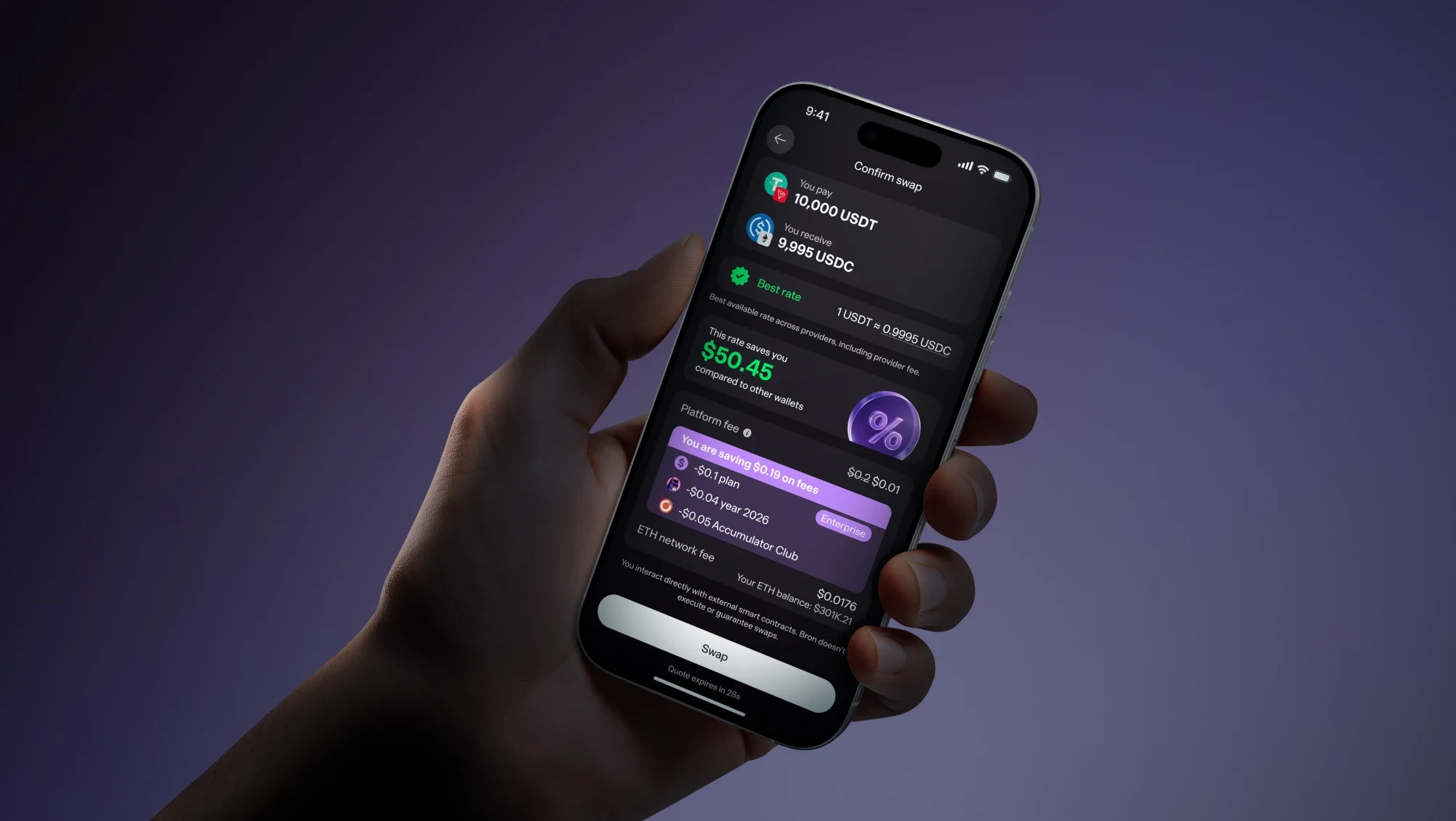
At Bron, we approached the problem from first principles. Instead of routing users to a single liquidity source, we built software that broadcasts your intended trade to multiple independent third-party solvers. These solvers compete with each other to fill your trade — effectively creating an auction. Competition does what it always does: it drives prices down.
The result is simple and powerful:
- Cross-chain USDT swaps (Tron ↔ Ethereum) with fees as low as ~5 bps (0.05%), depending on market conditions
- You can swap Bitcoin, Ethereum, Tron, Solana, Gram, Ripple, Canton Coin, Hyperliquid and many other assets into stablecoins easily.
- Fees that can be materially lower than those offered by many consumer wallet solutions
- Available directly inside the Bron wallet
- Individual trades supported up to ~$1,000,000, subject to liquidity and market conditions
- Fully collateralized execution designed to reduce counterparty credit risk.
From the user’s perspective, the experience feels natural. The complexity of blockchains, bridges, and liquidity sources disappears — much like the complexity of supply chains disappeared behind supermarket shelves. The promise of crypto is openness, efficiency, and empowerment. But these values are undermined when users are forced to navigate a maze of tools, fees, and risks just to move their assets.
The same way supermarkets transformed shopping, DeFi needs an upgrade in user experience — one that preserves decentralization while removing unnecessary friction.
Crypto should be easy. Crypto should be without fear.
Disclaimer:
This article is provided for general informational purposes only and does not constitute financial, investment, accounting, tax, or legal advice. Bron is a self-custodial software wallet that enables users to access decentralized liquidity and execute transactions via third-party protocols and counterparties; it does not provide brokerage, advisory, tax, accounting, legal, or compliance services and does not assess the suitability or regulatory treatment of any transaction. All transactions are subject to market conditions, liquidity availability, protocol rules, and operational and technical risks, and Bron does not guarantee pricing, fees, execution outcomes, or that any transaction will be suitable for a particular purpose. Users act at their own discretion and remain solely responsible for evaluating and understanding the risks associated with their use of the software.