











Burning Bridges: The Most-Robbed Rail in Crypto Must Be Replaced

The Freedom Crypto Promised
Crypto is sold as freedom to hold your own assets and move them without asking for permission. In practice, that freedom collapses the moment you try to do something perfectly ordinary: take a token you hold on one chain and convert it into a different token on another chain.
Consider what is probably the most common use case in the world. Roughly half of all USDT in circulation (the single largest stablecoin pool there is) lives on the Tron network. If you hold those stablecoins and you want to buy Bitcoin (the largest asset in crypto, accounting for close to 60% of total market cap), you quickly discover that both Tron and Bitcoin sit almost entirely outside the DeFi ecosystem the rest of crypto runs on. There are wallets that do not even support holding Bitcoin or Tron at all!
You are, however, determined: despite all the challenges, you want to buy Bitcoin with your USDT on Tron. There are a handful of cross-chain protocols that can actually perform the swap – after doing the research you connect your wallet to them and, if liquidity is there, you might end up achieving your goal.
What a Cross-Chain Swap Actually Is
Blockchains are sovereign worlds. Ethereum cannot see Solana; Bitcoin cannot see Tron; each network knows only its own ledger and nothing of any other. There is no native instruction that says “take my USDT on Tron and give me Bitcoin” — the two networks share no language, no shared state and no shared trust. Something has to stand between them and translate.
For the case we care about here, where the asset arriving is genuinely different from the asset leaving, that something is a cross-chain bridge. The usual bridge architecture is where each supported asset is paired with a shared reserve of liquidity, every trade routes through those reserves, and the protocol holds the pools on-chain.
These designs work by gathering a large, stationary pool of capital (hence, requiring a lot of capital to be deployed, that drives up the costs and limits the number of pairs available for swaps) in one place. The pools are what make the protocol useful, and the pools are what make it hard and dangerous to use.
Why Bridges Burn
Consider the arithmetic an attacker sees. A cross-chain bridge holds a concentration of value — hundreds of millions of dollars sitting out there waiting to be taken. It defends that value with its own machinery: a smart contract, a small set of validators holding the keys, or both. The pot is enormous and the lock, by construction, is weaker than every chain it touches. That is the precise definition of a honeypot.
The history of cross-chain swap protocols is the history of those honeypots being drained. THORChain, which was one of the first to offer native cross-asset swaps across Bitcoin, Ethereum and other major chains, was exploited twice within a single month in July 2021. The pools were the target both times.
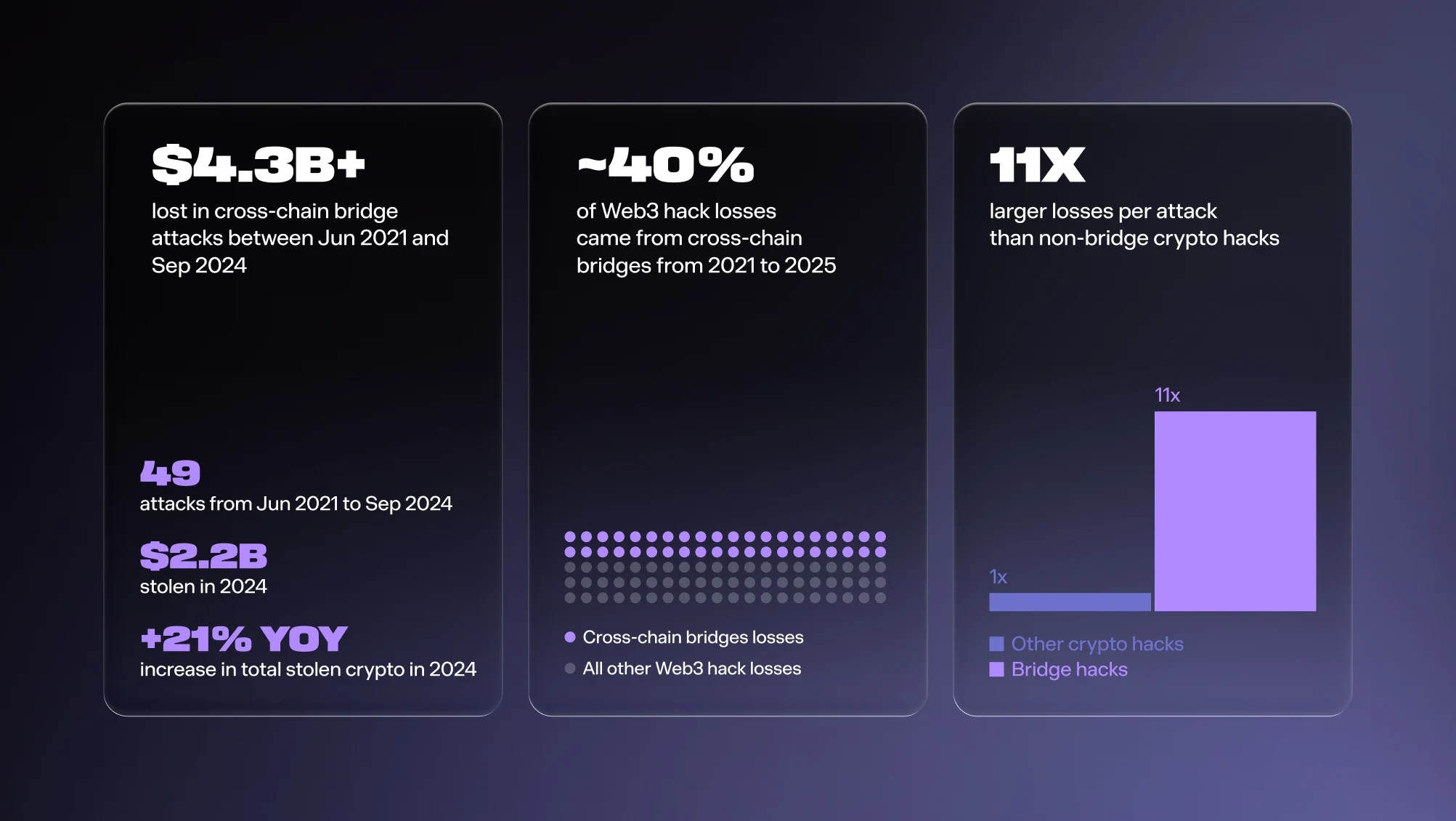
For several years, Multichain was one of the largest cross-chain platforms in the industry, routing billions of dollars across dozens of networks. In July 2023 the protocol collapsed after its chief executive — who held the multi-signature keys to the entire system — was detained in China. Roughly $130 million was drained from the routers in the days that followed.
The failure is not bad luck, and it is not, for the most part, bad code, but the design itself. Running a large regulated custodian like Copper taught me one thing – the best protection against hacks is to build systems where there is nothing to hack. It is hard to build those, but if you keep that in mind when building, the outcome is worth it — it eliminates the main point of failure.
A Swap With Nothing to Steal
When we started Bron, we had two ideas in mind. First, we wanted to build a wallet where swaps actually work. And we meant it literally — the user should be able to exchange USDT on Tron into USDC on Ethereum, buy Bitcoin using USDC on Solana or sell XRP into USDC on Gram. All of that has to be simple and has to work reliably without the user needing to know which bridges exist out there. Second, we wanted to get rid of bridges completely because you cannot achieve a good user experience by relying on infrastructure that does not really work and is susceptible to attacks. So we went to the drawing board, and these two principles became the foundation of what is now known as Bron Intents.
Bron Intents replaces the pooled-liquidity model of bridges with something far simpler: a direct swap between two parties. When you want to move value across chains, you state an intent — I have this asset here, I want that asset there — and an independent party, called a solver, competes to fill it. You send your asset directly to the solver on the first chain; the solver then sends the asset you want directly to you on the second. Two ordinary transactions on two blockchains, each one secured by that blockchain’s own consensus. There is no need for massive amounts of capital sitting in the pools waiting for users to transact, and the cost of capital is massively reduced. And there is another benefit: there is no honeypot, because there is no pot.
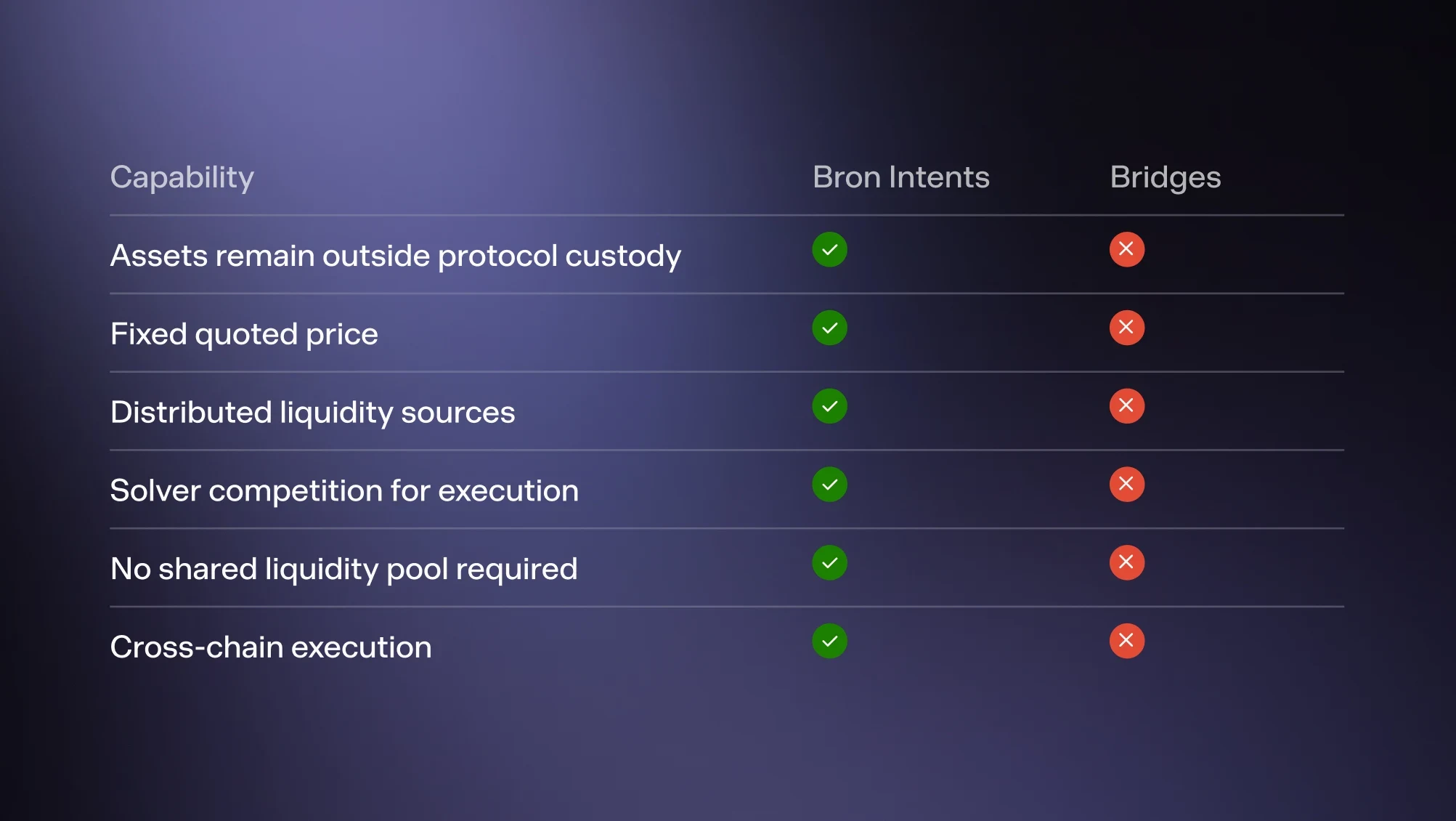
A swap exists for the few minutes it takes to settle, and then it is gone. An attacker who studies Bron Intents finds nothing to drain, because at no moment does the protocol hold a stationary pile of user funds. There is nothing to hack.
What protects the user is the structure of the protocol. Independent validators confirm, on-chain, that each leg of the swap has genuinely happened before the next one proceeds. Every solver must post collateral worth at least twice the value of the trade it is filling — no solver may ever take on an order larger than half of what it has locked away. If a solver fails to deliver, that collateral is used to compensate the user and a backup solver completes the swap. Every trade is, in effect, at least double-collateralized.
Because a swap is genuinely a swap, it is not confined to moving the same asset between chains. USDT on Tron becomes Bitcoin in a single step. Because the cost of capital is lower, the cost of risk is almost non-existent, and solvers compete for each order rather than drawing on one shallow reserve, users get competitive pricing and deep liquidity — Bron Intents supports swaps of up to $1,000,000 per trade. And the best part — there is no slippage. If you operate through bridges, you depend on a ton of parameters – if another order arrives right before you and takes the liquidity out, you might be executed at a worse price. With Bron Intents, solvers are obliged to quote exact prices to the user: what you see is what you get. If you approve a transaction to buy 1 BTC for 75,700 USDT on Tron, that is the deal. The solver delivers you 1 BTC, and it does not matter if the BTC price climbs to 79,000 USDT before the swap settles — that is the solver’s problem, not yours.
Available to Everyone
Because we believe the ability to move between assets on different chains is essential for crypto to reach mainstream adoption, and because the architecture of the Bron Intents protocol is structurally superior to bridges, we did not roll out Bron Intents only to users of the Bron wallet — we made it available to everyone as an open protocol. The protocol charges a small fee and already has many independent solvers competing for the trades. Bron Wallet is one of the “broadcasters” on the protocol, but other wallets can join as well. Bron Intents does not discriminate against anyone and charges the same fee to everyone – be it Bron wallet or any other wallet out there. We invite developers to learn more at developer.bron.org/intents/about and integrate Bron Intents into their own products.
Disclaimer:
Bron is solely a software provider. Swaps are executed by independent solvers on independent blockchains. Bron Intents is an open protocol. This article reflects the author’s views and does not constitute investment, financial, or legal advice. This communication is not directed at and not intended for residents of the United Kingdom.