











Knowledge Is Power: Financial Clarity in a Decentralized World

Trade has existed for as long as humanity has been aware of itself. People exchanged goods long before money, borders, or formal institutions appeared. Yet for centuries, trade remained closer to an art than a science. Merchants relied on intuition, reputation, and a fair amount of luck. Success depended less on systematic management and more on personal skill, memory, and trust. This raises an important question: why did trade remain so informal for so long?
The answer is surprisingly simple. Until the late Middle Ages, merchants lacked a reliable way to understand the true state of their businesses. There was no consistent method to see, on paper at least, what one owned, what one owed, and how those obligations were distributed across partners and counterparties. Commerce existed, but clarity did not. That changed in the late 14th century, when a quiet but revolutionary invention emerged in what we now call modern Italy.
When Trade Became Measurable
In the commercial centers of Venice, Genoa, and Florence, merchants began to use what we now recognize as the ledger of accounts based on double-entry bookkeeping. Trade had grown too complex to manage by memory alone. Goods traveled across seas, payments were delayed by months, and partnerships involved multiple parties with shared risk.
The double-entry system introduced a simple yet powerful idea: every transaction has two sides. Assets and liabilities must balance. Capital, profit, debt, and ownership could all be recorded in a structured and consistent way.
This shift cannot be overstated. Trade moved from intuition to calculation. Decisions could now be made based on records rather than recollections. The ledger transformed commerce into something that could be audited, reviewed, and trusted.
One of the most profound effects of the ledger was psychological rather than technical. Before systematic accounting, a business was inseparable from the individual who ran it. If a merchant died, the business often died with him. Knowledge lived in the merchant’s head, not on paper. Partners and heirs were left with fragments of information, disputes, and uncertainty. With proper ledgers, this changed. This sense of continuity made trade safer—not just for merchants, but for investors and partners as well.
As a result, capital began to flow more freely. Merchants were more willing to invest in long and risky expeditions. Partners were more comfortable pooling resources. Credit expanded. This administrative innovation quietly enabled the great geographical expansions that followed, along with the economic progress of early modern Europe.
Transparency as a Foundation of Trust
Fast forward to the present day, and the importance of financial clarity has not diminished. Modern banking reflects this lesson well. With the rise of neobanks, users can see their exact balances at any time of day, from anywhere in the world. Detailed account statements show every transaction, currency exchange, and purchase.
Cryptocurrency, at first glance, goes even further. Every transaction is recorded on a public blockchain. Anyone can inspect transfers, balances, and historical activity. In theory, this represents the highest possible level of transparency. One does not even need access credentials—only a public wallet address—to observe its full transaction history. From a technological standpoint, the groundwork has already been done. The ledger exists, and it is immutable. And yet, this is where the paradox begins.
When Transparency Becomes Inaccessible
Despite the public nature of blockchains, individual users often struggle to answer basic accounting questions about their own activity. When tax season arrives and a user needs to prepare a report of their crypto transactions, the experience quickly turns into a nightmare.
The first step is gathering all activity across wallets and chains. In practice, this is far more difficult than it should be. Most popular crypto wallets today do not offer native, comprehensive account statements comparable to those provided by banks. While some wallets allow users to view transaction histories on screen, many do not provide an easy way to export all transactions into a structured file such as a CSV that can be used for accounting, reporting, or tax calculations—especially across multiple blockchains.
If crypto is meant to be superior to traditional finance, why does it lack one of the most basic features of even the most archaic banking systems: a usable account statement? The irony is clear. Blockchains already contain all the data. Explorers display it publicly. Yet the burden of assembling, cleaning, and interpreting this data is placed entirely on the individual user.
The Reality of Manual Crypto Accounting
The typical process looks something like this: A user follows best practices and maintains two wallets: a cold wallet for long-term storage and a hot wallet for interacting with decentralized applications. They hold assets across several chains—Bitcoin, Ethereum, Solana, Tron, and perhaps one or two more. Suddenly, the user is dealing with ten different wallet addresses across five different blockchains.
To prepare a report, they must visit multiple blockchain explorers, manually paste each address, scroll through transaction histories, copy the data, and attempt to reconstruct it in spreadsheets. Formatting is inconsistent. Some explorers allow partial exports; many do not. Internal transfers between the user’s own wallets must be identified and excluded. Prices at the time of transaction must be sourced separately.
It is therefore unsurprising that tax compliance in crypto remains low. In many cases, the issue is not unwillingness but infeasibility. Even users who want to comply face an unreasonable operational burden. Accounting, once again, becomes an art rather than a science.
How we solve the problem
We built Bron because we encountered this problem ourselves. After years of working in institutional crypto infrastructure, we lived under the assumption that proper reporting and accounting were solved problems. Institutional clients demand them by default. Without clear records, regulated businesses simply cannot operate.
When we entered the world of crypto for individuals, the contrast was shocking. The tools that professionals take for granted were simply absent. There was no product we felt comfortable using ourselves. So we built one.
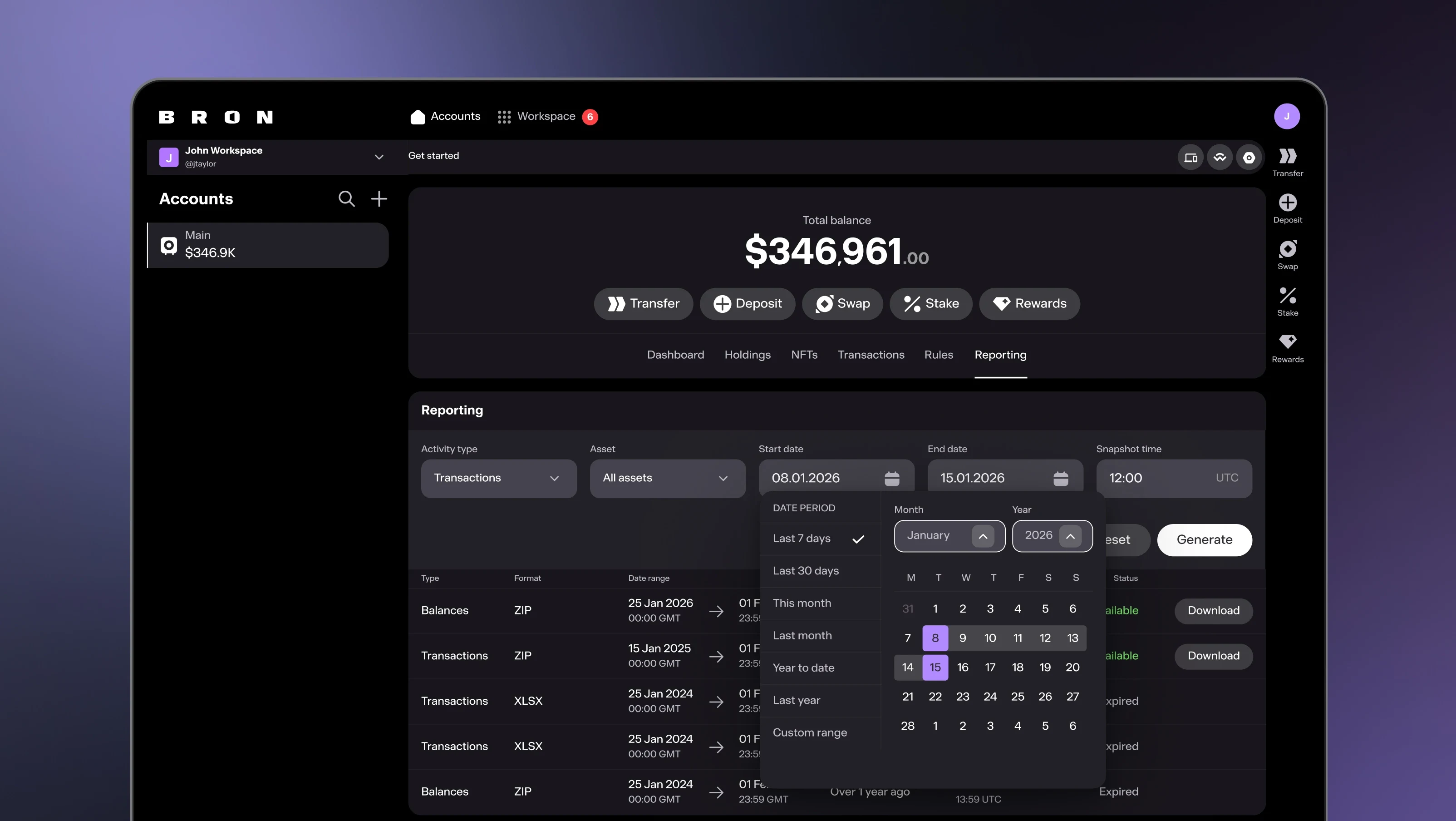
From the very first day, Bron was designed around the idea that a crypto wallet should have proper reporting. It is not an afterthought; it is a core feature. Users can download a complete CSV file of all transactions for any selected date range. They can view their balances at any specific point in time, allowing for precise historical snapshots—essential for tax reporting, audits, or personal record-keeping.
Accounting is not only about numbers; it is about meaning. Six months after a transaction, a string of characters does not help anyone remember why funds were sent or received. Bron allows users to attach notes to any transaction. These notes automatically appear in reports, preserving context over time.
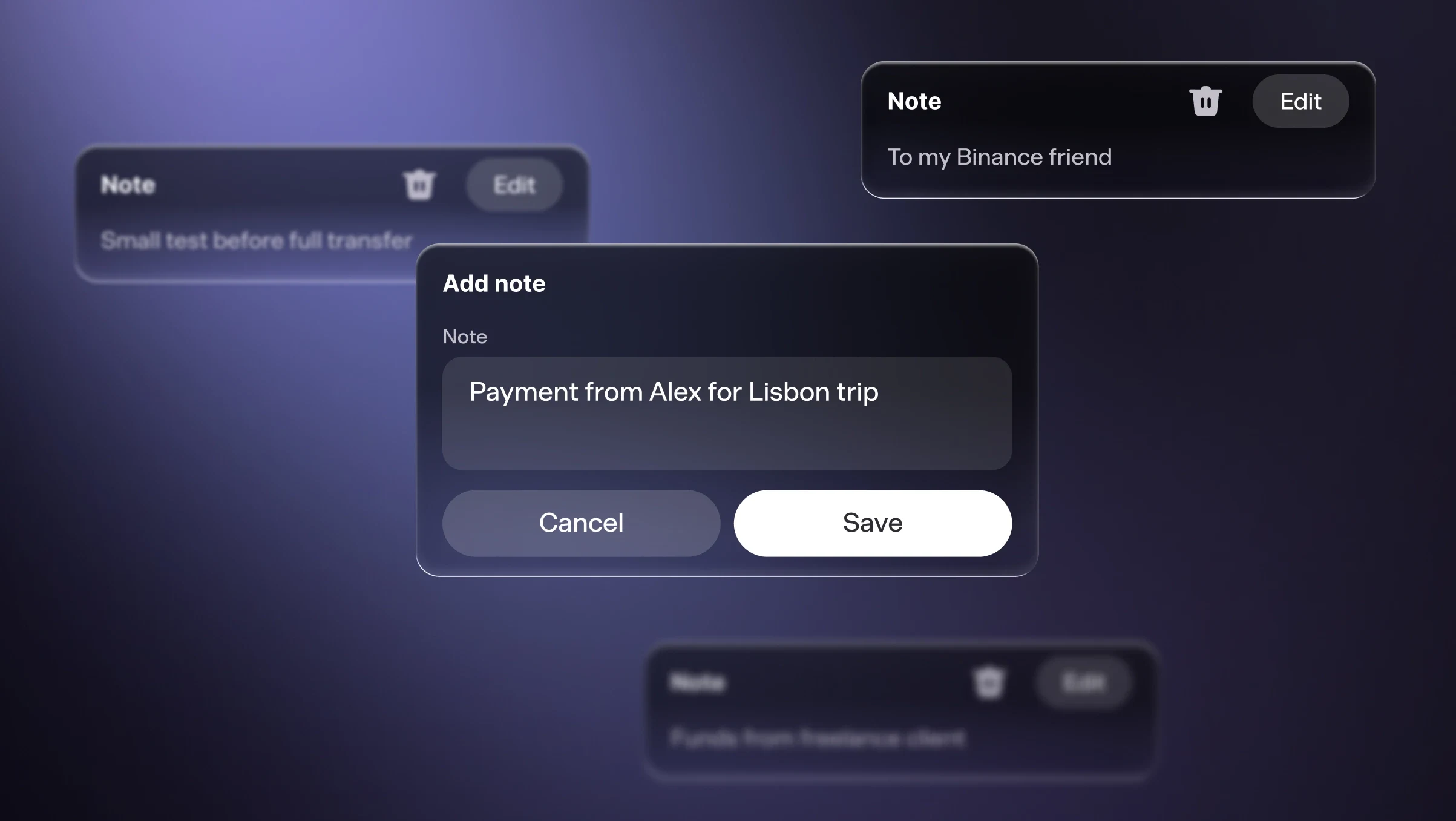
Users can also maintain an address book of frequently used wallet addresses. This reduces the risk of errors and ensures clarity in reporting. Transactions are no longer anonymous movements of value; they are documented actions with intent and explanation.
This may sound simple, but it is precisely these features that transform financial activity from chaos into order.
What the ledger of accounts did for medieval merchants, modern crypto wallets must do for today’s users. Growth follows clarity. Investment follows trust. Trust follows transparency that is usable, not merely available. Crypto does not need more complexity. It needs better user experience.
Bron exists to bring ease of use back into crypto—to make it understandable, auditable, and calm. Crypto should be easy. Crypto should be without fear.
Disclaimer:
This article is provided for general informational purposes only and does not constitute financial, investment, accounting, tax, or legal advice. Bron is a self-custodial software wallet; it does not provide tax, accounting, legal, or compliance services, does not determine whether any transaction is reportable, and does not guarantee that reports or exports are complete, accurate, or sufficient for any particular regulatory or tax purpose. Users remain solely responsible for understanding and meeting their applicable legal and tax obligations, verifying all data and outputs, and consulting qualified professionals as appropriate.