










Crypto is a Naked Sauna

Most people don’t realise how on-display their blockchain finances really are
If you are a frequent traveller, you may have noticed that different cultures treat saunas very differently. In Germany, for instance, it is perfectly normal for men and women to sit together in a sauna, completely naked, having a conversation as if nothing unusual is happening. In Japan, communal bathing follows strict rules and etiquette, and nudity is acceptable but only within very clear boundaries. In many other countries, the idea of mixed-gender nudity in a sauna (or anywhere outside of the bedroom) would be unthinkable.
None of these approaches is “right” or “wrong.” They are simply different cultural norms. The only thing that matters is knowing (ideally in advance) what kind of sauna you are about to enter.
If you walk into a German sauna expecting a private, towel-covered experience, you may be shocked. If you enter a conservative sauna expecting openness, you may be equally uncomfortable, or worse, make others uncomfortable. Awareness changes everything. When you know what to expect, you can decide whether you are comfortable participating or not.
Crypto Is a Public Sauna by Design
Crypto is often described as private: wallets are non-custodial, addresses are pseudonymous, and there is no obvious link between a blockchain address and a real person. This description is technically correct — but deeply misleading. In reality, crypto is much closer to a naked sauna than to a private room.
The moment someone knows your wallet address, they can see everything. Your balances, your transactions, where funds came from, where they went – everything is exposed. All of this information is available instantly and without your consent. Anyone can open a blockchain explorer and take a close look. You do not need permission and the wallet owner is never notified. You do not even need to be particularly skilled. The blockchain is public by design, it’s a feature not a bug.
What makes this problematic is not the transparency itself — transparency is one of the great innovations of blockchain technology. The issue is that most people do not realise just how exposed they actually are. We have personally shown this to many people. Friends, entrepreneurs, professionals who use crypto regularly. When they see, in real time, how much information is visible to anyone who knows their wallet address, the reaction is almost always the same: surprise, followed by discomfort that shifts into fear. They thought they were entering a private space. In reality, they were already sitting in a naked sauna.
“I Have Nothing to Hide” Is Not the Point
A common reaction is: “Why does this matter? Everything I’m doing is legal and compliant.” It’s a fair question — but it misses the point. Imagine that every time you opened your physical wallet in public, everyone around you could instantly see exactly how much cash you had inside, in which denominations, and how you spent it. Not just once, but always. Would that feel normal? Even if everything you do is perfectly legal?
Most people would say no. Not because they are hiding anything, but because financial privacy is a form of personal sovereignty. It simply does not feel right for friends, acquaintances, or strangers to know your exact financial position at any given moment. And beyond social discomfort, there is a more serious concern. Criminals do not need to guess who might be worth targeting anymore. Public ledgers allow them to profile wallet behavior, identify high balances, track patterns, and combine that data with information from social networks, data leaks, or simple human mistakes. Transparency removes friction — not only for innovation, but also for abuse.
Consider a very ordinary situation in crypto: A friend asks you for your wallet address so they can send you some crypto. You share it. Before sending anything, they can already see your balances. They can see how much you hold and once they send the funds, they can see whether the funds were received, and whether you have already spent them. If you do spend them, they can see exactly where you sent them. This is not malicious behavior. It is simply how blockchains work. But ask yourself honestly: is this the experience you want? Is there any way to receive funds without revealing your entire financial life to the sender? The answer is yes — but only if you design your crypto setup with this in mind.
Designing for a Transparent World
At Bron, we think a lot about these questions. Your experience of crypto shouldn’t be uncomfortable just because blockchains are public. The first step we recommend is separation, it’s the simplest and most effective way to responsibly manage your assets. Instead of using one wallet for everything, you can create a dedicated wallet with a small balance whose sole purpose is to receive funds. This is the address you share with friends, clients, or counterparties. They see exactly what is meant to be seen — nothing more.
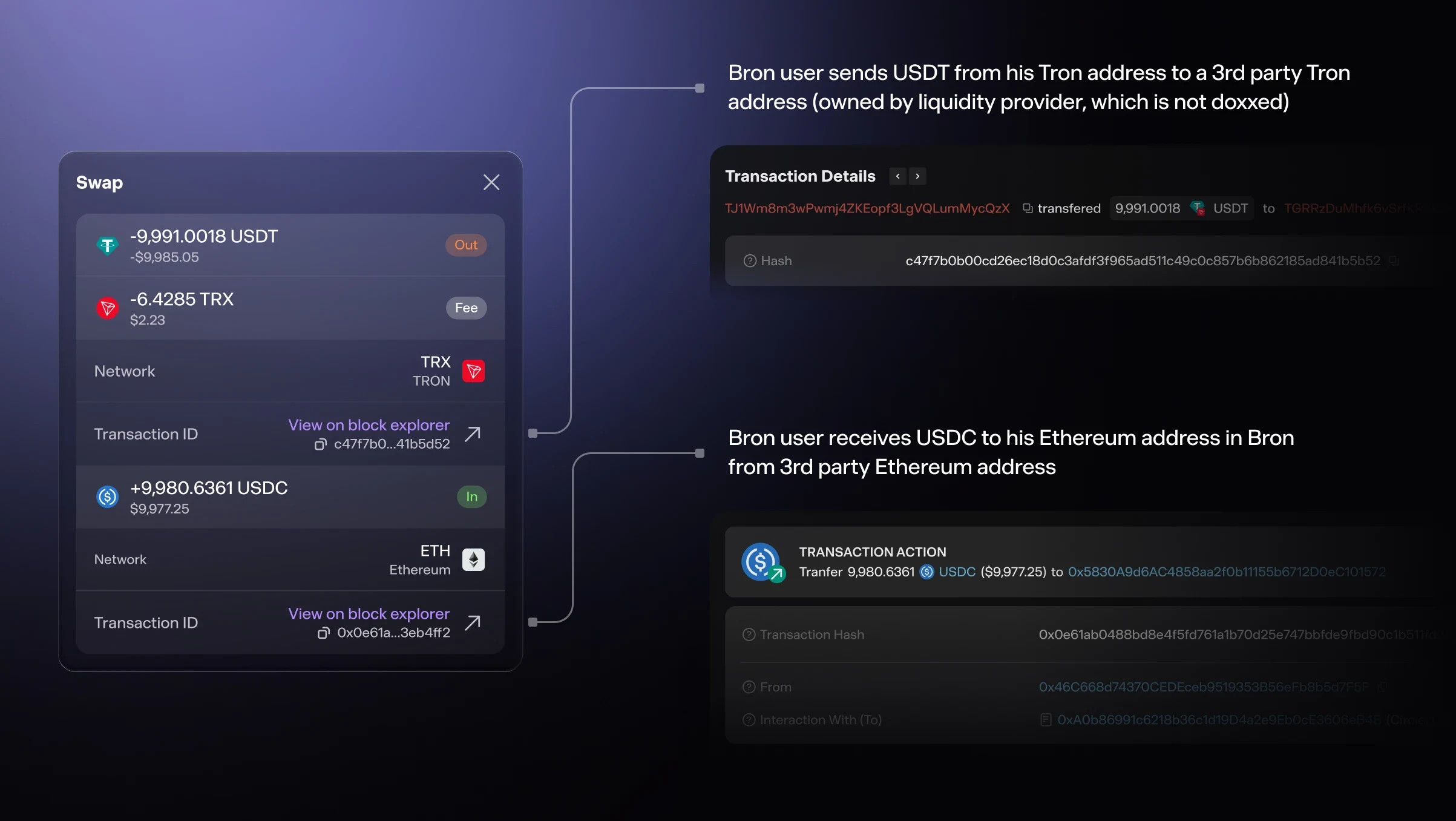
Now imagine you receive 100,000 USDT on Ethereum into that wallet. With Bron, you can access cross-chain swap functionality that lets you swap USDT on Ethereum into USDT on the Tron network, subject to liquidity. This matters more than it might seem at first. From the perspective of someone watching the Ethereum blockchain, all they will see is that 100,000 USDT left your wallet and went to another address — typically one belonging to an independent third party known as a solver, which facilitates the swap through a smart contract. What they will not see is where the funds reappear, namely in your Bron USDT Tron wallet.
You see it clearly inside Bron because Bron is a multi-chain wallet. But the curious observer loses the trail. This is not about hiding assets, it’s simply about retaining the level of financial privacy that we have become accustomed to, and which feels appropriate to keep our assets safe.
Cryptography Is Catching Up
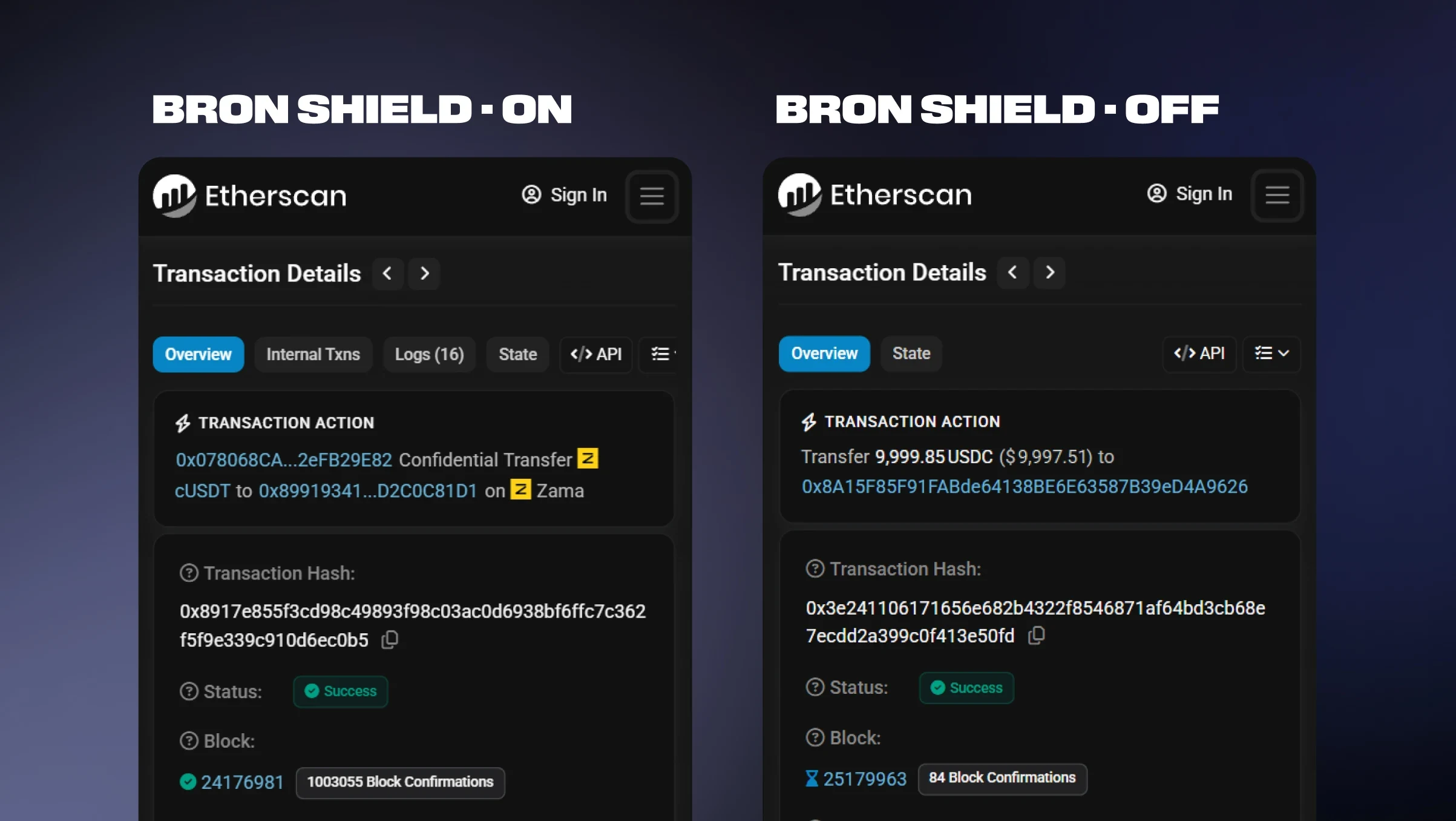
Wallet design is not the only tool available, the cryptography ecosystem is also rapidly evolving. Protocols like Zama, which Bron was the first to integrate with native support for erc-7984, allow transactions and balances to be processed using advanced cryptography so that sensitive information is no longer fully exposed on-chain, a process called Shielding.
Bron is live with Zama, and our users were among the first to be invited to participate in the Zama auction (there was even a 5% allocation bonus for using Bron). This represents the next step in the evolution of blockchain transparency — not eliminating it, but making it selective and intentional rather than absolute. You can learn more about shielding functionality inside Bron from our video.
Crypto no longer has to feel like walking naked into the wrong sauna
Bron exists to give users the choice. Through multiple wallets, access to seamless cross-chain swaps, and integrations with cutting-edge cryptography protocols like Zama, we help you navigate the transparency without fear. Because privacy is not about hiding - it is about choosing what you reveal.
Disclaimer:
This article is provided for general informational purposes only and does not constitute financial, investment, accounting, tax, or legal advice. Bron is a self-custodial software wallet that provides tools for interacting with blockchain networks and decentralized applications; it does not provide brokerage, advisory, tax, legal, or compliance services.