


Digital Asset Treasuries Explained (2026): The Rise of Digital Asset Treasury Companies (DATs) Holding Bitcoin and Crypto
Digital asset treasuries (DATs) are listed firms holding digital assets for those who can't own them. How a treasury company works and the alternatives.
- Author
-
 Dmitry Tokarev
- Published
- Share

A digital asset treasury is a store of Bitcoin, Ether or other crypto that a company keeps on its balance sheet. Since Strategy, formerly MicroStrategy, began buying Bitcoin in August 2020, however, the term has come to mean something narrower: the digital asset treasury company, or DAT. A DAT is a publicly traded company that raises money from shareholders and uses it to purchase digital assets, so that its share price moves with the coins it owns. Strategy made Bitcoin its main treasury asset and held 850,849 BTC by November 2026; a wave of copycats in 2025 made DAT a market term. BitMine, the Ether company chaired by Fundstrat’s Tom Lee, held 4.97% of all Ether in existence.
This guide explains why digital asset treasuries appeared at all: largely because regulation kept banks, pension funds and many investment funds away from tokens, while a listed share was something they could buy. It then shows how the model works, what it costs shareholders, where staking fits in, and why its case has weakened in 2026 as spot funds multiplied and self-custody for businesses became far easier. It ends with practical steps for businesses that want to hold coins on their own books: policy, custody, approvals, reporting and cost.
Digital Asset Treasury (DAT) in 2026
- A DAT is a listed company that raises capital to buy and hold coins, so its stock works as a proxy for tokens many institutions could not own.
- A DAT share is a claim on a company, not on coins: management, fees, debt and a premium or discount to the holdings sit between you and the coins.
- The premium has largely gone: in September 2026 only four of the 20 largest such firms traded above the value of their holdings.
- The original reason for these vehicles is fading: spot ETFs now cover Bitcoin, Ether, Solana, XRP and HYPE, and MPC wallets remove the single seed phrase.
- DATs are not useless: leverage amplifies gains in a bull market and some mandates allow listed equities only, but downturns expose their costs.
- Below: why they exist, how the model works, a comparison with spot funds and self-custody, and how a business can hold coins without a listed vehicle.
Digital Asset Treasury Definition: Operating Treasury vs DAT Company
The digital asset treasury meaning has narrowed over the past two years, and the two senses of the term now describe very different things:
- Digital asset treasury definition: cryptocurrency that a business holds on its own balance sheet as a reserve, for payments or as working capital, much like cash or short-term bonds. This is an operating treasury, and the coins serve the business.
- Digital asset treasury company definition: a listed company whose main activity is raising money to accumulate digital assets. The holdings are the business, and investors buy the shares to get exposure to the coins.
An operating treasury needs no listing. It needs safe custody, approval rules and clean reporting, and the tools for that have improved sharply: self-custody platforms built on multi-party computation (MPC) let a business keep Bitcoin or stablecoins in wallets it controls, with several people approving each payment and no single seed phrase to lose. Bron is one example of such a platform for businesses.
| Operating digital asset treasury | Listed DAT company | |
|---|---|---|
| What it is | Coins a business holds for its own needs | A public company whose main activity is accumulating coins |
| Why the coins are held | Investments, reserves, payments, stablecoin working capital and other digital asset activity | To give shareholders exposure to the coins |
| How purchases are funded | Cash the business already earns | New shares, convertible notes, preferred stock and loans |
| Who owns the coins | The business | The company; shareholders own its equity |
| How success is measured | Investment returns, cost, security, liquidity, clean books | Coins behind each share and the premium to NAV |
| Share of the balance sheet | Usually a slice of cash reserves | Often almost all of it |
| Examples | A software firm holding some Bitcoin; an exporter paying suppliers in USDC | Strategy, BitMine, Metaplanet |
The operational side of holding coins is covered in our guide to crypto treasury management; the rest of this article covers listed vehicles and their alternatives.
What Is the Purpose of a Digital Asset Treasury? Getting Crypto Past the Rulebook
The original purpose of digital asset treasury firms was simple: to sell digital asset exposure to investors in traditional finance who could buy shares but not coins. The model matters most to institutions such as pension funds whose mandates prohibit holding crypto directly but allow them to invest in public companies. From a bank supervisor’s perspective on digital assets, the obstacle was capital; for pensions and funds, it was mandates and guidance.
| Investor | What kept them out of direct crypto | Status in 2026 |
|---|---|---|
| Banks | Basel standard SCO60 gives most unbacked crypto a 1,250% risk weight and caps such exposures at 2% of Tier 1 capital; US guidance SAB 121 (2022) made custodians book clients’ coins as liabilities effectively penalising any crypto holdings. | SCO60 took effect on January 1, 2026 where adopted and is under review; SAB 121 was rescinded in January 2025. |
| US 401(k) plans | A 2022 Department of Labor release told fiduciaries to use “extreme care” before offering crypto. | Rescinded in May 2025; the department is now neutral. |
| EU UCITS funds | Crypto is not an eligible UCITS investment; In 2018 Luxembourg barred even indirect exposure. | Luxembourg has allowed indirect exposure up to 10% of NAV since February 2026; direct holdings remain off-limits. |
| Korean investors | In January 2024 the Financial Services Commission said brokering overseas spot ETFs may breach the Capital Markets Act. | Korea’s 2026 growth strategy plans to allow domestic spot funds. |
| Japanese investors | Gains taxed as miscellaneous income at up to 55%, and no domestic spot fund. | A July 2026 law moves crypto under the Financial Instruments and Exchange Act; a tax of about 20% is expected from 2028. |
Investors took the stock route: state pension systems in Florida, New Jersey and Michigan reported Strategy shares in 13F filings; South Korean retail investors bought a net $1.4 billion of BitMine shares in 2025, according to Korea Securities Depository data cited by Bloomberg; in Japan, Metaplanet offered Bitcoin exposure at stock-market tax rates, often inside tax-free NISA accounts.
The number of these companies grew fast. In 2021, fewer than 10 public companies held Bitcoin in their treasuries; as of now more than 200 had adopted such a strategy. The data provider CoinGecko estimates that these companies put at least $49.7 billion of capital into digital assets during 2025. By January 1, 2026, their combined digital asset treasury crypto holdings were worth $134.0 billion, up from $56.5 billion a year earlier, including more than 1 million BTC and 6 million ETH: over 5% of the supply of each.
Takeaway: a DAT solved an access problem rather than an investment problem. Its real product was permission, and wherever the rules have since changed, that product is worth less.
How the DAT Model Works: Shell Companies, Equity and the Premium to NAV
Where DAT companies came from
Few were built from scratch. The usual route was to take over a small listed company the market had given up on, raise money through a private placement and repurpose it for digital asset accumulation. BitMine was a Bitcoin miner worth about $26 million when, on June 30, 2025, it announced a $250 million placement at $4.50 a share and named Tom Lee chairman. Sonnet BioTherapeutics, a cancer drug developer, became Hyperliquid Strategies, a HYPE holder, in a merger that left its new backers with 98.8% of the shares. KindlyMD, a healthcare provider, merged with Nakamoto Holdings; 180 Life Sciences became ETHZilla; SharpLink had marketed sportsbooks, and Metaplanet ran hotels. What these firms brought was a listing that brokers, pension funds and index providers already accepted.
How DATs raise capital and why crypto prices matter
Once listed, such companies utilize capital markets like any issuer: private placements (PIPEs) at a discount, at-the-market programs that sell new shares gradually, convertible bonds and preferred stock. The proceeds go into coins, and the metric that matters is crypto per share, the amount of the underlying asset behind each share.
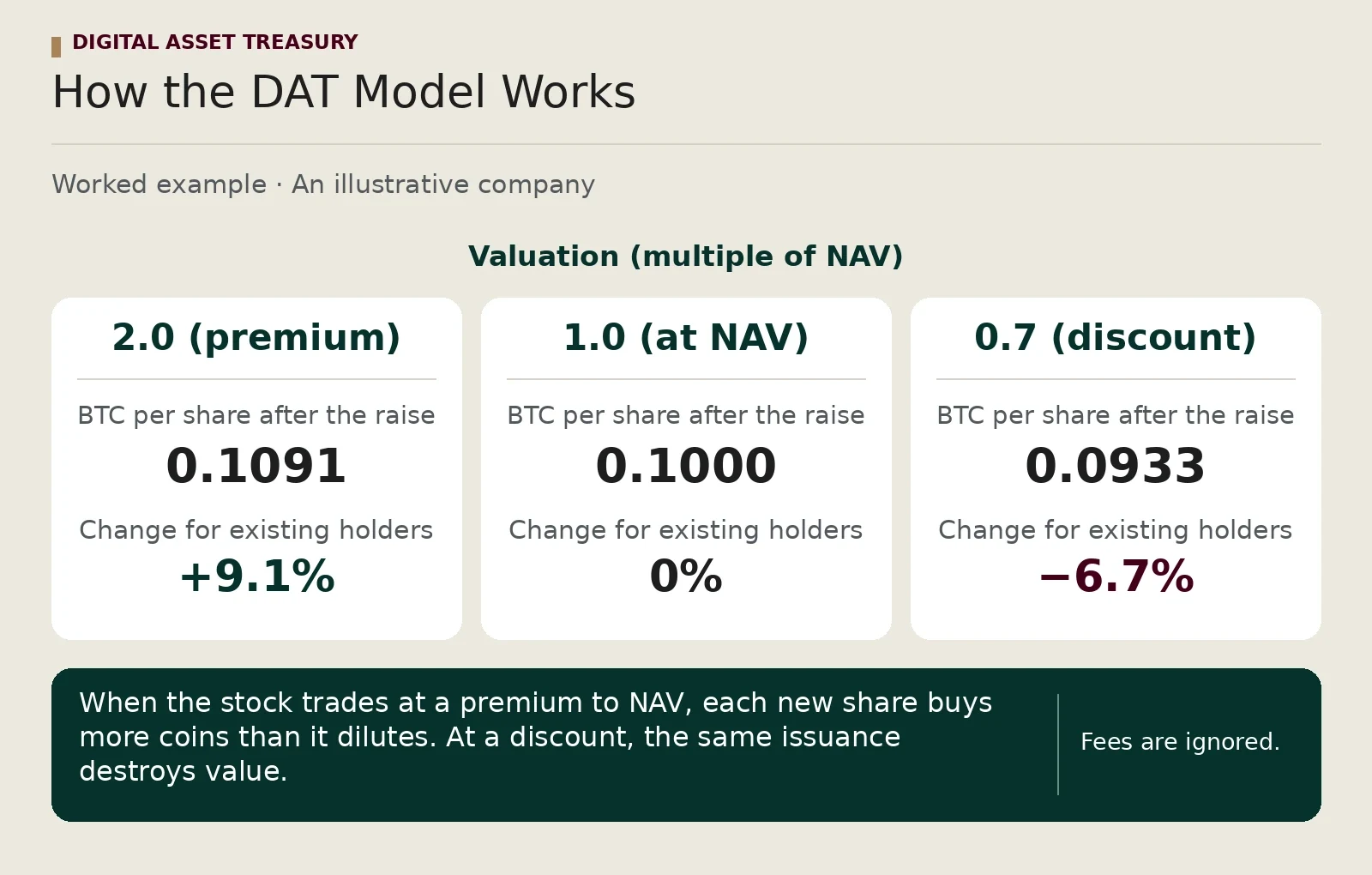
Two terms decide whether issuing stock helps or hurts. Net asset value (NAV) is the market value of the holdings net of debt. The multiple of NAV, or mNAV, compares what the market pays for the whole company with that NAV: at 2.0 investors pay $2 for every $1 of coins, at 0.7 they pay 70 cents. When the stock trades at a premium to NAV, each new share buys more coins than it dilutes. At a discount, the same issuance destroys value.
Worked example. Before the raise, an illustrative company has:
- Holdings: 10,000 BTC, worth $600 million at a Bitcoin price of $60,000. That $600 million is its NAV.
- Shares: 100,000, so the NAV behind each share is $6,000.
- Bitcoin behind each share: 10,000 BTC ÷ 100,000 shares = 0.1 BTC per share.
The company then sells $120 million of new stock and buys 2,000 more BTC, taking its holdings to 12,000 BTC. How many new shares it must issue, and so how much Bitcoin each share is left with, depends on the price the market pays for its stock. Fees are ignored.
| Valuation (multiple of NAV) | Share price | New shares sold | Total shares after the raise | BTC per share after the raise | Change for existing holders |
|---|---|---|---|---|---|
| 2.0 (premium) | $12,000 | 10,000 | 110,000 | 0.1091 | +9.1% |
| 1.0 (at NAV) | $6,000 | 20,000 | 120,000 | 0.1000 | 0% |
| 0.7 (discount) | $4,200 | 28,571 | 128,571 | 0.0933 | -6.7% |
This is the flywheel. In a rising crypto market, investors were paying a premium to the NAV of coins DATs held on account and companies could issue shares, buy more coins and lift the coins behind each share further, which supported the premium. When digital asset prices fall the loop runs backwards: the premium shrinks, new issuance dilutes, and the issuer must find other money for interest and dividends, buy back shares or sell coins in a weak capital market.
Takeaway: a stock bought at 1.5 times NAV loses a third of its value if the premium disappears, even when the coins behind it do not move.
The Expansion of DATs: Different Types of DAT Companies in 2026
After Strategy led the way in 2020, and above all during the 2025 boom, several distinct kinds of digital asset treasury (DAT) crypto vehicles emerged:
- Pioneer Bitcoin treasury companies. Strategy, buying since 2020, and Metaplanet fund purchases with new stock, debt and preferred shares. Their coins earn nothing, as BTC has no native staking.
- Shell conversions. Small listed firms remade through a private placement: BitMine, ETHZilla, Nakamoto, SharpLink.
- Ecosystem vehicles. Companies tied to one digital asset ecosystem, often backed by its insiders: Hyperliquid Strategies (HYPE), Upexi (Solana), TON Strategy (Toncoin).
- Staking vehicles. Holders of Ether, Solana and other native tokens of proof-of-stake blockchains, who stake most of their coins for income; BitMine and SharpLink lead.
- Operating companies with a reserve. Firms with revenue of their own, such as Bit Digital.
The largest Bitcoin treasury companies and Ether holders in 2026
| Company | Asset | Holdings | Share of supply | Business before | Stakes its coins? |
|---|---|---|---|---|---|
| Strategy | Bitcoin | 850,849 BTC (Nov 15, 2026) | About 4.05% | Business intelligence software | No |
| BitMine | Ether | 6,077,745 ETH (Nov 15, 2026) | 4.97% | Small Bitcoin miner | Yes |
| SharpLink | Ether | About 895,117 ETH (Nov 2, 2026) | About 0.7% | Sportsbook and casino marketing | Yes |
| Metaplanet | Bitcoin | 44,000 BTC (Sep 30, 2026) | About 0.2% | Hotels | No |
Takeaway: the model is concentrated. One Bitcoin holder and one Ether holder dominate, and new companies launched at the 2025 peak saw premiums collapse first.
The Problem With DAT Stocks: A Treasury Company Gives You Equity, Not Crypto
DATs promised to outperform the underlying asset. Shareholders, however, own equity in a business, and several layers stand between them and the coins:
- A management team with wide discretion. Investors buy for the coins; the board decides what the money does. BitMine’s $11.8 billion of holdings in November 2026 included a $180 million stake in Beast Industries and a $67 million stake in Eightco Holdings, which it calls “moonshots”. ETHZilla sold Ether for buybacks in October 2025 and $74.5 million more to redeem convertible notes that December, then asked investors to judge it on a tokenization business.
- Fees a fund would not charge. In April 2025 Upexi agreed to pay GSR 1.75% a year of the Solana it managed, under a 20-year contract the company could end without cause only with a two-thirds shareholder vote; GSR terminated it in December 2025 after Upexi filed for arbitration. The placement agent on Upexi’s $100 million raise took 7% of gross proceeds.
- Marketing and overheads. Metaplanet guided to about $29 million of selling, general and administrative expenses for 2026, including marketing and events, and in April 2026 advertised on the Las Vegas Sphere, where a day reportedly costs about $450,000. Every shareholder pays a slice of it.
- Claims that rank ahead of you. Lenders and preferred holders are paid first. Strategy’s variable-rate STRC preferred stock currently pays 12% a year, and the company keeps a $4.75 billion cash reserve for dividends and interest; in one week of November 2026 it drew $18.9 million from it.
- Dilution and placement overhang. Placement investors often buy at a discount and sell once their shares become tradable. KindlyMD sold placement shares at $1.12 for its Nakamoto deal; the stock traded near $34 in May 2025 and fell 55% in a day that September when those shares became tradable. After a 99% drop, Nakamoto carried out a 1-for-40 reverse split in May 2026 to keep its Nasdaq listing.
- Index exclusion. On November 11, 2026, MSCI said it would drop Strategy and Metaplanet from its indexes after November 30 under a new rule for publicly listed companies whose assets fail its operating tests. Funds tracking MSCI indexes held about 13 million Strategy shares, by Strategy’s estimate.
The numbers show it. In September 2026 only Bit Digital, Strive, Hyperliquid Strategies and BitMine among the 20 largest digital asset treasuries traded above an mNAV of 1, and most had lagged the token itself since launch. With Bitcoin near $60,000 in late November 2026, below its average cost of $75,452, Strategy itself traded around or below the value of its coins, depending on how debt and preferred stock are counted. Others have quit: Sequans Communications sold its last 314 BTC in September 2026 to clear its debt.
A disorderly unwind could even set back the normalization of digital assets on corporate balance sheets that DATs helped bring about. For investors the lesson is narrower: treasury strategies built on a premium work only while crypto prices and sentiment hold up.
Takeaway: a listed vehicle is worth owning instead of the coin only if management adds more coins per share than fees, overheads and dilution take away. Few have managed it across a full cycle.
DAT Strategies for Income: What Staking Does and Does Not Fix
Some DATs offset these costs by staking. On proof-of-stake networks, holders of digital assets like Ether, Solana and HYPE lock tokens with validators that process transactions and secure the network, and earn new tokens and fees in return, much like interest.
BitMine is the clearest case: on November 15, 2026 it had staked 5,227,037 Ether, 86% of its holdings, through its MAVAN validator network and partners, for annualized staking revenue of about $245 million at a yield of 2.57%. SharpLink stakes too, including $200 million through Lido. BTC cannot be staked natively, so a Bitcoin holder earns nothing unless it lends its coins or sells options on them, which brings additional risk from counterparties.
| Asset | Native staking | Indicative reward | Staking inside a US fund | Staking in self-custody |
|---|---|---|---|---|
| Bitcoin | No | None | No | No |
| Ether | Yes | About 2.6% a year | Yes, e.g. BlackRock’s ETHB since March 2026 | Yes |
| Solana | Yes | About 5-6% a year | Yes, e.g. Bitwise’s BSOL since October 2025 | Yes |
| HYPE | Yes | About 2% a year | Yes, since May 2026 | Yes |
Staking helps, but listed vehicles no longer have it to themselves: staking funds pass rewards to their investors, and companies holding digital assets in their own wallets can stake directly and keep the full reward. Staking has risks of its own: rewards vary, withdrawals can wait in a queue, and validators can be penalized for faults.
Takeaway: staking narrows the gap between a DAT and its coin for tokens of proof-of-stake blockchains, does nothing for Bitcoin vehicles, and is now available without a company in between.
DATs vs Spot Bitcoin ETFs and Crypto ETFs: Which Investment Vehicle Fits in 2026?
Many investors bought DAT stocks for lack of better options. Those options now exist. US spot funds for Bitcoin began trading in January 2024 and for Ether in July 2024; Solana, Litecoin and HBAR followed in October 2025, XRP in November 2025 and HYPE in May 2026. Vanguard, long opposed to crypto funds, opened its platform to them in December 2025, a milestone for digital asset adoption.
An exchange-traded fund holds the underlying digital assets, and because authorized participants create and redeem shares, its price stays close to NAV. There is no management layer buying stakes in other companies, no debt and no preferred dividend. Self-custody removes the wrapper altogether.
| DAT stock | Spot ETF | Self-custody | Verdict | |
|---|---|---|---|---|
| What you own | Equity in a company | Shares of a trust holding the coins | The coins | Only self-custody is direct ownership |
| Tracking of the coin price | Premium or discount, often large | Close to NAV | Exact | ETF and self-custody track; DATs drift |
| Annual cost | Overheads, fees, dilution, dividends | About 0.2%–0.25% at large funds | Zero to a wallet subscription | Fund and self-custody are cheapest |
| Leverage | Built in through debt and preferred stock | None | None unless you borrow | DAT, if you want leverage |
| Staking income | Kept by the company | Passed through by staking funds | Earned directly | Self-custody keeps the full reward |
| Who controls the coins | Management and its custodians | The fund’s custodian | You | Self-custody |
| In a crash | Premium collapses; forced sales possible | Falls with the coin | Falls with the coin | Fund and self-custody add no extra loss |
| Who can buy it | Anyone with a brokerage account | Anyone with a brokerage account | Anyone | DAT, for equity-only mandates |
A DAT still has a niche: mandates that allow listed equities but not funds or tokens, coins without a spot fund in the investor’s market, and investors who want leverage and accept dilution and premium risk.
Takeaway: for plain exposure to Bitcoin or Ether, a spot ETF does the job at a fraction of the cost and without premium risk; for real ownership, self-custody is the direct route.
Holding Digital Assets Directly: Why Self-Custody Is No Longer the Hard Option
For years the strongest argument against holding coins yourself was the seed phrase: 12 or 24 words that controlled everything, could be lost or copied, and could never be reset. For an individual that was a risk while for businesses it was a deal-breaker because a seed phrase is not a corporate setup. Whoever holds the words can move every coin alone, and if that person leaves, dies or goes rogue, the business can lose its funds or access to them. That is a key-person risk no board or auditor can accept, so businesses and institutional investors turned to exchanges, custodians, funds and DAT stocks, which hold the coins for them.
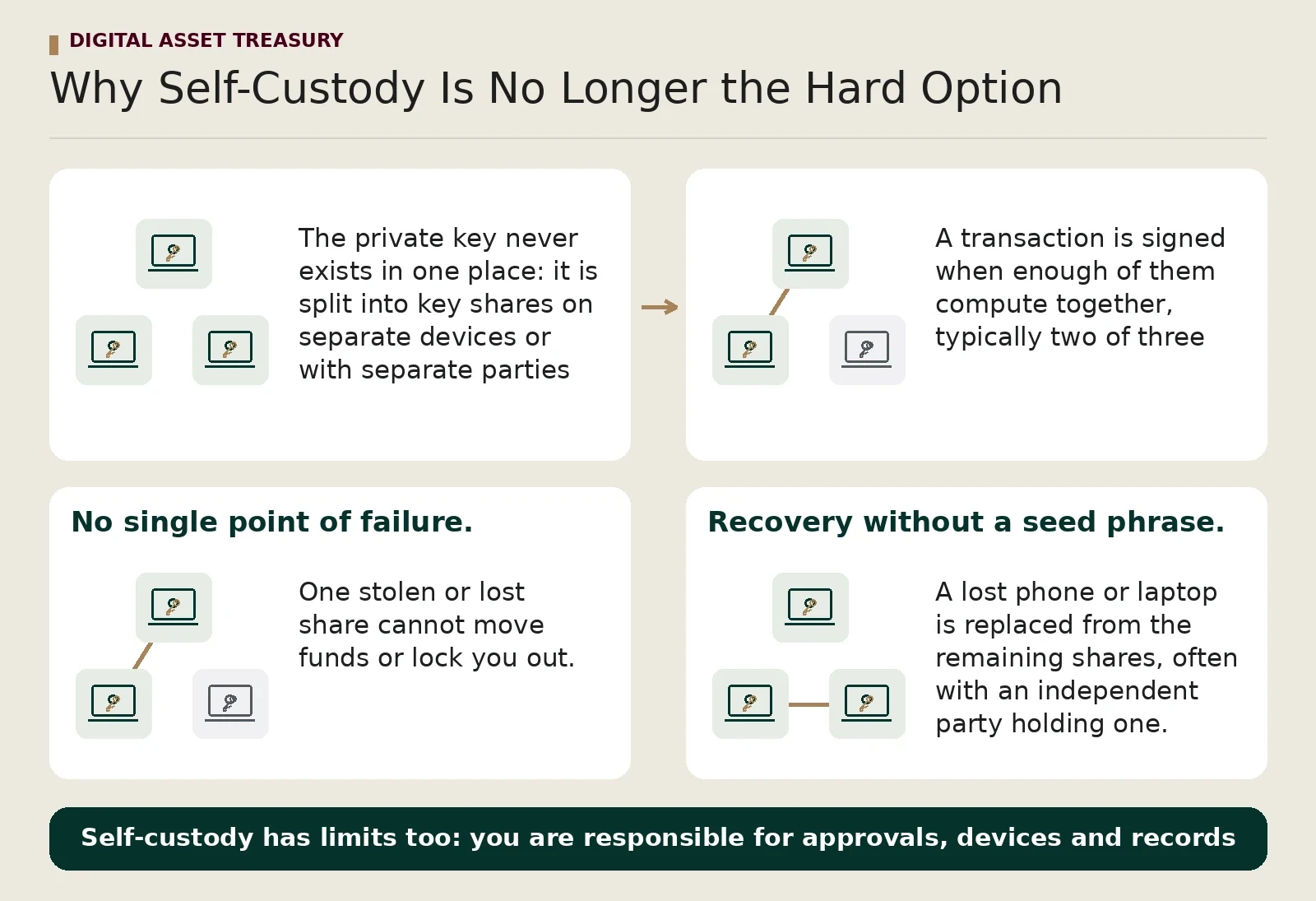
Multi-party computation changed the trade-off. In an MPC wallet the private key never exists in one place: it is split into key shares on separate devices or with separate parties, and a transaction is signed when enough of them compute together, typically two of three. Because no share can sign alone, an MPC setup can put a policy engine in front of every transaction: rules on who may start a transfer, who must approve it, how much and where it can go. That removes the key-person risk. A business can run its coins the way a bank runs payments: under the four-eyes principle, no transfer leaves without a second approver. A modern digital asset wallet built this way offers:
- Shared control. The bank-style setup: one person initiates a transfer and another approves it, with roles, approval quorums, spending limits, address allowlists and an audit trail of every action. No employee can move funds alone, and one person leaving does not lock the business out.
- No single point of failure. One stolen or lost share cannot move funds or lock you out.
- Recovery without a seed phrase. A lost phone or laptop is replaced from the remaining shares, often with an independent party holding one.
- A way out. Better providers let customers rebuild full keys without the vendor if it ever stops operating so there is no vendor risk.
Self-custody has limits too: you are responsible for approvals, devices and records; MPC wallets run on a provider’s software, so check that keys can be rebuilt without it; and some wallets charge subscriptions or require minimum balances.
Takeaway: for anyone allowed to own digital assets, the 2026 choice is no longer between a fragile seed phrase and a costly wrapper: digital wallets built on MPC give direct ownership with institutional-style controls.
Corporate Treasuries in 2026: Treasury Strategies to Hold Bitcoin on the Balance Sheet Without a DAT
Companies that hold coins for their own operations rarely want to become a DAT: they may want some Bitcoin among their treasury reserves, accept stablecoins from customers or pay suppliers abroad. This use of treasuries is classic corporate finance, the same treasury function applied to a new asset class: corporate treasury principles, powered by new tech. A sensible corporate treasury strategy:
- Write a policy. Set the allocation (say, a fixed share of cash reserves), the coins allowed and who approves changes, and have the board sign it off.
- Choose self-custody with shared control. For a small company, three owners with a rule that any two must approve each transaction is a common start, with a view-only role for the accountant.
- Add limits and allowlists. Cap daily outflows, restrict payments to approved addresses and add a delay for new ones.
- Get reporting right. Each transaction should be priced in dollars when it happens, carry a note and export to Excel. Under US GAAP, ASU 2023-08 requires any crypto asset within its scope to be measured at fair value through net income for fiscal years beginning after December 15, 2024, which brings price volatility into earnings; IFRS treats it differently, so agree the approach with your auditor.
- Plan liquidity. Arrange bank on- and off-ramps through a regulated third-party provider, and check how exports fit your accounting software or treasury management systems.
- Plan continuity. Make sure access survives a lost device, a departing employee or an owner’s death.
Day-to-day treasury operations need no expensive setup. Some self-custody wallets charge no subscription for a team of up to three users, earning from swap and conversion fees and sometimes requiring a minimum balance; business plans with more seats, single sign-on and a dedicated manager cost a few hundred dollars a month. Compare that with the 1.75% annual fee in Upexi’s management contract: $175,000 a year on $10 million of Bitcoin.
Takeaway: a business can keep Bitcoin under its own control, with audit-ready records, for a fraction of what DAT shareholders pay, and with no listing, fundraising or premium to defend.
Digital Asset Treasuries: Frequently Asked Questions
What is a digital asset treasury?
Broadly, the crypto a business holds on its own balance sheet, such as Bitcoin reserves or stablecoin working capital. In markets, it usually means a listed company whose main business is accumulating coins, a model Strategy pioneered in 2020.
What is a digital asset treasury company?
A DAT is a publicly traded company that raises capital through shares, convertible notes, preferred stock or loans and spends it on coins. Strategy, BitMine and Metaplanet are the best-known examples.
What are digital asset treasury companies used for?
Mostly as a route into tokens for investors who can buy stocks but not tokens or funds, and as a leveraged bet.
What does DAT mean in crypto?
DAT, digital asset treasury, is shorthand for a listed crypto-holding company; some analysts write DATCo. In the plural, DATs: digital asset treasury firms as a group, which together held more than 5% of the supply of both Bitcoin and Ether at the start of 2026.
Is there an official digital asset treasury companies definition?
No single digital asset treasury (DAT) definition exists in law. Data providers keep their own lists, and in 2026 MSCI adopted a rule that excludes “non-operating companies” failing its tests, the basis on which it is removing Strategy and Metaplanet from its indexes.
How is a crypto digital asset treasury different from crypto ETFs?
An ETF holds the coins for its investors and trades close to their value. A DAT is an operating company: it can borrow, issue stock or invest in other ventures, and its shares can trade far above or below the value of its digital asset holdings.
Which company holds almost 5% of all Ether?
BitMine Immersion Technologies, chaired by Tom Lee. On November 15, 2026 it held 6,077,745 ETH, 4.97% of the 122.2 million in existence, near the target it calls the “Alchemy of 5%”.
What is digital asset treasury custody, and who should hold the keys?
It is how a company stores its coins: with a custodian or in its own wallets. For a business holding its own reserves, self-custody with shared approvals keeps control in-house with no single point of failure.
Sources
- Strategy Inc., Form 8-K, November 16, 2026 (Bitcoin holdings, average cost, USD Reserve, STRC dividend)
- MicroStrategy Adopts Bitcoin as Primary Treasury Reserve Asset, Business Wire, August 11, 2020
- Tom Lee says Ethereum’s decline defies fundamentals as Bitmine adds 7,653 ETH, The Block, November 16, 2026
- BitMine announces $250 million private placement and Tom Lee as chairman, The Block, June 30, 2025
- BitMine market value before the placement, Benzinga, June 30, 2025
- Sharplink, Inc., Form 8-K exhibit 99.1 (ETH holdings as of November 2, 2026)
- Sharplink Q3 2026 results and Lido staking allocation, Crowdfund Insider
- Metaplanet holds 44,000 BTC as of September 30, 2026, Benzinga
- From budget hotel operator to Japan’s MicroStrategy: What is Metaplanet?, DL News
- Metaplanet bets on splashy advertising, DL News, April 27, 2026
- Strategy (MSTR) holdings and mNAV, CoinGecko
- Bitcoin price and Strategy holdings, crypto.news, November 22, 2026
- MSCI to remove Strategy and Metaplanet from its indexes, BitcoinTreasuries.net, November 2026
- DWF Ventures: only 4 of 20 biggest crypto treasuries trade above their holdings, Altcoin Buzz, September 24, 2026
- CoinGecko 2025 Annual Crypto Industry Report
- Key capital market trends: Digital asset treasuries, DLA Piper, October 3, 2025
- What is a digital asset treasury company (DAT)?, The Block
- Basel Committee agrees to expedite targeted review of cryptoasset standard, BIS, November 19, 2025
- Basel Committee meeting, update on cryptoasset review due by year-end, BIS, October 1, 2026
- Basel SCO60 cryptoasset prudential standard, CryptoSlate
- SEC issues SAB 122 to rescind SAB 121, Deloitte, January 2025
- US Department of Labor rescinds 2022 guidance on cryptocurrency in 401(k) plans, May 28, 2025
- CSSF opens the door to crypto exposure in UCIs, PwC Luxembourg, February 16, 2026
- Financial Services Commission: Bitcoin spot ETF not allowed domestically, Asia Business Daily, January 14, 2024
- South Korea to flip Bitcoin ETF stance as part of broader crypto push, January 2026
- South Koreans cling to Ether hoarder BitMine despite 80% drop, Bloomberg, December 30, 2025
- Japan passes key bill recognizing crypto as financial product, lowering tax rate, The Block, July 15, 2026
- Florida’s pension fund boosts Bitcoin bet via MicroStrategy stock, crypto.news
- New Jersey State Pension Fund holds Strategy shares, Crypto Briefing
- Michigan State Retirement Fund boosts stake in Strategy, Crypto Briefing
- Sonnet BioTherapeutics announces business combination to create Hyperliquid Strategies, Nasdaq
- Crypto treasury craze and insider-backed vehicles, The Block, August 14, 2025
- Digital asset treasury companies and pre-announcement trading (SharpLink background), Fortune, August 28, 2025
- Upexi, Inc., Form S-1/A (GSR asset management agreement, 1.75% fee)
- Upexi, Inc., Form 8-K, April 2025 (placement agent fee)
- GSR terminates asset management agreement with Upexi, Reuters brief, December 31, 2025
- Nakamoto nosedives after PIPE unlock, DL News
- Nakamoto turns to a reverse stock split, CoinDesk, April 10, 2026
- Nakamoto completes 1-for-40 reverse split, Cointelegraph, May 27, 2026
- ETHZilla sells Ether to redeem convertible debt, Cointelegraph, December 2025
- ETHZilla shifts away from the DAT strategy, FXStreet, December 22, 2025
- Sequans exits Bitcoin treasury strategy after selling remaining 314 BTC, Cointelegraph, September 24, 2026
- BlackRock expands digital asset suite with staked Ethereum ETP (ETHB), iShares, March 12, 2026
- The Bitwise Solana Staking ETF (BSOL) begins trading, Bitwise, October 28, 2025
- Litecoin, HBAR and Solana ETFs debut, The Block, October 28, 2025
- Canary’s spot XRP ETF debut, The Block, November 13, 2025
- Bitwise launches spot Hyperliquid ETF (BHYP), Bitwise, May 14, 2026
- 21Shares Hyperliquid ETF (THYP), 21Shares
- Vanguard clients can trade funds holding crypto, The Block, December 1, 2025
- FASB issues ASU 2023-08 on crypto assets, Deloitte
Disclaimer:
This article is provided for general informational purposes only and does not constitute financial, investment, accounting, tax, or legal advice. Bron is a self-custodial software wallet that provides tools for interacting with blockchain networks. Users are solely responsible for evaluating their own circumstances, and understanding the risks associated with the use of digital assets and self-custodial software.