


Top MPC Crypto Wallets for 2026: How to Choose a Multi-Party Computation Wallet
Compare the best MPC crypto wallets in 2026 by custody, recovery, inheritance and cost, and see which multi-party computation wallet fits your needs.
- Author
-
 Dmitry Tokarev
- Published
- Share
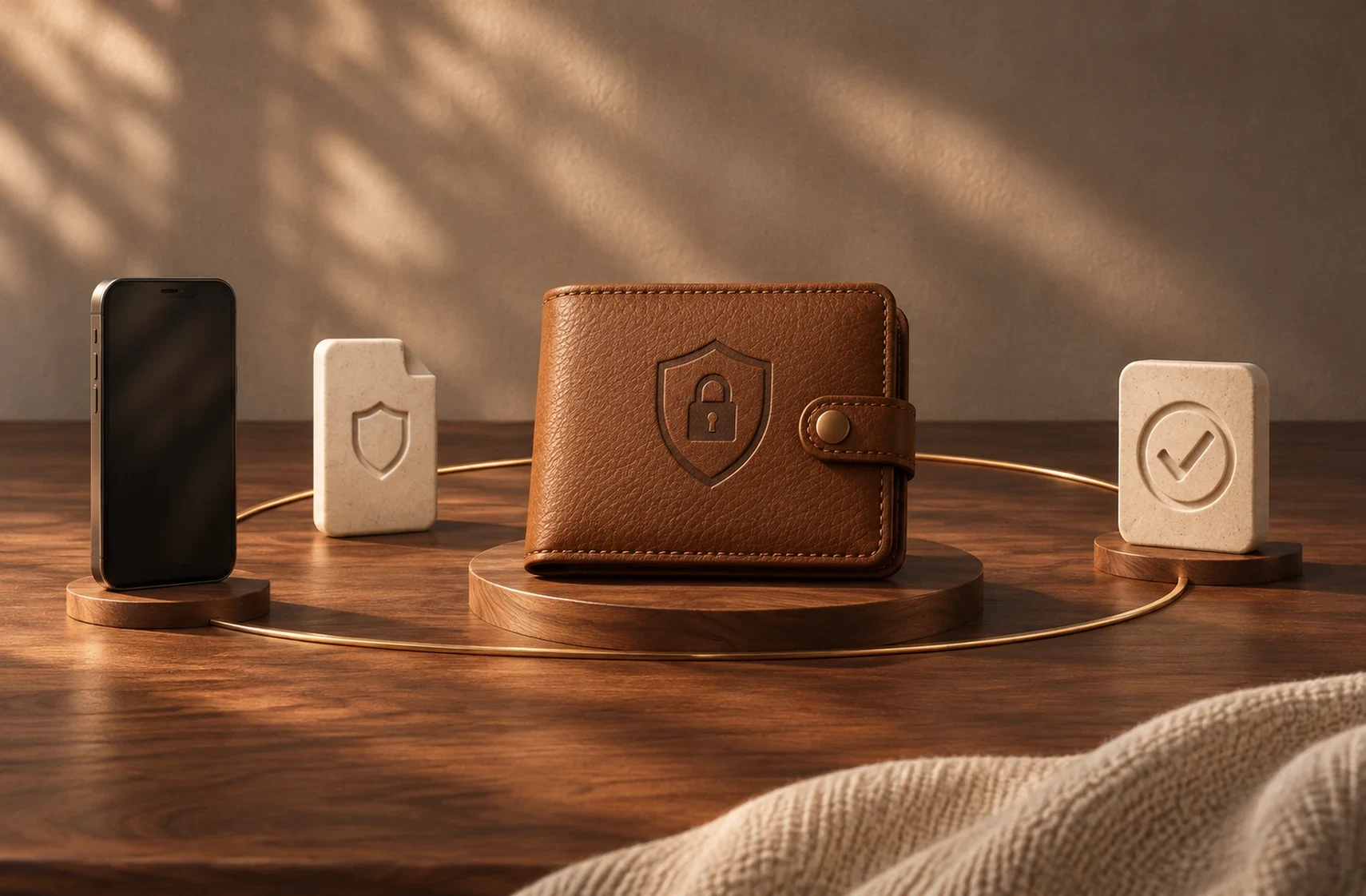
A conventional wallet depends on a seed phrase, twelve or twenty-four words that act as a single secret: lose them and the funds are gone, let someone else see them and the funds are theirs. Multi-party computation (MPC) eliminates that single secret. It divides the signing power of a private key into multiple shares held by multiple parties, so you can lose your phone, your laptop and every other device and still recover access to your cryptocurrency. In short, an MPC crypto wallet is built for people who cannot afford to lose their assets.
Below we compare five providers that use MPC: Bron, Zengo and Vultisig, which are non-custodial wallets for individuals and businesses; Fireblocks, which sells non-custodial infrastructure to businesses; and BitGo, a regulated custodian that holds the keys for its clients. We judge them on custody, recovery, what happens if the provider disappears, inheritance, shared control, privacy, trading and cost. For private and family holders as well as small and medium businesses, Bron comes out on top. Zengo is a good product for beginners. Vultisig suits people who want open-source code and are happy to do more themselves: it is a bit of a DIY option. Fireblocks suits large companies and comes with an institutional price tag, and BitGo fits those who would rather have a custodian hold their keys.
Best MPC Crypto Wallet 2026: Key Takeaways
- MPC splits signing power into key shares created when the account is set up, so there is no seed phrase to lose or leak, and access survives the loss of every device.
- Unlike multisig, MPC produces one ordinary signature, so the same shares and approval rules cover Bitcoin, Ethereum, Solana, Tron and other chains at normal network fees.
- Custody comes first: with a non-custodial setup, the provider cannot move funds without you, while a custodian such as BitGo holds every key and approves every withdrawal.
- Check what happens if the provider disappears, if you lose your devices or if you pass away. Only Bron has a built-in beneficiary process with a cancelable delay.
- Costs vary widely: Bron, Vultisig and Zengo’s core app are free, while Fireblocks costs $999 a month to start and from $36,000 a year after that.
MPC: from an institutional tool to a crypto wallet solution for individuals and businesses
For most of the last decade, MPC technology was mainly the preserve of institutions. Exchanges, funds and custodians adopted it to protect large balances without relying on one person or one piece of paper, and they paid institutional prices for it: even today, the entry plan of Fireblocks, one of the best-known institutional platforms, costs $999 a month. That has recently changed, though. Years of crypto wallet development have made MPC substantially cheaper to run, and wallet developers now bring it to individuals, families and businesses through a new generation of crypto products. They do not require you to be an engineer, and they do not require the budget of a hedge fund.
Bron is built around exactly this idea: an MPC wallet that is designed to be impossible to lose, with no seed phrase and a recovery path even if every device is gone.
Blockchain analytics firm Chainalysis counted 158,000 thefts from personal wallets in 2025, part of more than $3.4 billion stolen across the industry that year. Many of these thefts start with one private key or recovery phrase that was phished or copied, and many more coins are lost for good when the only copy of those words disappears. A design with no single point of failure addresses both risks at once.
Verdict: MPC is no longer an institutional luxury. For anyone holding a meaningful amount of crypto, removing the single secret is now both possible and affordable.
What is an MPC crypto wallet?
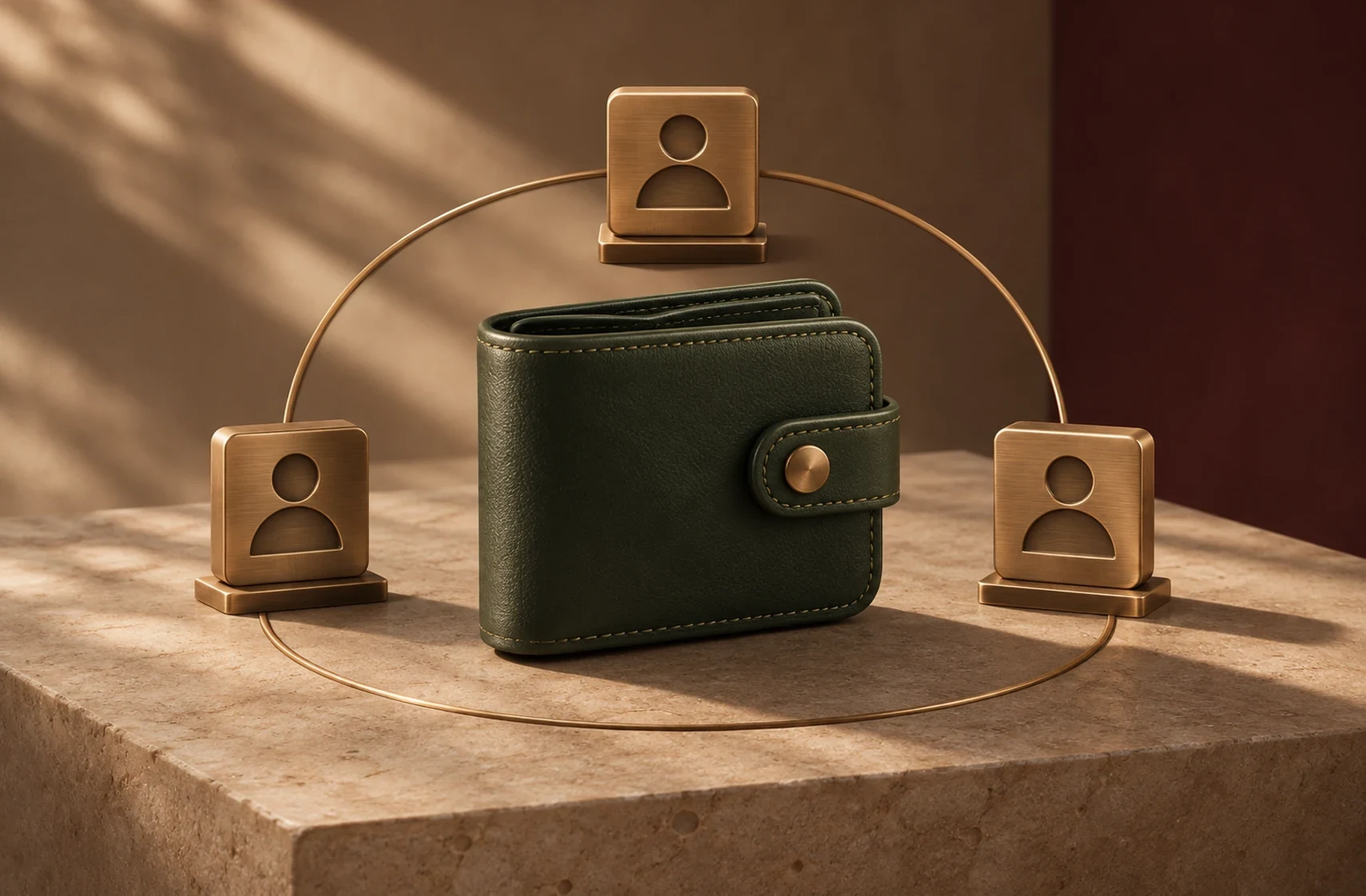
It is a cryptocurrency wallet in which the private key is never stored in one place. A private key is the secret that authorizes every transaction on a blockchain. In a conventional setup it is backed up as a list of words. With MPC, the same signing power is divided between several parties from the very beginning, and they sign together without ever assembling the key.
Multi-party computation is a branch of cryptography that lets several parties compute a result jointly without revealing their own inputs to each other. Applied to signing, the result is a valid signature, and the secret inputs are the shares. In an MPC wallet, crypto is therefore controlled by a threshold of shares rather than by one secret: for example, any two of three, or both of two.
How key shares work when using MPC
- Key generation at wallet creation. At creation, each party generates its own cryptographic key share through a distributed key generation process. Together they derive one public key and one wallet address, but the private key is distributed across the parties and never created or stored in one place.
- Signing. To approve crypto transactions, the required number of parties run the MPC protocol: each works only with its own share and they pass intermediate messages to each other. The output is one ordinary signature that any network accepts. The shares never travel or meet in one place, so the parties sign without ever reconstructing the full key.
- Refreshing and recovery. If a device is lost or a share may be exposed, the remaining parties can generate fresh shares for the same key and retire the old ones. The address and the assets stay where they are.
Given the distributed nature of MPC, where the shares live is the design choice that separates one product from another. A share can sit in your phone’s secure hardware, on the provider’s servers, with an independent recovery company or on several devices you own.
Verdict: MPC replaces the single private key with shares created at setup, not at signing. Its security and recoverability depend on who holds those shares and how many are needed to sign.
MPC wallet vs seed phrase: removing the single point of failure
The seed phrase is the weak point of traditional crypto wallets, hardware ones included. It solves backup elegantly, but it turns your whole balance into one secret that must be kept from everyone else and still be found by your family. Seed-phrase wallets are designed around hiding that secret better; MPC eliminates it instead.
| Seed phrase | MPC | |
|---|---|---|
| What controls the funds | One private key, backed up as 12 or 24 words | A threshold of shares; no complete key exists |
| One secret controls everything | Yes: whoever holds the words holds the funds | No: one share alone cannot sign |
| If you lose your phone or device | Restore from the words, if you still have them | The remaining shares restore access after identity checks |
| If the backup or one share leaks | Funds can be drained | A single share is useless; shares can be refreshed |
| Passing assets to heirs | Heirs need the words, so someone must share them before the owner’s death, or the assets are lost | Can be designed as a process with delays and checks, depending on the product |
| Dependence on the provider | None: any compatible app can restore the words | Depends on the design; check the exit path (most modern solutions have no provider dependence) |
The last row is the trade-off. A recovery phrase is vendor-independent by construction, while MPC-based wallets have to engineer their way to the same guarantee. The best of them publish exactly how you regain your assets if the provider stops operating and make their MPC code open source.
Verdict: MPC is the better choice for anyone who worries about losing or leaking their backup words. Its possible weakness is provider dependency (mostly relevant for older solutions), so ask your provider about its exit path.
MPC vs multisig wallets
Multisig setups reach a similar goal by a different road. Instead of using MPC to split a private key into shares, they use several independent keys, and the chain itself checks that enough of them signed, for example two of three. Multisig was the first widely used answer to key person risk, but it is far more of a do-it-yourself setup than a proper MPC solution.
| Multisig | MPC | |
|---|---|---|
| Where the approval rule lives | On-chain, in a script or smart contract | Off-chain, in the signing protocol and the provider’s policy engine |
| Blockchain compatibility | Built separately for each chain; some chains lack it | Works on practically any chain, because the result is a standard signature |
| What is visible on-chain | The multisig setup is usually visible | One ordinary signature; the policy setup is not visible |
| Network fees | Higher: more signatures or contract calls | The same as a single-key transfer |
| Changing a signer | New keys, often a new address or contract change | Shares are refreshed; the address stays the same |
| Backups | Usually one recovery phrase per key, so in effect a multisig means several seed phrases to manage | Shares do not have to be written down and can always be restored |
| Transparency | Rules can be verified on-chain by anyone | Depends on the provider’s documentation and open code |
The practical difference for a private holder is usability across chains. A multisig vault on Bitcoin and a multisig smart account on Ethereum are two different setups with different backups, while one MPC setup applies the same shares and the same approval rules to Bitcoin, Ethereum, Solana or Tron. Multisig keeps one real advantage: its rules are enforced on-chain. However, with the emergence of open-source MPC solutions, many DAOs and protocol treasuries have moved to MPC.
Verdict: multisig is best for single-chain treasuries that value on-chain transparency. MPC is best for multichain portfolios and for families and businesses that should not have to guard several sets of backup words.
Custodial vs non-custodial MPC wallets: who holds the keys
MPC describes how keys are protected, not who controls them. That second question decides whether a service is custodial or non-custodial, and the two are often mixed up in roundups like this one.
- Custodial: a company holds the key material and moves funds on your instructions. You have a claim against the custodian, much like a bank customer. Licensed custodians such as BitGo use MPC or multisig internally, and their regulation is exactly why they suit institutional investors who are required to use a qualified custodian.
- Non-custodial: you hold the deciding share, and the provider cannot move funds without you. Bron, Zengo and Vultisig work this way for individuals and businesses. None of them is a regulated custodian, and none of them can move your assets on its own.
- In between: Fireblocks sells non-custodial MPC infrastructure to businesses. Its software platform is not a custodian, but the group also owns separately licensed companies, including a New York trust company that offers qualified custody under a separate contract.
| Provider | Custody model | Who holds the shares | Regulated? |
|---|---|---|---|
| Bron | Non-custodial | Your device, Bron and Qrypt, an independent recovery provider; any two of three sign, and Qrypt contractually works solely for the user | No: non-custodial software, not a licensed custodian |
| Zengo | Non-custodial | Your phone and Zengo’s server; both must sign | No: non-custodial software |
| Vultisig | Non-custodial | Your own devices, or one device plus Vultisig’s co-signing server | No: non-custodial software |
| Fireblocks | Non-custodial platform | One share on the client’s device or server, two in Fireblocks’ secure cloud enclaves; Fireblocks cannot sign alone | Platform: no. Affiliates: Fireblocks Trust Company (New York trust charter, 2024) and Fireblocks LLC (US money transmitter) |
| BitGo | Custodial; self-custody also offered | In custody accounts, BitGo holds all three keys in offline vaults | Yes: BitGo Bank & Trust, N.A., a national trust bank chartered by the OCC |
Regulation and control pull in opposite directions. A licensed custodian gives you safeguards such as supervision, segregated accounts and, in BitGo’s case, insurance, but every withdrawal passes through the custodian. Self-custody gives you direct control, but no license to point your compliance officer to.
Verdict: choose a custodial MPC service if a regulator requires you to use one. For private holders and businesses who want their crypto assets to remain theirs, a non-custodial wallet is the better fit.
How we compare MPC wallets: wallet security and beyond
We judge every provider on 10 criteria to determine which solution suits each type of customer best.
- Custody and key-share model: who holds the shares, how many are needed to sign and whether the provider could move funds alone.
- Security against hacks and human error: whether a stolen phone, a phished login or one coerced person is enough to move funds, and which security measures, such as approvals, delays and allowlists, enhance security against it.
- Recovery: what you need to regain access after losing every device, and how long it takes.
- Provider dependency and exit: what happens to your assets if the company behind the service disappears.
- Inheritance and incapacity: whether heirs can take over without receiving a live secret in advance.
- Multi-user control: roles, co-approval and view-only access for family members, advisers and accountants.
- Privacy and discretion: hidden accounts and protection of balances from curious eyes.
- Coverage, swaps and trading: supported chains, cross-chain swaps, perpetual futures and tokenized traditional assets inside the app.
- Everyday protection and service: fraud and sanctions screening, staking, bank transfers and human support.
- Cost: subscription, minimums and transaction fees for a private holder.
Verdict: a good product must pass the first five tests. The last five cover wallet features that decide which one suits how you actually use your digital assets.
Top MPC wallets in 2026, reviewed
We rank the three non-custodial wallets built for individuals and businesses first. Fireblocks and BitGo follow because they do different jobs, institutional infrastructure and regulated custody, though some private holders weigh them as alternatives.
1. Bron: best MPC wallet for private and family self-custody
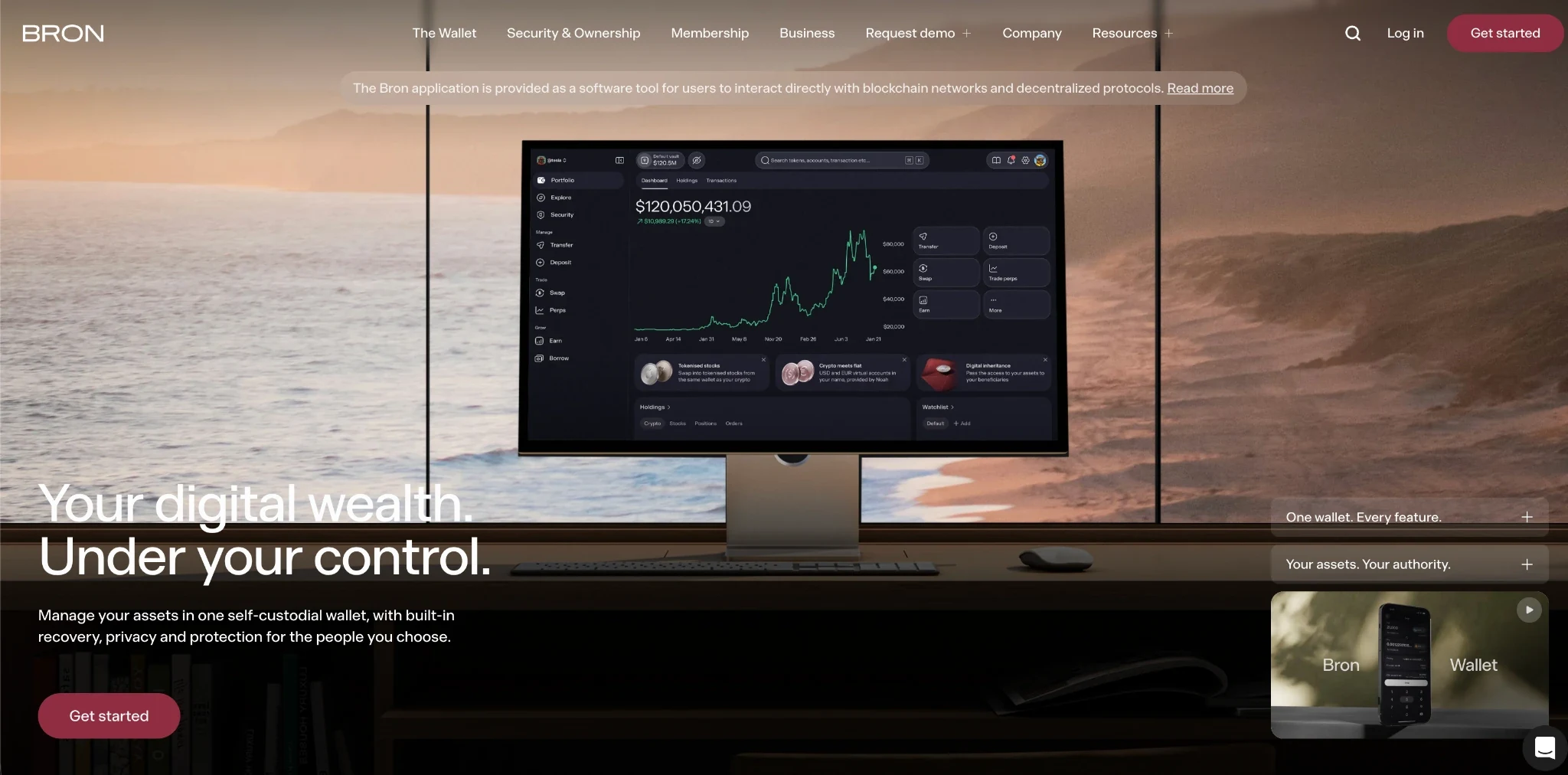
Bron is a non-custodial wallet for individuals, families and businesses, built by the founder and former CEO of Copper, a digital asset custodian for institutions. It runs on desktop, iOS and Android.
How it works. The wallet splits signing power into three key shares when an account is created: one on your device, protected by its secure hardware and your biometrics, one held by Bron and one held by Qrypt, an independent recovery provider contracted on your behalf. Any two can sign, but Qrypt only signs once you, as the user, explicitly ask it to. Day to day, your share and Bron’s sign together, and Bron only co-signs transactions you initiate. No private key is ever created or stored.
Recovery and exit. If you lose every device, you can restore access with codes from two Guardians, people you trust who never see your balances, or with FaceScan, a biometric check; each is followed by a 48-hour security delay. Without either, self-recovery takes 30 days. Every recovery starts from your email, so that account needs protecting too. If Bron ever stopped operating, your device and Qrypt could still rebuild your signing key offline. The MPC library is open source, and the app has been audited by Trail of Bits, Cure53 and CertiK.
Inheritance and shared control. Inheritance is built in on every tier. You name as many beneficiaries as you like; only they can start a claim, and a 12-month delay (6 months with codes from two Guardians) runs before anything changes, during which you, any Guardian or any beneficiary can cancel. It works alongside your will and does not replace it; we compare it with other crypto inheritance solutions. For families and advisers, Owner, Member and Viewer roles, approval quorums, transaction limits, address allowlists and security delays provide security and operational control on every supported chain.
Privacy and trading. Accounts can be hidden behind their own PIN, and a PIN reset waits 24 hours, which protects you if someone forces you to open the app. Nine tokens on Ethereum, including USDC, USDT and WETH, can be shielded (powered by Zama) so that transfer amounts are hidden on-chain. The wallet covers 27 blockchain networks, including Bitcoin, Ethereum, Solana, Tron, XRP, Canton and Hyperliquid, with cross-chain swaps through a connected intents protocol, and it connects to DeFi and other decentralized applications through WalletConnect. In the app you can trade Hyperliquid perpetual futures, as well as more than 470 tokenized US-listed stocks and ETFs issued by Ondo, which are priced by competing solvers with no slippage, up to $500,000 per trade. Addresses are screened against US and UK sanctions lists, twelve assets can be staked, and USD and EUR bank transfers run through a regulated third-party provider to an account in your own name.
Limits. Bron asks for a Qualifying Balance of $10,000 or more, reached at least once during a 14-day trial. Both the trial and the Qualifying Balance are skipped entirely if you join with a Bron Pass invitation. There is no spending card, no support for the Monero network, and Zcash works on transparent addresses only. Perpetual futures and tokenized stocks are not available to US persons, in the UK or in some other regions. Human support replies in a median of 15 minutes, but overnight replies might take hours. Bron does not hold or control your assets, so there is no insurance on holdings.
Best for: individuals, families and businesses who want seedless recovery, inheritance and shared control in one app. Weakness: the $10,000 minimum balance at entry and slower human support at night.
2. Zengo: best seedless option for retail users
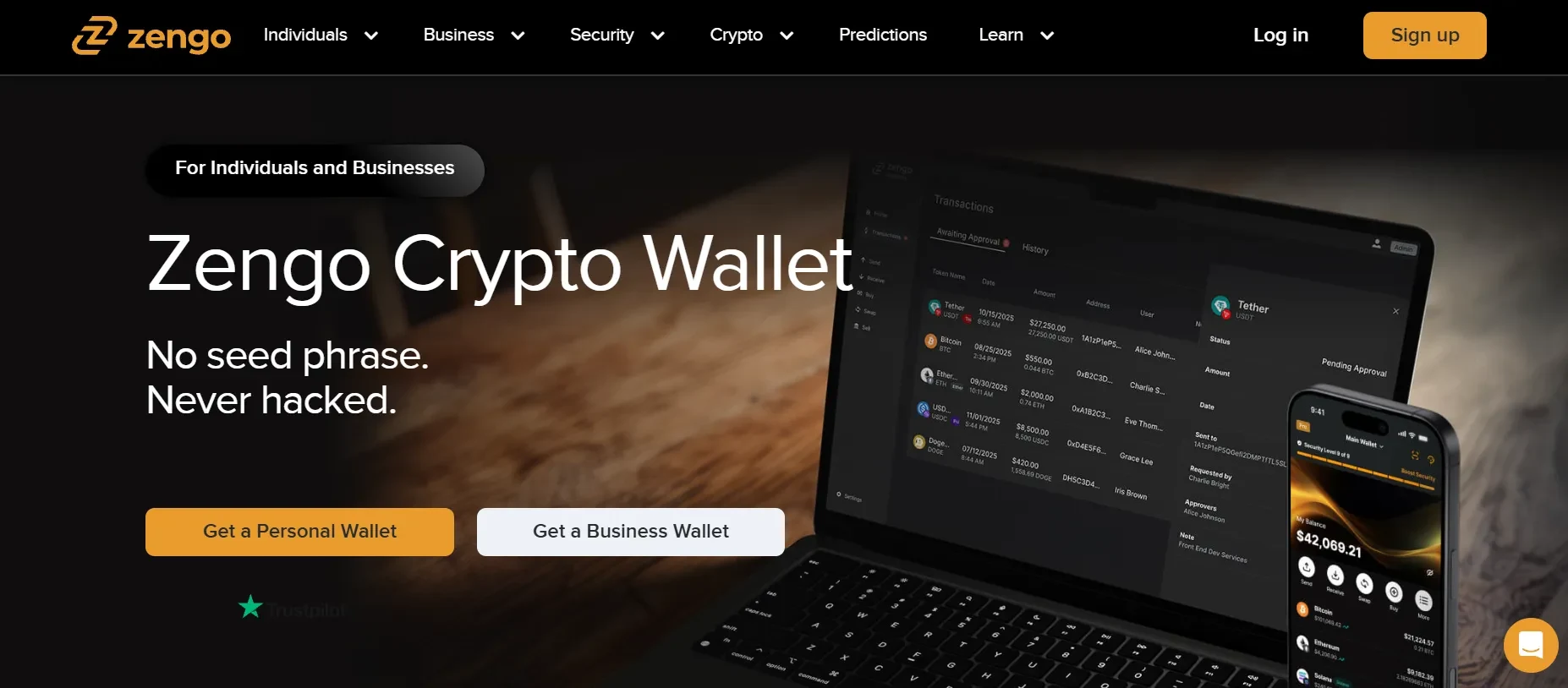
Zengo is a mobile wallet founded in 2018 and is now part of eToro Group.
How it works. The Zengo wallet uses two key shares, generated independently when the account is created: one on your phone and one on Zengo’s server. Both must take part in every signature, so neither your phone nor Zengo can move funds alone.
Recovery and exit. To restore access on a new phone you need your email and a recovery file stored in your personal cloud account; a 3D FaceLock face scan is optional but recommended. If Zengo ceased operating, an independent escrow and trustee arrangement is designed to let users recover their funds, triggered through a public GitHub repository.
Inheritance and features. Legacy Transfer, part of the paid Zengo Pro subscription, passes the account to one recipient after an inactivity period of 3 to 24 months that resets whenever you open the app. The recipient needs a Zengo account and a legacy file shared through Dropbox. Pro also adds security features such as Theft Guard, a biometric check on withdrawals, and a Web3 firewall, plus priority support, and Zengo’s round-the-clock human support is the strongest in this group. The app offers swaps, staking and prediction markets.
Limits. Because the server co-signs everything, Zengo must be online for you to transact. Inheritance is a timer with a single recipient rather than a verified claim. There is no desktop app, team features sit in a separate Zengo Business app, and network coverage, 14+ chains by Zengo’s own count, is narrower than Bron’s or Vultisig’s.
Best for: crypto users who want a basic seedless phone app with good support. Weakness: reliance on an independent escrow and trustee arrangement, rather than on the user alone, to regain full control if Zengo shuts down; no policies for joint use; and inheritance that is only an inactivity timer.
3. Vultisig: best open-source choice for engineers
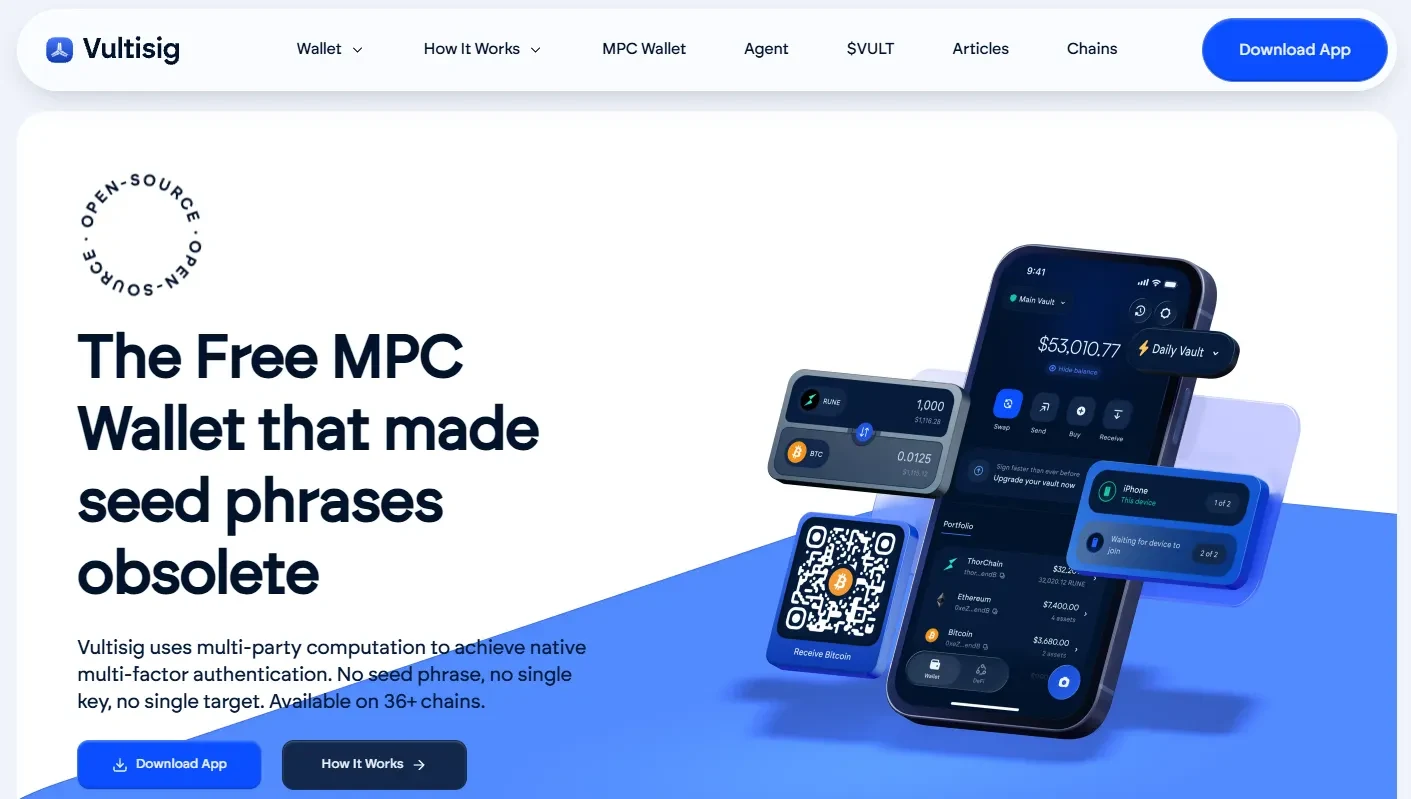
Vultisig is a free, fully open-source wallet that calls its key shares vault shares and uses the DKLS23 threshold signature protocol. It runs on iOS, Android and desktop and as a browser extension, and supports 36+ chains. It is a DIY solution: the wallet requires a bit of technical knowledge.
How it works. A Secure Vault is created across several devices you own, two of three being the recommended setup, and each device generates its own share when the vault is created. To sign, the threshold of devices must take part. A Fast Vault pairs one device with VultiServer, Vultisig’s co-signing server, which you register with an email and a password, for everyday spending.
Recovery and exit. Every share must be exported as an encrypted backup file. If you lose a device, you import its backup on a new one or, in a two-of-three vault, reshare from the remaining devices. Vultisig has no access to your shares and cannot recover them for you, so if you lose two of three shares and have no backup saved, you part ways with your assets. There is no exit risk on Vultisig itself: an open-source decoder turns a threshold of backups into ordinary private keys that other apps can import.
Inheritance and control. There is no inheritance feature. Vultisig’s own guidance is to give one share to a spouse or family member and another to a lawyer or accountant, which means handing live key material to people in advance. Control is the threshold itself, with no roles, approval policies or view-only users.
Cost and limits. The app is free; swaps and bridges carry a 0.5% fee, reduced for holders of its VULT token. You are your own recovery service: lose too many shares and backups and the funds are gone. Signing with a Secure Vault means bringing several devices together, which is secure but slow for frequent use, and the app offers no trading beyond swaps.
Best for: technically confident holders who want open code and no company holding a share. Weakness: every backup, recovery and inheritance decision is yours to manage.
4. Fireblocks: best self-custody MPC wallet for institutions and large businesses
If you are looking for the best self-custody MPC wallet for institutions or a large enterprise, Fireblocks is the reference point for institutional private key management. It is a wallet platform for business payments, treasury and asset management that supports 80+ blockchains and connects to more than 30 crypto exchanges and a network of over 2,000 counterparties. It is not offered to individuals, but businesses can use its embedded wallets to give their own customers a white label crypto wallet.
How it works. Fireblocks uses its own MPC-CMP protocol. One share sits with the client, in the mobile app of each user who can sign or on a server running the client’s API co-signer, and two sit in Fireblocks’ secure cloud enclaves. Fireblocks never holds enough shares to sign without the client. A granular policy engine adds robust security features: roles, approval chains and limits.
Recovery and exit. Fireblocks offers several backup and recovery options. Signing users back up their share with a recovery passphrase, and a full workspace key backup is mandatory. With that backup and Fireblocks’ open-source recovery tool, a client can rebuild its keys and move assets without Fireblocks; third-party disaster recovery services are an add-on.
Regulation. The Fireblocks software platform is not a custodian. The group owns licensed subsidiaries: Fireblocks Trust Company, chartered by the New York State Department of Financial Services as a limited purpose trust company in 2024, offers qualified custody, and Fireblocks LLC is a registered US money transmitter. Fireblocks states that their services are not included with the software platform and require separate onboarding and contracts.
Cost and limits. Essentials costs $999 a month for up to six months, with $1 million of outbound volume per quarter, five users and a 0.20% fee above that volume. Custom plans start at $36,000 a year. Onboarding is sales-led, there is no inheritance feature, and Essentials support runs eight hours a day, five days a week.
Best for: trading firms, fintechs, funds and enterprises that need scalable infrastructure with API automation and a regulatory status to satisfy compliance requirements. Weakness: the price, and it is not available to private individuals.
5. BitGo: best regulated MPC wallet service if you want a custodian
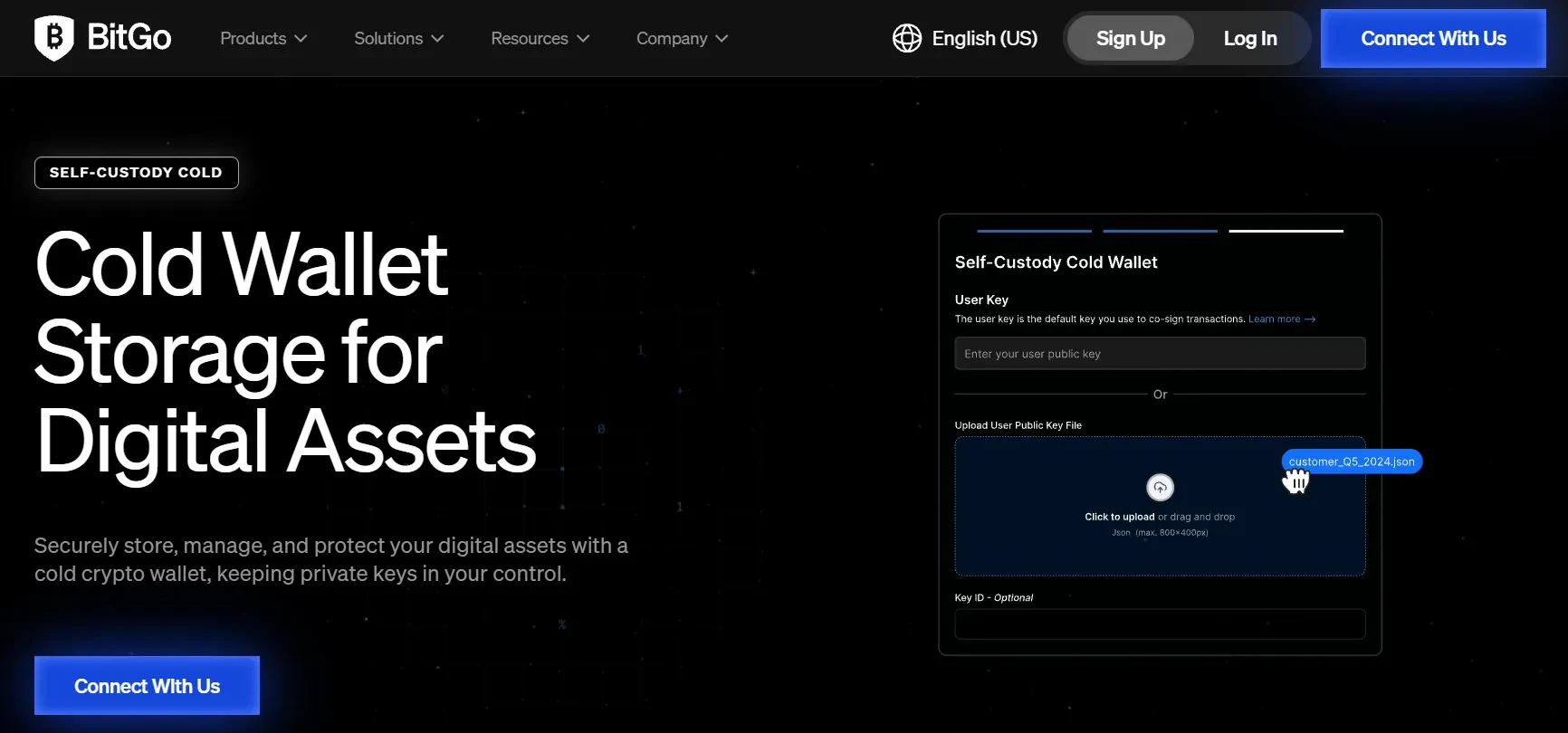
BitGo, founded in 2013 and listed on the New York Stock Exchange since January 2026, is a custodian first. Its trust subsidiary became BitGo Bank & Trust, N.A., a national trust bank chartered by the OCC, after the regulator approved the conversion in December 2025. For anyone choosing an MPC wallet service, crypto custody at BitGo is the clearest example of the custodial model.
How it works. BitGo secures assets with three keys, as multisig or as MPC threshold signatures. In custody, BitGo holds all three in cold storage spread across vaults, and no single person controls more than one key for an account. You request a withdrawal, BitGo verifies it, including a video identity check unless your policies waive it, signs it and completes it within a 24-hour service level. BitGo also offers self-custody, in which you hold the user key and a backup key and BitGo co-signs, used mainly through its app and API by developers and institutions.
Protection and cost. Assets in custody are segregated from BitGo’s own balance sheet, and BitGo carries up to $250 million of insurance for cases in which it holds all keys. BitGo currently offers qualified custody with no custody fees to eligible individual investors, and its self-service self-custody option is free. Institutional custody is priced in basis points on assets plus a monthly minimum, set by contract.
Limits. In custody, the keys are BitGo’s, not yours: every withdrawal waits for the custodian and passes its compliance checks. There is no inheritance feature, so heirs deal with BitGo as they would with any custodian.
Best for: holders who want a regulated, insured custodian to keep the keys for them. Weakness: it is custodial, so you trade direct control for supervision.
MPC wallets compared: features and cost
The tables below put all five side by side on the criteria above. Terms and prices are as each provider publishes them in November 2026.
| Bron | Zengo | Vultisig | Fireblocks | BitGo | |
|---|---|---|---|---|---|
| Custody | Non-custodial | Non-custodial | Non-custodial | Non-custodial platform | Custodial (self-custody also offered) |
| Key shares and threshold | 2 of 3: you, Bron, Qrypt | 2 of 2: you, Zengo | Your devices (2 of 3 recommended), or 2 of 2 with VultiServer | 3 shares: 1 client, 2 Fireblocks; client share always required | 3 keys, all held by BitGo in custody |
| Recovery after losing every device | Guardians or FaceScan (48-hour delay), or self-recovery in 30 days | Email and cloud recovery file, optional face scan | Import your encrypted share backups, no recovery if lost | Passphrase-protected share backup | Through BitGo, as custodian |
| If the provider disappears | Your device and Qrypt rebuild the signing key | Escrow and trustee recovery arrangement | Open-source decoder rebuilds keys from backups | Workspace key backup and open-source recovery tool | Assets segregated at a regulated trust bank |
| Inheritance | Built in: unlimited beneficiaries, 12-month delay (6 with Guardians), cancelable | Legacy Transfer (requires paid subscription): one recipient after 3 to 24 months of inactivity | No feature | No feature | No feature |
| Multi-user control | Owner, Member, Viewer roles; approvals, limits, allowlists, delays on all chains | Separate Zengo Business app, requires subscription | Device threshold only | Advanced roles and policy engine | Enterprise roles and policies |
| Privacy | PIN-hidden accounts; on-chain shielding through Zama | Bitcoin Vault and private transaction mode (requires subscription) | No hidden accounts and no on-chain shielding | No consumer privacy features | Custodian sees all holdings |
| In-app trading | Swaps, Hyperliquid perps; 470+ tokenized US-listed stocks and ETFs | Swaps, prediction markets | Swaps | Links to 30+ trading venues and counterparties | Trading and staking from custody |
| Platforms | Desktop, iOS, Android | iOS, Android | iOS, Android, desktop, extension | Web console, mobile signer, API | Web app, API |
The second table looks at cost: who can use each service, what you pay for it and the main limitation behind each price. Some providers charge through swap and trading fees, some through subscriptions and some, like BitGo, through the control you hand over. Prices are as published in November 2026 and exclude blockchain network fees.
| Provider | Who can use it | What you pay | Main limitation on cost |
|---|---|---|---|
| Bron | Individuals, families, businesses | No subscription for individuals; Business plan (if more than 3 users are needed) is $250 a month | No subscription, but a $10,000 Qualifying Balance must be reached at least once during the trial, unless invited with a Bron Pass |
| Zengo | Individuals; Zengo Business for companies | Core app is free, but a lot of functionality sits behind the Zengo Pro subscription | Inheritance and Theft Guard need a paid subscription |
| Vultisig | Individuals, families, businesses | Free; 0.5% on swaps and bridges, lower for VULT holders | You carry the cost of managing backups yourself |
| Fireblocks | Businesses only | Essentials $999 a month for up to six months; Custom from $36,000 a year | Volume caps and add-ons; sales-led |
| BitGo | Institutions and eligible individuals | Custody currently free for eligible individuals; others pay basis points plus a monthly minimum | BitGo holds the keys and can freeze your assets at any time |
Verdict: for a private holder, Bron offers the most complete set of recovery, inheritance and control features at a modest cost. Zengo also has free options, but many features and functionalities are limited until you pay a subscription. Vultisig is completely free and requires no subscription, but you need the technical skills to make sure you do not lose your shares. Fireblocks costs far more, and BitGo’s offering comes with onboarding and handing over the keys.
How to choose the right MPC wallet solution for your use case
Start with your wallet needs, not the brand. The right choice is the one whose custody model and features fit how you hold and use your assets.
- Family wealth and estate planning: Bron. Recovery without backup words, beneficiaries with a cancelable delay and co-approval for relatives or advisers sit in one account.
- Best MPC wallet for long-term crypto storage, 2026: Bron again, because its third share sits with an independent recovery provider, so neither losing your devices nor losing us locks you out. Holders who prefer to keep everything in their own hands can use a Vultisig Secure Vault and accept the backup work.
- A simple phone app for everyday amounts: Zengo, which is easy to set up and has strong support.
- Open code and no company in the signing path: Vultisig, provided you are confident managing encrypted backups across several devices.
- A company treasury with many signers and API automation: Fireblocks, if the budget allows; smaller teams do well with Bron’s Business plan.
- A regulated custodian that holds the keys for you: BitGo, accepting that withdrawals go through the custodian, or a separate contract with Fireblocks’ licensed entities.
- Trading in the same app: Bron is the only one of the five with in-app perpetual futures and tokenized US stocks, outside the US and UK.
Verdict: for most private and family holders the decision comes down to recovery and inheritance, which is where Bron leads. Pick a different provider only if one specific need, such as regulated custody or institutional scale, outweighs them.
Crypto security habits that still matter with MPC
MPC protects the key against unauthorized access, but it cannot stop you from approving a bad transaction. Secure crypto storage still depends on a few habits that cover the remaining cyber threats.
- Check the full address before sending, because address poisoning plants look-alike addresses in your history.
- Use allowlists and limits where your provider offers them, so a single mistake cannot empty an account.
- Read what you sign: prefer apps that simulate a transaction and show its effect before you approve.
- Protect your email, because most MPC recovery flows start there.
- Ignore unsolicited “support”: no genuine provider asks for your recovery file, codes or passkey.
Verdict: MPC removes the single secret, but good habits still decide most outcomes in digital asset security.
Frequently asked questions
What is the best MPC crypto wallet in 2026?
For private holders, families and small and medium businesses, Bron tops the charts, because it combines two-of-three MPC with an independent recovery party, built-in inheritance and shared controls. Zengo is the simplest seedless phone option, Vultisig suits users who are technically capable and share crypto purists’ values, Fireblocks serves enterprises and BitGo is the choice for regulated custody.
Is an MPC wallet safer than a hardware wallet or cold storage?
The two storage solutions protect against different risks. Hardware wallets and other traditional wallets keep a private key offline, which defeats remote attacks, but the key is still backed up by a recovery phrase that can be lost or found. MPC leaves no complete key to steal or lose, and it can be recovered if every device is gone. Its main risk is dependence on the provider, which is why the exit path matters. Against hacks over the internet, hardware devices and MPC wallets offer the same level of security.
Is an MPC wallet non-custodial if the provider holds a key share?
Yes, as long as the provider cannot move funds without you. In Zengo and Fireblocks, the provider’s shares cannot sign without the client’s share. In Bron, the only pair of shares that excludes you is Bron plus Qrypt, an independent company that acts only on your verified instruction and has no contract with Bron. In BitGo’s custody service the custodian holds every key, which makes them custodial.
What happens if the wallet provider shuts down?
It depends on the design. Bron’s users rebuild their signing key with their own device and Qrypt, Zengo relies on an escrow and trustee arrangement, Vultisig and Fireblocks users rebuild keys from their own backups with open-source tools, and BitGo’s custody assets are segregated at a regulated trust bank.
Can I recover an MPC wallet if I lose my phone?
Yes, that is the main reason to choose MPC over other digital wallets. Depending on the provider, recovery uses trusted contacts, a face scan, a cloud recovery file or your own encrypted backups, usually with a security delay. Keep access to the email account linked to your wallet, because most recovery flows start there.
Are MPC wallets regulated?
Non-custodial providers such as Bron, Zengo and Vultisig are software providers and do not hold or control your assets. Custodians that use MPC, such as BitGo, are regulated because they hold client assets. Fireblocks keeps its software platform separate from its licensed custody and money transmission subsidiaries, so customers can choose.
Can I pass MPC-secured assets on to my heirs?
Only if the provider supports it or you arrange it yourself. Bron has a built-in inheritance process with unlimited beneficiaries and a long, cancelable delay, Zengo offers an inactivity-based Legacy Transfer on its paid plan, and the others require you to share key material or rely on a custodian’s estate process. Whatever you choose, keep your will up to date as well.
Sources
All provider facts were checked on the providers’ own pages in November 2026.
- Chainalysis 2025 theft figures, as reported by The Block (December 18, 2025).
- Bron: The Impossible to Lose Wallet, Membership, and the Help Center articles MPC Security, Data Security and Shards, Access Recovery, Private Key Recovery When You Can’t Use Bron, Inheritance, Bron Security Overview, Supported Networks, Tokenized Stocks on Bron, Hidden Account, Shielded Tokens, Staking, Bron Pass and How Bron Support Works.
- Zengo: Zengo Pro page; Help Center articles on the Recovery Kit, Legacy Transfer and what happens if Zengo goes out of business; Zengo’s guide to self-custody wallets (April 2026); eToro’s announcement of the Zengo acquisition (April 15, 2026) and of its investment in Extended (July 2026).
- Vultisig: homepage, FAQ, Backup and Recovery guide and Emergency Recovery documentation.
- Fireblocks: pricing page, Regulated Entities page, Help Center article on backup and recovery and the Fireblocks Trust Company announcement.
- BitGo: Individual Investors page, Billing Methodology, developer documentation on wallet types, and announcements of the OCC charter (December 2025) and NYSE listing (January 2026).
Disclaimer:
This article is provided for general informational purposes only and does not constitute financial, investment, accounting, tax, or legal advice. Bron is a self-custodial software wallet. While Bron’s architecture is designed to eliminate single points of failure and reduce certain risks, the use of blockchain technology and self-custodial wallets involves inherent operational, technical, governance, and security risks, including risks related to user configuration, device compromise, social engineering, or software vulnerabilities. Users remain solely responsible for evaluating their own circumstances, security practices, and risk tolerance when using any software to manage digital assets.