


Crypto Inheritance: How to Pass Cryptocurrency to Your Heirs
A will names your heirs but cannot unlock a crypto wallet. Learn how crypto inheritance works and how to make sure heirs can access your digital assets.
- Author
-
 Dmitry Tokarev
- Published
- Share

Digital assets are never lost in the usual sense of the word. Every coin is still recorded on the blockchain, visible to anyone who cares to look. What disappears is the ability to move it. Blockchain analytics firm Chainalysis estimated in 2020 that, in bitcoin alone, about 3.7 million coins, roughly a fifth of all those mined at the time, had not moved for years and were most likely gone for good. Some belonged to early miners who forgot about them, some sat on hard drives that ended up in landfills, and some belonged to people who passed away without telling anyone how to reach them.
That last group is what this guide is about. Crypto inheritance is a problem that traditional estate planning was never designed to solve: the assets are safe, the heirs are known, and still nobody can move them. Below we explain how passing on cryptocurrency works for each way of keeping it, why the classic workarounds fall short, and how to create an estate plan that transfers access as well as ownership.
Crypto Inheritance: Key takeaways
- A will says who inherits your crypto, but it cannot unlock a self-custody wallet. Heirs need the private key or a recovery path that was set up while you were alive.
- Crypto held at an exchange, broker or bank passes through the provider’s death-claim process. Crypto you hold yourself passes only if someone can reach it.
- Sharing or splitting a seed phrase moves the risk rather than removing it. Someone who finds the words can empty the wallet, and if nobody finds them, the assets are gone.
- Keep an inventory of wallets, accounts and on-chain positions, with no keys or passwords in it, and review it once a year.
- Bron takes the majority of these tasks off your shoulders and allows for a programmable path for digital assets inheritance
Why a will alone does not give your heirs access to crypto
In many households, one person is deep into digital assets and the other simply follows along. The first knows how crypto works, which accounts exist, where the hardware device is kept and what the twelve or twenty-four recovery words are for. The second knows the family owns some bitcoin, trusts that it is taken care of, and assumes the will covers the rest.
The will, however, can only do half the job. Like the rest of your estate plan, it can say who should inherit your cryptocurrency, but it cannot make that cryptocurrency spendable. A non-custodial wallet is governed by its private key, and if the key is lost, no probate court, executor or trustee can recover it.
In the traditional world, a court can order a bank to release an account because the bank holds the money. In self-custody, whoever holds the private key holds the assets, so a court order has nowhere to go. Heirs may hold a valid will, a death certificate and letters testamentary, and still be locked out forever.
If you still use seed phrase wallets, please note that writing the seed phrase into the will is not the answer either. A will that goes through probate can become a public document: in the United States and in England and Wales, for example, anyone can obtain a copy from the court once it has been filed or probate has been granted. Mention your crypto in the will so the estate clearly includes it, and keep the instructions on how to reach it in a separate document that never goes to court.
This gap between ownership and access is where most crypto estates fail. Unlike traditional assets, coins you hold yourself exist only in digital form and do not come with an institution that records who the owner is and hands everything to the lawful heir once the paperwork is in order.
Your estate plan has two halves: who inherits, and how heirs can access the assets
An effective plan for passing on digital assets has two parts, and both have to work simultaneously.
- The legal part says who your heirs are. It lives in your will, a trust or your wider estate plan, and it is what legally gives them the right to your digital property.
- The technical part makes sure the people you chose can actually reach what you leave. Without it, the legal part is the deed to a house that nobody can enter.
This guide covers the second part: the mechanics of how your family can access digital assets, which depend almost entirely on how you hold them today. The legal side of estate planning for digital assets is work for your estate planning attorney.
How you store crypto decides how your heirs inherit it
The way cryptocurrency is inherited depends on the way it is held. There are two broad models, custodial and non-custodial, and your crypto may well sit in both without you ever thinking of them as different. The difference matters more at death than at any other moment.
| Custodial holdings | Non-custodial wallets | |
|---|---|---|
| Examples | Spot ETFs at a broker, coins in a bank or neobank app, exchange accounts | Hardware wallets, seed-phrase apps and browser extensions, multisig and MPC setups |
| Who controls the assets | The provider | You, through a private key or key shares in MPC setups |
| What heirs need | Death certificate, probate documents, ID | The key, or a recovery path set up in advance |
| Can a court order help? | Yes | No (a court cannot restore the keys) |
| Main risk | The provider fails, freezes or delays | Loss of the private key or inability to access the wallet |
Custodial cryptocurrency accounts: ETFs, brokers, neobanks and exchanges
Custodial means a company holds the assets for you. If you purchased bitcoin through a spot ETF at your broker, bought cryptocurrency assets inside a banking or neobank app or keep a balance on an exchange, a counterparty keeps the keys, knows who you are and has a process for the day a customer dies.
For these accounts, the process works much as it does for other financial assets, or for assets like real estate. There is a will, or if there is none, the law of the country decides who receives the estate. The executor proves that the owner has died and shows who is entitled to the estate, and the provider releases the balance so it can be transferred to heirs as the will or the law directs.
Coinbase, for example, asks for a death certificate, probate documents such as letters testamentary or letters of administration, government ID for the person named in them, and a signed letter telling it what to do with the balance. Kraken asks for a similar set and does not let customers add a beneficiary to an account.
The process is often slower than families expect, but it is predictable. Its weakness lies elsewhere: everything is only as safe as the company that keeps it. When Gerald Cotten, founder of the Canadian exchange QuadrigaCX, died in December 2018, more than 76,000 clients were owed a combined C$215 million. The Ontario Securities Commission later concluded that most of the shortfall came from his fraud rather than from keys lost at his death. That makes the point even more clearly: with a custodian, your family inherits its risks along with your balance.
Non-custodial wallets and the seed phrase paradox
Things get substantially more interesting when digital assets are held non-custodially, which is how many long-term holders prefer to keep them. Most such setups are built on a seed phrase: twelve or twenty-four words that regenerate the private key and, with it, full control of the funds. Whoever holds the words holds the money. There is no help desk and no court that can issue a replacement.
The mere existence of a seed phrase creates three requirements:
- You should never lose it, or you lock yourself out.
- Nobody else should ever find it, or they can empty your accounts.
- Your family should be able to inherit it, or the assets die with you.
The second and the third directly contradict each other. Hide the words well enough that a burglar, a curious relative or a cleaner will never come across them, and your family is unlikely to find them either. Leave them where your family will find them, and you have weakened the very security that made self-custody worth choosing.
The history of different solutions to pass cryptocurrency on
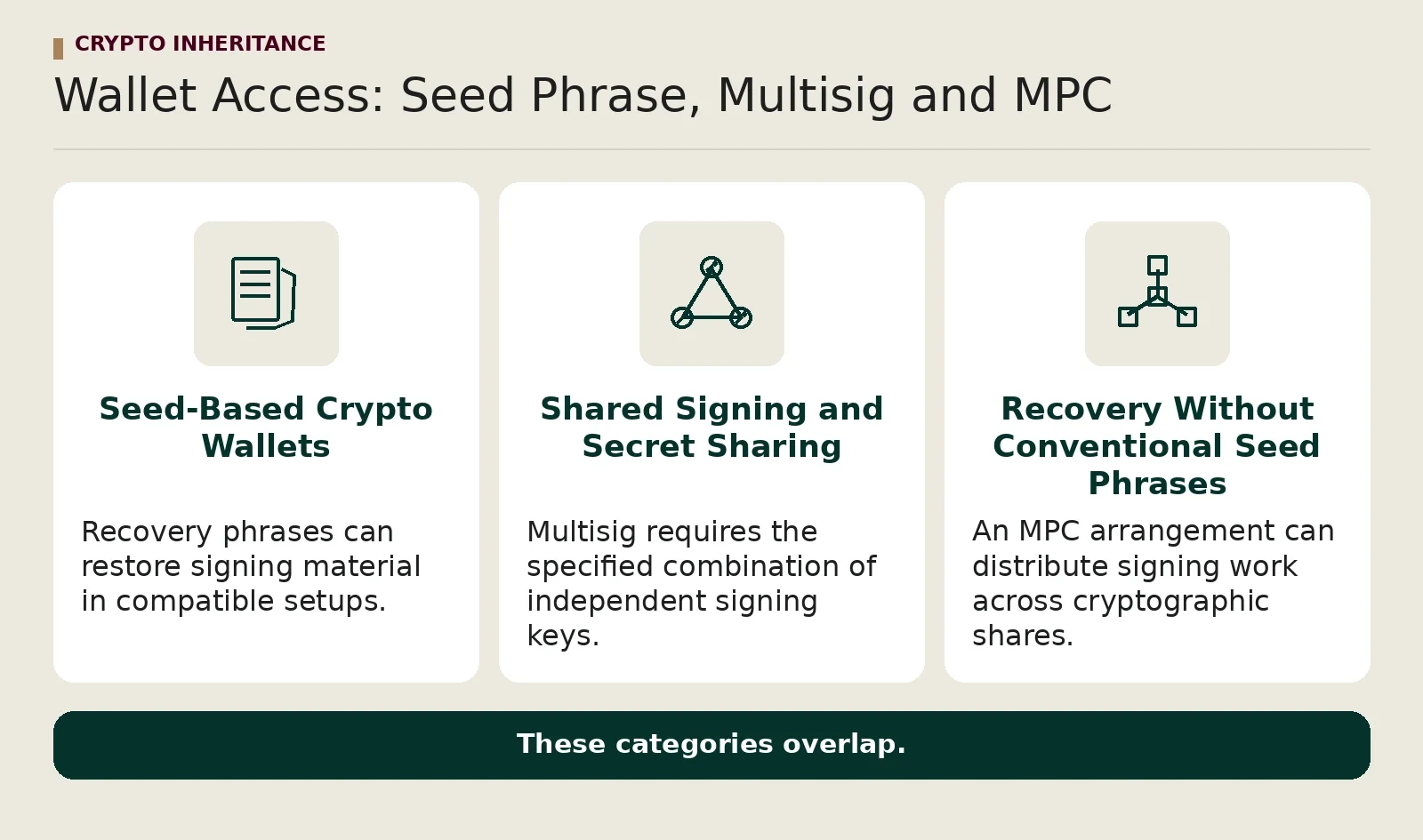
Keeping all your digital assets under your own control gives you a lot of freedom, and exactly as much responsibility. Over the years, holders have tried several ways to reconcile security with succession. We will review them below and note their shortcomings, then move on to how modern wallets solve the problem. If history is not your main interest, skip to the next section.
Sharing the seed phrase with a partner
The traditional answer is to share the seed phrase with a spouse or partner. It solves access but creates a second copy, and with it a second point of failure.
Relationships end, papers get thrown out during a move, someone else stumbles on the card, and if both partners die in the same accident the problem returns. Words handed over years ago by the more crypto-native partner also tend to mean little to the person who receives them: a card with twelve words, and no idea what they open, how to use them or what to do next.
Splitting the seed phrase
A variation of the above splits the backup into parts, either by cutting the word list in two or with Shamir’s Secret Sharing, where any three of five shares rebuild the secret. No single copy exposes everything, but your family must know who holds the shares, and enough of those people must still have theirs when the time comes. Needless to say, the people who keep the shares, and later the executors of their own estates, need the technical skills to deal with a Shamir’s Secret Sharing setup.
Multisig wallets
Institutions ran into the same problem earlier and called it key person risk. Their first widely used answer was the multi-signature (multisig) wallet, where moving funds needs, for example, two of three or three of five signatures. Services such as Casa and Unchained use this model and hold one of the keys themselves.
Multisig removes the single key, but it brings problems of its own:
- More seed phrases to protect. Each signature is usually backed by its own seed phrase, so the family has two or three to guard instead of one.
- Enough key holders must be available. Recovery works only if enough of them are reachable, alive and still in possession of their backups at the moment it matters.
- Easy to get wrong. Managing several devices, several sets of words and the multisig configuration is hard without technical experience, and a mistake with any of them can be as final as losing the original seed phrase.
Many institutions moved away from that setup years ago, for a reason.
Dead man’s switch
A dead man’s switch is a setup that automatically sweeps your cryptocurrencies to a predetermined address if you do not log in for a set period of time. The destination address is typically one controlled by your partner or another family member. Some services apply the same idea to information instead, releasing encrypted recovery instructions to a named person once the owner stops checking in.
This is far from ideal, for two reasons. First, the assets would move prematurely if you simply stay offline longer than planned or, God forbid, fall ill or become incapacitated. Second, it only relocates the problem: the receiving wallet has its own seed phrase, so your plan now depends on another person never losing theirs.
Historical methods for passing on crypto assets, compared
| Method | What your family needs | Main weakness |
|---|---|---|
| Shared seed phrase | The words, and where to use them | Anyone who sees the words owns everything. If you do not share the seed phrase with your family members, they run the risk of never finding it. |
| Split seed phrase or Shamir shares | Enough shares, and to know who holds them | Shares get lost; holders must coordinate; technically very hard to accomplish. |
| Multisig, such as 2-of-3 | Enough keys, each with its own backup, plus the configuration | Several seed phrases to manage; complex for non-technical family members |
| Dead man’s switch | An address of their own | Can trigger early; the receiving address has its own seed phrase |
Key person risk: what institutions learned about keeping access alive
When we speak about families, it helps to treat the risk exactly as institutions do. The crypto-native member of a family is a key person in the same sense as a fund’s chief investment officer: if they are gone, the family’s most valuable digital holdings must not go with them. The aim is to leave no single point of failure, and above all to make sure that the private key, or whatever secret gives access to the assets, does not die together with its owner.
As digital assets became an asset class for funds and banks, the institutional market settled on multi-party computation (MPC) to achieve this. In an MPC wallet:
- No complete private key exists in one place. There is nothing for a thief or a single point of failure to take.
- The signing capability is split into key shares, often called shards, held on different devices or by different parties.
- A transaction is signed when enough shares compute together, without the shares ever being combined or them recreating a private key.
- Institutional setups are usually 2-of-3, not 2-of-2. Even if the service provider holding one shard disappears, the client is not locked out.
For a family, the important difference from multisig is that none of the shares has to be a seed phrase that a person writes down and guards. Shares can live in a phone’s secure hardware, with the wallet provider and with an independent recovery party, and a lost share can be re-created from the remaining shares. For a fuller explanation, see our guide to MPC wallets and key shares.
How MPC turns wallet recovery into digital asset inheritance
Applying MPC to a family brings two benefits that seed-phrase wallets cannot offer.
The first is recovery: because the shares are distributed, you can regain access even if you lose every device. The provider, together with a trusted third party that works for you rather than for the provider, can re-create your share once you have proven who you are.
The second follows from the first. If access can be re-created in your favor, it can be re-created in favor of someone you appointed in advance, under rules you set while you are alive. If the MPC provider also supports a policy engine, meaning rules such as “every transaction needs two or more approvals”, the inherited account can be configured so that when you name several people, none of them can move funds alone and each of their approvals is required.
This is how passing on your holdings stops depending on a piece of paper. Nobody needs to receive a secret from you: your successors only need to prove who they are, and the rules you set decide what happens next. This is exactly how we built digital inheritance into the Bron wallet.
Crypto inheritance solutions compared
Several providers now build a way to pass crypto on into their products. They differ mainly in what your heirs must hold, which assets are covered and how long the safeguard lasts before anything moves. Terms and prices below are as each provider publishes them in November 2026.
| Solution | How it works | What your heirs need | Safeguard before anything moves | Cost |
|---|---|---|---|---|
| Bitkey (Block) | Bitcoin wallet built around a hardware device | Their own Bitkey device and app | 6-month delay after a claim; the owner can cancel | Hardware for owner and heir; no separate inheritance fee |
| Bron | MPC wallet with no seed phrase, covering more than 25 blockchain networks | Their own Bron login (passkey and email) | 12 months, or 6 once two Guardians’ codes are entered; the owner, any Guardian or any beneficiary can cancel | Included on every tier, no subscription required; nothing to pay for heirs |
| Casa | Multisig vault of 3 or 5 keys for bitcoin, ETH and stablecoins | A key in the Casa app, checked periodically | 6-month verification; the owner can cancel | Included in every plan, from $250 a year |
| Unchained | Collaborative bitcoin multisig, with Unchained holding one key | The executor, estate documents and Unchained’s guidance | Legal verification required | Signature plan: $6,000 the first year, then $4,500 a year |
| Vault12 Guard | Encrypted backup of seed phrases and keys, shared among Guardians | To be one of the Guardians, plus approval from enough of the others | The owner has 48 hours to veto | Paid monthly Inheritance plan |
| Zengo | MPC wallet; assets move after an inactivity period the owner sets (in effect, a dead man’s switch) | A Zengo account and a shared file kept in Dropbox | Inactivity timer, reset whenever the owner logs in; the owner can cancel | Requires a paid Zengo Pro subscription |
How crypto inheritance works in an MPC wallet, step by step
Some MPC wallets now have inheritance built in. Bron is one of them, and the steps below follow its process.
Every account is secured by MPC, with no seed phrase: the signing key is split into three shards, one on the owner’s device, one held by Bron and one held by an independent recovery provider (Qrypt). Any two shards can sign, and if Bron ever became permanently unavailable, your shard and Qrypt’s would rebuild your signing key.
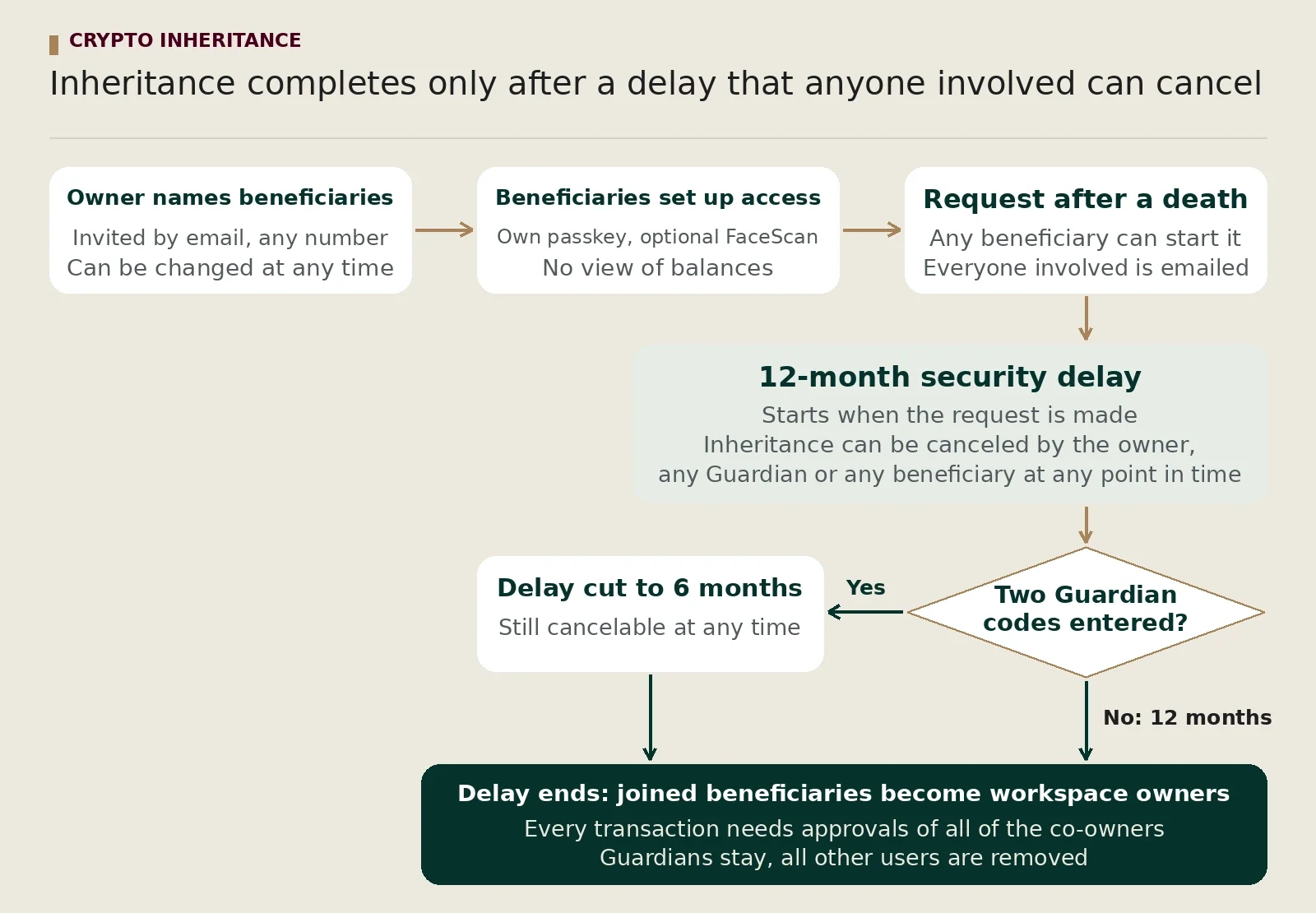
- The owner names beneficiaries. You invite as many beneficiaries as you wish by email from your workspace settings. They can be people with no other role, or people who already have access as an Owner, Member, Viewer or Guardian of your workspace. You can add or remove beneficiaries at any time, and anyone you remove is not notified (you can tell them yourself, or leave it unsaid if you would rather not strain the relationship).
- Each beneficiary sets up their own access. Each person accepts the invitation and creates a passkey, ideally stored in a cloud keychain so that it travels with them from device to device. As long as they keep their email account and their passkey (or can restore it with FaceScan), they stay in the plan. Until a request is made, a beneficiary sees no balances, no transactions and no list of other users. If multiple beneficiaries are appointed, they do not know of each other until they all join the inheritance process. Their interface only lets them start or join a request to inherit.
- After the owner passes away, a beneficiary requests access. Any beneficiary can sign in and request access. The owner and every Guardian and beneficiary are notified by email, and a mandatory security delay begins:
- 12 months by default, starting the moment the request is made.
- 6 months once they obtain recovery codes from two of the owner’s Guardians, the trusted contacts the owner appointed for account recovery, and enter them in Bron.
During the delay, other beneficiaries, and any co-owners of the workspace, can join the request. Only those who join become owners when it completes. The workspace keeps working as usual in the meantime, so positions that cannot wait, such as a loan that can be liquidated or tokens that must be claimed by a deadline, can still be handled. For that reason it helps to have more than one Owner, or at least a Member who can manage those positions.
- Safeguards for the owner and the family. The delay protects an owner who is alive but out of reach for a long time, for example in hospital, travelling without a connection or detained. The owner, any Guardian or any beneficiary can cancel the request at any time before it completes, and everyone is emailed when someone joins, when a request is canceled and seven days before the delay ends. A request against a living owner achieves nothing beyond a cancellation.
- When the delay ends. All previous users except Guardians are removed, and the beneficiaries who joined become the owners of the workspace. Accounts the owner hid behind a PIN do not stay hidden from them: hiding applies only to the person who set it, so the new owners see everything the workspace holds. If there is more than one co-owner, nobody can act alone: every transaction needs approval from all of the new owners. The new owners then restore signing access and decide together how to manage crypto assets: keep them in Bron or send them elsewhere.
Technical access, however, is not legal ownership. Becoming an owner of the workspace does not by itself make the cryptocurrency theirs: it is still part of the deceased owner’s estate, and the people named in Bron are not always the people entitled to inherit it under the will or local law. The estate may also have debts or taxes to settle first. Before moving anything, the new owners should speak to an attorney and, if the estate plan includes a trust, to its trustee, because coins moved before the estate is settled may have to be returned.
Bron’s inheritance does not replace your will or anything else in your estate plan. It is a technical mechanism that makes sure your assets reach the people you chose. What it does is give your will something it can actually point to.
A word on incapacity. Inheritance is designed for death, and a delay of six to twelve months is of no use to a family that needs access while you are alive but unable to act, after an accident or during a long illness, so plan for that separately. In Bron you can add a trusted person to your workspace as an Owner today and set approval rules so that transfers need sign-off from a second trusted person, such as another family member or an adviser added as a Viewer with approval rights. On the legal side, ask your lawyer about a power of attorney that explicitly covers digital assets for such a situation.
A word of caution: digital property your wallet does not show
Even the best mechanism can only pass on what it can see, and some of your crypto holdings may not show up in your wallet at all. When you connect your digital wallet to a decentralized exchange, deposit into a lending protocol, provide liquidity, stake through a third party or open a perpetual futures position, the assets may move into a smart contract. The app may show a receipt token or nothing at all, and family members who do not know the position exists will never think to close it. That is why it is important to keep an itemized inventory.
Build an inventory of your digital estate and online accounts
Estate planning for cryptocurrency starts with an inventory: a living document to ensure your heirs know what your estate consists of and where each part lives. It should never contain seed phrases or passwords, only enough for them to know the assets exist and whom to ask about them. A good inventory lists:
- Wallets: each one, its provider or device model, the networks it holds and the recovery method set up for it.
- DeFi and other on-chain positions: the protocol, the network, the type of position (lending, liquidity, staking, perps) and the address that opened it. Keeping this part up to date can be tedious, but it pays off.
- Custodial accounts: each exchange, broker, ETF and neobank holding, with the email used for the account.
- Other digital accounts: email, cloud storage and your password manager, because heirs often need to access your online accounts to find everything else.
- People: your executor, any digital executor (if appointed), your Guardians and your beneficiaries, with their contact details.
Keep the inventory with your estate documents and refer to it in the instructions in your estate plan. Update it whenever you open or close a position, and make sure the person handling your estate knows where it is.
Some estate planners suggest that clients with significant digital assets also name a digital executor: a person comfortable with technology who handles the digital part of the estate alongside the executor named in the will. Naming a digital executor in Bron is easy: add them to your workspace as a Viewer with view-only access, and they will always be on top of your assets.
Digital estate planning checklist for crypto
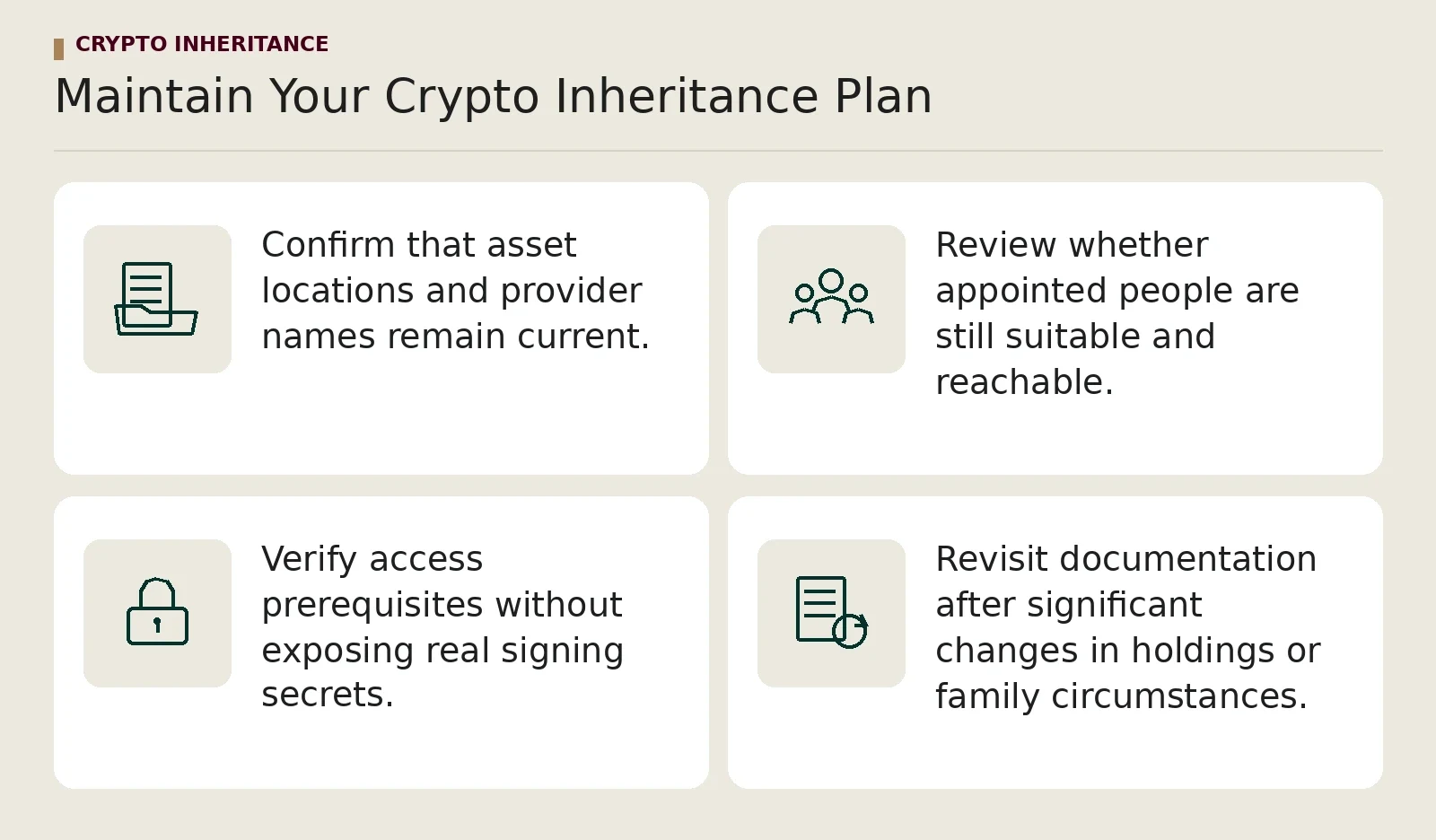
Use these eight steps to bring your plan up to date.
- List what you hold. Every wallet, exchange account, ETF position and DeFi position, without any keys or login details.
- Decide who inherits, and put it in your estate plan. Make sure your will, trust and other estate planning documents include digital assets.
- Give each account an access path. Custodial accounts follow the provider’s death-claim process; self-custody needs a recovery or succession mechanism set up while you are alive.
- Retire single points of failure. If significant crypto still depends on one seed phrase, consider moving it somewhere access can be recovered and inherited. Bron is built for exactly that.
- Invite your beneficiaries and check that they have activated their access.
- Tell people their roles. Your executor, your Guardians and the people you named should each know what they may be asked to do.
- Write the inventory and store it safely.
- Review once a year and after any major life event.
What heirs should do in the first weeks after a death
If you are the one inheriting, there is rarely a reason to hurry: coins on a blockchain do not expire, while mistakes made in the first days can be permanent. A sensible order of work is:
- Find the inventory and the will. Look for the inventory, the will and any letter of instructions, and share what you find with the executor.
- Keep every device safe and unchanged. Store phones, laptops and hardware wallets somewhere secure, and do not reset or wipe them: a hardware wallet that is reset without its seed phrase is lost for good.
- Never type a seed phrase into a website or an app someone sent you. If you find one, use it only with the wallet it belongs to, ideally with someone experienced beside you.
- Contact each custodian. Exchanges, brokers and banks will ask for the death certificate, probate documents and ID. Let the executor lead, and do not rush the transfer of crypto into your own accounts until it is clear who receives what.
- Start or join the wallet’s inheritance process. In Bron, sign in and request access or join a request already started, then contact the Guardians for their codes to shorten the delay to six months. Agree with the other beneficiaries that everyone joins before the delay ends.
- Check positions that need attention. Loans and leveraged positions can be liquidated if prices move. If the wallet has other Owners or Members, they can close them while the delay runs; otherwise ask the executor or an adviser before unwinding anything.
- Record values on the date of death. They are needed for estate tax purposes and, in the US, generally become the heir’s cost basis.
A warning about fake recovery services. Grieving families are an easy target. Websites, search ads and social media accounts offering to “recover” a relative’s crypto usually want either an upfront fee or the seed phrase itself, and the FBI has warned about fake firms that approach people who have lost crypto with promises to get it back. No wallet provider or exchange will ever ask you for a seed phrase. Treat any unsolicited offer of help as a scam, and if the wallet has an inheritance process, start it from the provider’s own app or from a website address you type in yourself.
Frequently asked questions
What happens to your bitcoin and other cryptocurrencies when you die?
What happens to your assets at death depends on how they are held. The coins themselves stay on the blockchain at the same addresses. Custodial holdings pass through the provider’s process and, usually, probate. Coins you hold yourself stay where they are and can be moved only by someone who has the key or a recovery path set up in advance. If nobody does, they are lost. Make sure you use a wallet with a clear inheritance process, and name your beneficiaries in advance.
Can heirs access a crypto wallet without the seed phrase or private key?
For a standard seed-phrase wallet, no. Without the words, or the device and its PIN, nobody can recover the funds, including the company that made it. Setups built on MPC or multisig can offer recovery and succession paths that do not depend on a seed phrase, provided they were configured while the owner was alive.
Can an executor or a court order unlock a non-custodial wallet?
No. An executor can claim custodial accounts with the right documents, and rules such as RUFADAA help fiduciaries request access from online service providers. But no court can produce a private key, and self-custody has no custodian to receive and comply with the order.
How do I pass cryptocurrency to my heirs without sharing my seed phrase?
Use a wallet with a built-in inheritance process, where the people you name set up their own access in advance, and a security delay and a well-thought-out process with Guardians protect you while you are alive. A collaborative multisig is also a viable option, but it requires a lot of technical knowledge.
Do heirs pay estate tax on inherited crypto?
It depends on the country. In the United States, the IRS treats bitcoin as property, like other digital assets, for tax purposes, and inherited property is generally valued at its fair market value on the date of death. Federal estate tax applies only to estates above the estate tax exemption, which is $15 million per person in 2026. Other countries have their own inheritance tax rules.
Does crypto go through probate?
Cryptocurrency you own in your own name is generally part of your estate and may go through probate, unless it is held in a trust or passes another way. Probate gives legal authority over custodial accounts, but it cannot give anyone technical access to self-custodied coins. That still depends on the plan you put in place.
How often should I update my crypto inheritance plan?
Review it at least once a year and after any major life event: a marriage, a divorce, a birth, a move abroad or a large new position. Updating your estate plan and your inventory at the same time keeps the two consistent.
Disclaimer:
This article is for general informational purposes only and is not legal, tax, estate-planning, or financial advice. Bron is self-custodial software: it does not take custody of, hold, control, or access user assets or private keys. Digital inheritance and recovery are software features the user configures and controls; Bron does not act as an executor, trustee, or fiduciary and does not itself transfer or distribute assets — any recovery or inheritance process is carried out by the beneficiaries and guardians the user designates.