


What Is Crypto Treasury Management? A 2026 Guide for CFOs and Finance Teams
Crypto treasury management for CFOs: custody, approvals, reporting, liquidity and yield, plus best practices and treasury management systems compared.
- Author
-
 Dmitry Tokarev
- Published
- Share

Crypto treasury management is the discipline of holding, moving, recording and safeguarding a company’s digital assets, from USDT and USDC to bitcoin, with the same controls a finance team applies to cash in the bank. The principles are the ones every treasurer already knows: keep the money safe, keep enough liquidity to meet obligations, control who can move funds, and report every movement accurately. The difference is that a public network offers none of the safeguards a bank provides, so those controls have to be built into the company’s own setup.
In this guide, we compare crypto and traditional treasury and explain when regulated custody is worth its cost. We show how a non-custodial platform built on multi-party computation (MPC) gives a small or mid-sized business the same controls for a fraction of the price, and walk through the five parts of a complete setup: custody and wallets, policy and approvals, accounting and reporting, payments, and yield on idle balances. We then cover risk management and compliance, compare seven business platforms side by side, and close with best practices and answers to the questions CFOs ask most often.
Crypto Treasury Management: Key Takeaways
- What it is: the familiar treasury functions (custody, liquidity, approvals and reporting) applied to digital assets held on public networks instead of in bank accounts.
- The rule that matters most: control of the keys is control of the money, so no single person, device or secret should be able to move company funds.
- A complete setup: custody and wallets, policy and approvals, accounting and reporting, payments, and yield on idle balances, backed by sanctions and AML screening and a tested exit plan.
- Who needs what: large and listed companies often need regulated custody; smaller businesses get bank-grade controls from a non-custodial MPC platform for a few thousand dollars a year.
- The honest caveat: no tool removes market, depeg or smart contract risk; your treasury policy and its limits decide how much risk the company takes.
Traditional treasury management vs crypto treasuries: what changes
A crypto treasury and a traditional one share the same goals, but the risks sit in different places. In the traditional financial system, a bank is a counterparty: when a US bank fails, the FDIC insures deposits only up to $250,000 per depositor, per bank and per ownership category, and anything above that becomes a claim on the failed bank’s assets unless regulators step in to cover it. The bank also absorbs a whole category of risk, because it verifies who is paying, recalls some errors and resets a forgotten password. On a public network, the keys are the money: a signed payment settles in minutes and cannot be recalled, and lost or stolen credentials can mean lost funds.
CFOs also rely on the controls banks provide, and their auditor expects to see them: dual signatures, multi-level approvals, payment limits and statements that drop straight into the books. For years, the crypto equivalent came only with institutional custody and enterprise platforms, priced in basis points on assets held or in contracts worth tens of thousands of dollars a year, so most small and mid-sized businesses were priced out. A large enterprise or a listed company may still need a regulated custodian, but a smaller business can now run the same approvals, limits and reporting on a non-custodial MPC platform, such as Bron, at a fraction of the cost, while staying in control of its assets.
The table below compares how the two models handle the same jobs, from where the money sits to what happens when a password is lost.
| Traditional treasury | Crypto treasury | |
|---|---|---|
| Where the money sits | Deposit account at a bank | Addresses on public networks, controlled by keys |
| Main structural risk | Bank failure (counterparty risk) | Lost, stolen or misused keys (key-person risk) |
| Lost credentials | Bank verifies identity and restores access | Funds can be lost for good unless the wallet has a recovery design |
| Approvals | Dual signatures and approval limits set at the bank | Enforced by the wallet’s policy engine, if it has one |
| Operating hours | Banking hours and cut-off times | 24/7/365; payments settle in minutes |
| Payment errors | Some can be recalled | Final once confirmed on the network |
| Statements | Monthly statements and bank feeds into the ERP | Exports from the wallet or a crypto accounting tool; balances can be checked on-chain in real time |
| Currencies and rails | One account per currency; SWIFT, SEPA, ACH | One asset can exist on several networks (USDT on Tron, Ethereum, Solana) |
| Deposit protection | FDIC up to $250,000 per depositor, per bank, per ownership category | None; protection comes from controls and custody design |
| Idle cash | Money market funds, sweeps, deposits | Tokenized Treasury funds, rewards programs, on-chain lending |
The comparison leads to one conclusion: compared with traditional treasury operations, the controls a bank used to provide have to be built into the company’s own setup, because nobody else will apply them after the fact.
Takeaway: map each control you rely on at your bank (dual approval, limits, statements, password reset) and confirm your crypto setup provides an equivalent before moving material balances on-chain.
Regulated custody or a non-custodial treasury management system?
The first decision in managing a crypto treasury is who holds the keys. There are two answers, and the right one depends on the company’s size, its obligations and its budget.
Regulated custody. A regulated custodian is a licensed trust company or bank that holds the keys on the client’s behalf, much as a securities custody bank holds shares. Listed companies, investment funds and other regulated financial services firms often need this route, because their boards, insurers or regulators expect assets to sit with a qualified institution. Its price reflects that level of assurance. Coinbase, for example, publishes an annualized custody fee of 50 basis points with a $500,000 minimum balance, plus an implementation fee of up to $10,000. At that rate, a $5 million treasury costs $25,000 a year to hold, before transfer and trading fees.
Non-custodial infrastructure. Here the company keeps control of its assets, and the vendor supplies the software: key management, approval policies, payments and reporting. Enterprise platforms such as Fireblocks sit at the top of this market, with custom plans starting at $36,000 a year. Below them, a newer group of MPC platforms built for small and medium sized businesses, including Bron and Zengo Business, offers comparable controls for roughly $2,500 to $10,000 a year (prices compared in the tools section below).
The non-custodial route has a second advantage beyond cost: the company’s assets are never on a provider’s balance sheet, so a vendor failure does not turn the company into a creditor. The trade-off is that the company carries more responsibility. The company must configure its own approvals and limits, and it should confirm, in writing, how it would recover its funds if the vendor stopped operating.
Takeaway: if a regulator or your board requires qualified custody, budget for it. If not, a non-custodial treasury management system gives a small or mid-sized business the same controls for a fraction of the cost, provided it checks the vendor’s recovery and exit design.
The five treasury functions of a complete digital asset treasury
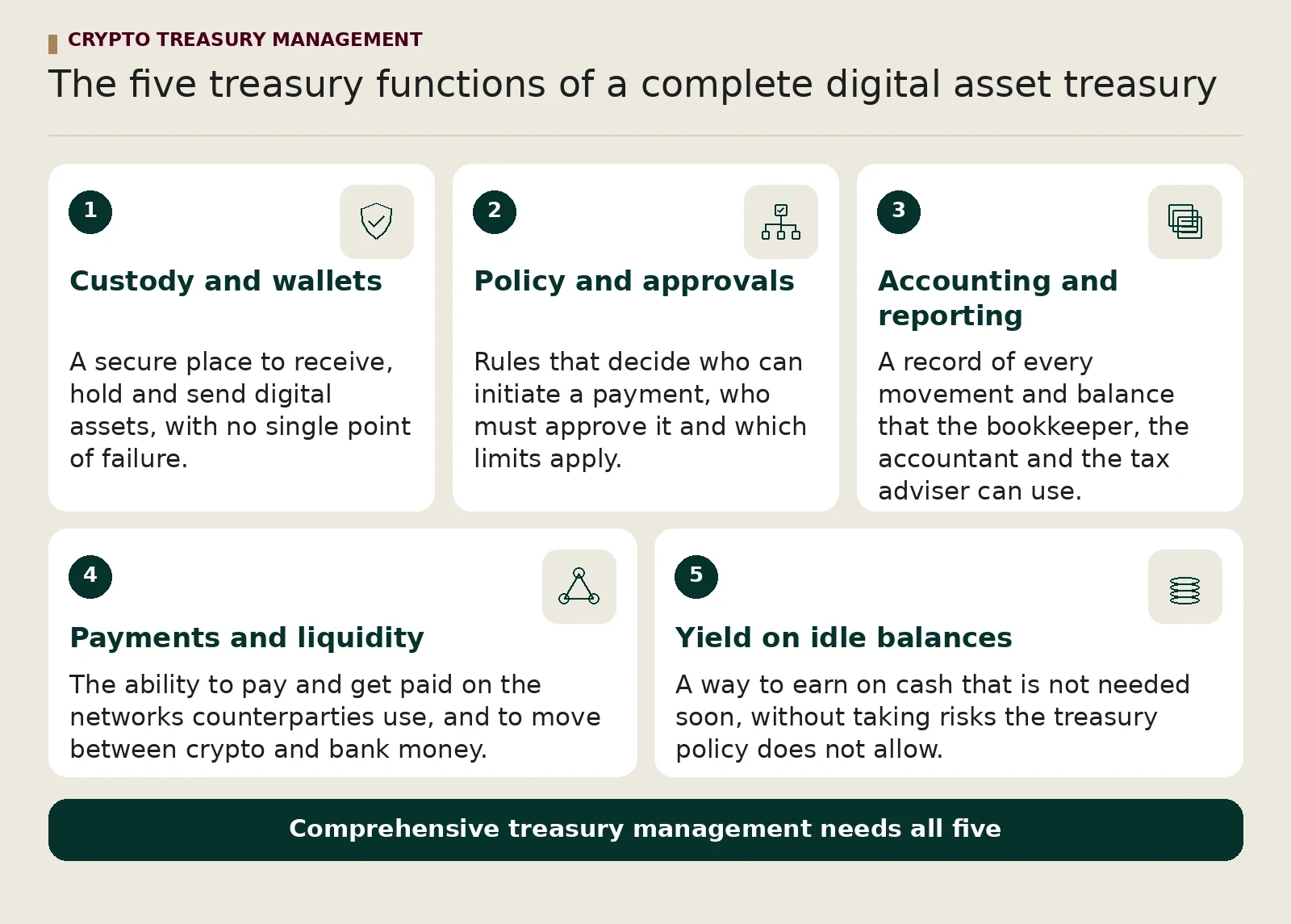
A business that needs to hold digital assets and move them on-chain needs five capabilities. Together they form a complete set for managing digital assets in a business; missing any one of them leaves a gap that finance teams usually end up filling with spreadsheets and manual checks.
- Custody and wallets: a secure place to receive, hold and send digital assets, with no single point of failure.
- Policy and approvals: rules that decide who can initiate a payment, who must approve it and which limits apply.
- Accounting and reporting: a record of every movement and balance that the bookkeeper, the accountant and the tax adviser can use.
- Payments and liquidity: the ability to pay and get paid on the networks counterparties use, and to move between crypto and bank money.
- Yield on idle balances: a way to earn on cash that is not needed soon, without taking risks the treasury policy does not allow.
Two disciplines run across all five: risk management and compliance (sanctions and anti-money-laundering screening), and business continuity (what happens if a key person leaves or the vendor disappears). Both are covered after the five parts.
Takeaway: use these five functions as a checklist when assessing any platform. Comprehensive treasury management needs all five, and a tool that covers only one or two will need others alongside it.
1. Custody and wallet infrastructure: removing key-person risk
Many small businesses start managing crypto the way individuals do, with a seed-phrase wallet: a browser extension or hardware device backed by 12 or 24 words that can regenerate the private key. For a company, this makes little sense. Whoever holds the seed phrase controls the money, with no approval, no limit and no record of who acted. That creates key-person risk by design: if the founder or CFO who holds the phrase leaves, loses it, falls ill or decides to walk away with the funds, nothing in the setup can stop it.
This risk is far from theoretical, as one well-known case shows. When Gerald Cotten, founder of the Canadian exchange QuadrigaCX, died in December 2018, he was reported to be the only person able to access its cold wallets. A later review by the Ontario Securities Commission found that most of the C$169 million shortfall owed to clients stemmed from his own fraud. One person with sole control produced both kinds of loss: inaccessible funds and misappropriated funds.
Writing the phrase down twice, or splitting it between two executives, does not solve the problem; it only creates more copies to steal. Two technologies remove the single point of failure:
- Multisig: a smart contract holds the funds and requires, say, two of three named signers to approve each payment. It is transparent and vendor-independent, but each network needs its own setup, and many popular options, such as Safe, work only on Ethereum and compatible networks.
- MPC: the key is created as separate shares on different devices or servers and is never assembled in one place; the shares sign jointly. Because the result is a standard signature, the same approval rules can apply across Bitcoin, Ethereum, Tron, Solana and other networks.
Until recently, MPC came mainly from institutional platforms with institutional price tags. Today, MPC crypto wallets built for small and medium sized businesses, such as Zengo Business and Bron, offer the same model on monthly plans. In Bron’s case, the key is split into three shares held on the user’s device, by Bron and by Qrypt, an independent recovery partner that works solely for the customer, and any two are needed to sign.
Takeaway: retire any seed phrase that one person controls. Require at least two independent parties for every signature, and confirm that a lost phone can be replaced without changing the company’s addresses.
2. Policy, approvals and workflow: the four-eyes principle on-chain
Secure custody answers the question “can anyone steal the keys?”. Policy answers the harder one: “who is allowed to use them, and for what?” The minimum standard is the four-eyes principle familiar from any bank mandate: no payment leaves the company on one person’s decision.
In practice, the best workflow mirrors a well-run accounts payable desk. A junior team member, the maker, prepares payments: enters recipients, amounts and networks, and attaches the invoice reference. A senior person, the checker, reviews and approves them. Large or unusual payments go to the owner or a second executive. Because an MPC platform enforces these rules before a signature is produced, they cannot be skipped by someone in a hurry.
An illustrative approval matrix for a small company might look like this:
| Payment | Prepared by | Approved by | Extra control |
|---|---|---|---|
| Up to $10,000 to a saved address | Finance associate | Finance manager or CFO | Payments only to the address book |
| $10,000 to $100,000 | Finance associate | CFO plus one other approver | Daily cumulative limit |
| Above $100,000 | Finance associate | CFO and owner | Time delay before signing |
| First payment to a new address | Anyone | Two approvers | 48-hour hold on new addresses |
| Changes to users, limits or the address book | Owner | Majority of owners | Nobody approves their own request |
The last row matters most and is the one most often missed. If a single administrator can add a user, raise a limit or whitelist a new address, every other control can be switched off by one compromised account. Platforms differ here: some, such as Bron, Fireblocks and Utila, can put changes to the rules themselves behind a quorum, while others rely on a single admin.
Takeaway: write your approval matrix before you choose a platform, then check that the platform can enforce every row of it, including approvals for changes to the rules.
3. Accounting, reporting and visibility
A blockchain explorer shows that 48,500 USDT moved from one address to another. It does not show that the payment settled invoice INV-1147 for a software vendor, net of a credit note. Six months later, nobody will remember what it was for. That is why the simplest reporting feature is also the most valuable: a note attached to every transaction at the moment it is created, and exported with it.
In practice, finance teams need three things from the platform:
- Notes on every transaction: a free-text field on each incoming and outgoing payment, filled in when the payment is made and carried into every export. Many wallets still lack it; in our comparison below, Safe and Ledger Multisig have none. Yet it is the cheapest reconciliation tool there is: the note tells the accountant which invoice, contract or payroll run a payment belongs to, so nobody has to reconstruct it from memory or chase colleagues months later.
- Balances: holdings per account, asset and network at any chosen date, valued in dollars. This is what goes on the balance sheet. Under US GAAP, ASU 2023-08 requires in-scope crypto assets to be measured at fair value at each reporting date, for fiscal years beginning after December 15, 2024, so period-end balances must be priced consistently.
- Transactions: every incoming and outgoing movement, with date, counterparty, amount, network fee, note and the dollar value at the time. This feeds the P&L, cost-basis records and tax filings.
With notes and these two exports, reconciliation (matching the wallet’s records to the general ledger so that every balance and movement agrees) becomes a routine month-end task rather than a forensic exercise. No specialist integration is needed to get the data into the books: a clean Excel export can be handed to an AI assistant, which maps each line to the chart of accounts and prepares journal entries in the format that the company’s ERP (the enterprise resource planning system where it keeps its books) can import.
Two access features complete the picture. A view-only role lets a bookkeeper or external accountant see everything and move nothing, which gives real-time visibility without adding signing risk. An activity log records which person prepared, approved and signed each payment, and when, which is the audit trail an external reviewer will ask for.
Takeaway: before committing to a platform, export a month of test data and ask your accountant whether the balance and transaction files can go straight into your books.
4. Payments and liquidity management across networks
The payments layer is where a crypto treasury either saves the finance team time or costs it hours every week, and five capabilities make the difference:
- Bulk transfers with built-in checks. Paying 40 contractors one by one invites mistakes. A better workflow, and one that streamlines every payment run, is to upload a pre-filled template with every recipient, asset, amount and network, and let the software check each line before anything is signed, flagging, for instance, a Tron address entered where Ethereum was selected. This matters because on-chain payments are final: in December 2025, one user lost $50 million in USDT after copying a look-alike address planted in their history, a scam known as address poisoning. Templates that draw recipients from a verified address book remove that copy-and-paste step.
- Batch signing, if you need it. Some platforms let an approver sign a whole batch in one step, which is essential for payment companies sending hundreds of payouts a day. For an ordinary business, approving each payment individually works perfectly well, especially when signing takes a fingerprint or Face ID.
- Every network your counterparties use. Customers and suppliers choose their own rails: some prefer USDT on Tron, where more USDT circulated than on Ethereum by mid-2026, according to Messari data; others pay on Ethereum or Solana, or in bitcoin. A treasury platform should receive and send on all of them and move funds between them with cross-chain swaps, for example USDT on Tron into USDC on Solana, without an exchange account.
- A bridge to the bank. Most companies still pay salaries, rent and taxes in fiat currency, so converting crypto revenue into dollars or euros and wiring it to the company’s own bank account, through a regulated third-party provider, is what turns a crypto balance into working capital. A company card that spends directly from a stablecoin balance goes one step further: subscriptions, advertising and travel are paid from crypto revenue without an off-ramp, under spend management controls such as per-user limits.
- Privacy for sensitive payments. On a public network, anyone can see what you pay a supplier or an employee. Confidential tokens built on the Zama Protocol’s ERC-7984 standard encrypt amounts and balances, while addresses stay visible and every transfer remains verifiable. That protects supplier terms and matters even more for payroll. Bron is among the first wallets to support them natively.
Cash and liquidity management should work as it does in fiat. Forecast payments for the next one to three months, keep that amount in liquid stablecoins on the networks you pay on, and only then decide what to do with the rest. A simple asset allocation by time horizon helps, and keeps a volatile asset class such as bitcoin away from money needed for payroll:
| Tier | Covers | Typical holding | Access |
|---|---|---|---|
| Operating | The next 30 to 90 days of payments | USDT and USDC on the networks you use | Immediate |
| Reserve | Three to 12 months of costs | Stablecoins or tokenized Treasury funds | Same day to a few days |
| Strategic | Board-approved long-term holdings | BTC or ETH, within set limits | Market-dependent |
Takeaway: test a bulk payment run on a small amount, confirm the platform flags wrong-network addresses, and size the operating tier from your forecast before putting any balance to work.
5. Yield on idle balances: investment management without new risks
In traditional cash management, surplus cash is swept into a money market fund overnight. In crypto, idle stablecoins earn nothing unless the treasury puts them to work, and the way it does so determines which new risks it takes on. The aim is to optimize returns without changing the treasury’s risk profile, and there are three main routes, from the safest to the riskiest:
- Tokenized US Treasury funds. These are tokens representing shares in funds that hold short-term US government debt, the on-chain equivalent of a government money market fund, issued by asset management firms such as BlackRock and Franklin Templeton. About $14 billion of them circulated on public networks in November 2026. The risk profile is closer to the T-bills underneath than to DeFi, although eligibility rules apply. Your provider should provide you access to these products, save for eligibility requirements: many of these are closed to US persons.
- Stablecoin rewards. Under the GENIUS Act, signed into US law on July 18, 2025, stablecoin issuers may not pay interest or yield to holders. Some platforms though have rewards programs funded by platforms and distributors themselves rather than by the issuer, so you still might be eligible to receive them.
- On-chain lending. In chase of the yield many platforms route stablecoins into lending protocols such as Morpho and Aave. It is the riskiest of the three routes: smart contract risk, the vault curator’s choice of borrowers and collateral, and liquidity risk, since withdrawals depend on cash that has not been lent out. Do your own research before choosing this option.
The best options keep the assets in the company’s own wallet and avoid adding smart contract risk to the treasury. Bron, for example, gives access to tokens providing exposure to US Treasury yield. It also runs a Stablecoin Rewards program with PayPal: USDT or USDC is swapped into PYUSD, rewards are paid daily in PYUSD, and the funds are not deposited into lending protocols.
Takeaway: put a written investment policy in place before chasing yield: which instruments are allowed, a cap per product and provider, and how much must stay available within a day.
Risk management and regulatory compliance in crypto treasury operations
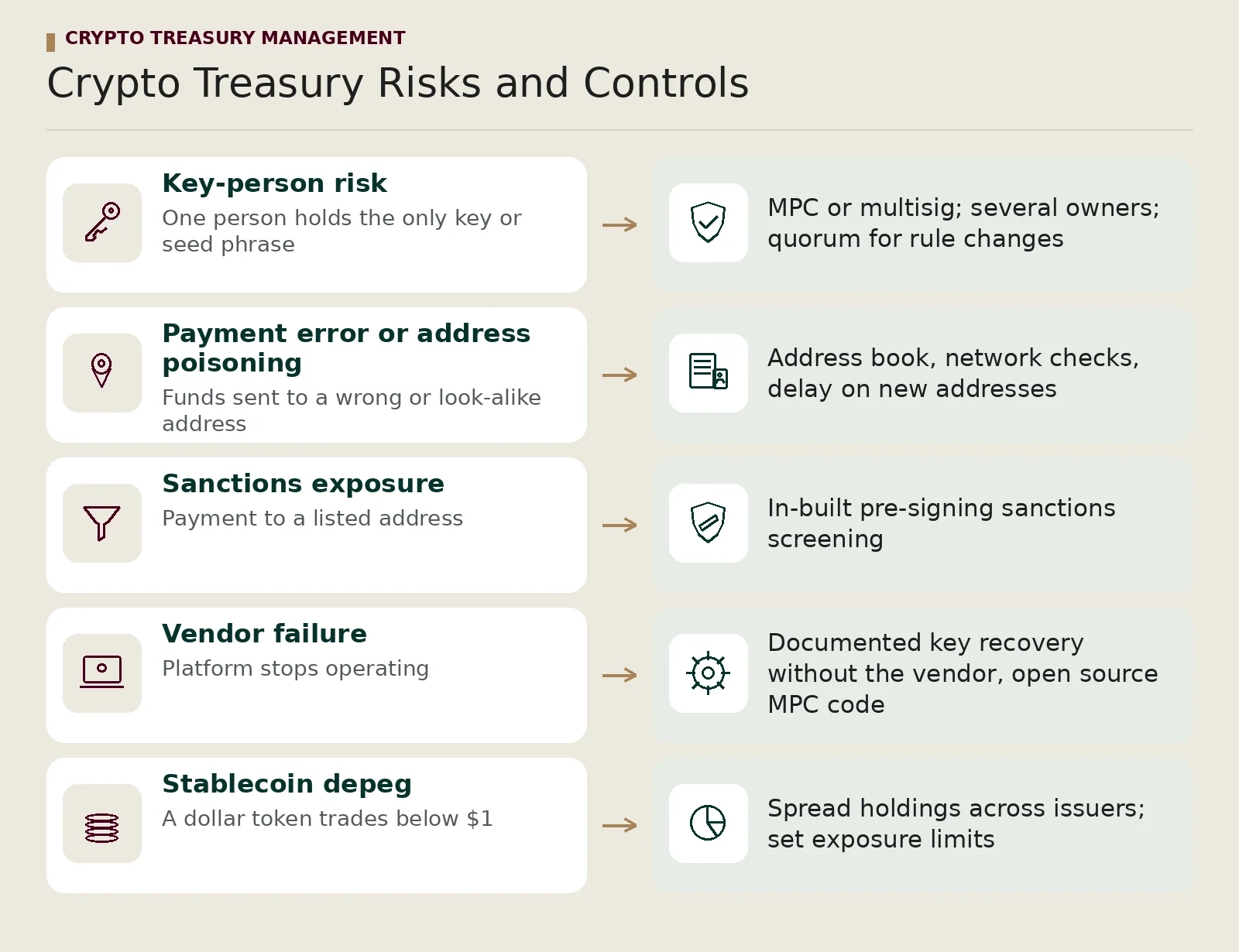
The five parts above handle day-to-day operations. Risk management protects the company’s financial stability when something goes wrong: a payment to the wrong party, a compromised device, a departing employee or a vendor that shuts down.
Sanctions and AML screening. US sanctions are a strict liability regime. In its guidance for the virtual currency industry, OFAC states that a company can be penalized for a prohibited payment even if it did not know the recipient was sanctioned. Since 2018, OFAC has listed specific crypto addresses on its Specially Designated Nationals (SDN) list, so a treasury should screen every recipient before a payment is signed. Anti-money-laundering (AML) screening goes further: it scores counterparties and incoming funds for exposure to mixers, scams, hacked funds and other illicit sources, so the company knows what it is receiving as well as what it is sending. Large organizations usually connect risk management tools such as Chainalysis, Elliptic or Hypernative to their custody platform, under their own contracts. Smaller ones need screening built in, because a separate analytics contract can cost more than the wallet.
Bron, for example, screens every recipient against the US OFAC SDN and UK sanctions lists before signing and stops a payment to a listed address. Through its integration with Hypernative, it also scores counterparties and incoming funds for AML risk and checks transactions for threats such as malicious contracts and phishing addresses before they are signed. A set number of checks is included in the Business plan, with additional checks available on a pay-as-you-go basis.
Business continuity. Two continuity questions deserve a written answer. First, what happens when a person leaves? The company should be able to remove a user, replace an owner and reassign approvals without a ticket to the vendor and without changing its addresses. Second, what happens if the vendor stops operating? With a well-designed non-custodial platform, the company can rebuild its keys and move its assets without the vendor’s help, and that exit should be fully documented and self-serve.
Market and depeg risk. Stablecoins are only as stable as their reserves and their issuer’s banking partners. In March 2023, USDC briefly traded as low as $0.87 after Circle disclosed that $3.3 billion of its reserves were held at Silicon Valley Bank. Holding dollar tokens from more than one issuer, such as USDT and USDC, limits that exposure.
The risk register below pairs each of the main risks with the control that addresses it.
| Risk | What it looks like | Control |
|---|---|---|
| Key-person risk | One person holds the only key or seed phrase | MPC or multisig; several owners; quorum for rule changes |
| Payment error or address poisoning | Funds sent to a wrong or look-alike address | Address book, network checks, delay on new addresses |
| Sanctions exposure | Payment to a listed address | In-built pre-signing sanctions screening |
| Tainted incoming funds | Customer pays from a hacked or mixed source | AML risk scoring of counterparties and deposits |
| Insider fraud | A user raises their own limit or adds an address | Separation of duties; nobody approves their own request |
| Vendor failure | Platform stops operating | Documented key recovery without the vendor, open source MPC code |
| Stablecoin depeg | A dollar token trades below $1 | Spread holdings across issuers; set exposure limits |
| Yield product loss | Smart contract exploit or curator failure | Investment policy caps; prefer instruments without smart contract risk and not leaving self custody |
Takeaway: turn this table into your risk register, name an owner for each row, and review it whenever the organization’s treasury adds a network, an asset or a new provider.
Crypto treasury management software: how the tools compare
No single category of crypto treasury management software does everything, so it helps to know what each type is built for before comparing products. Most small and mid-sized businesses need one platform that can unify custody, approvals, payments and reporting for their financial operations, plus an accountant who can work with its exports. Corporate treasury teams at larger organizations often combine several specialist tools and use APIs to automate workflows.
Treasury systems by type
The first table sets out the main types of system: who holds the keys, what each type typically costs, which businesses it suits and what to watch out for.
| Type | Who holds the keys | Examples | Typical annual cost | Best for | Watch out for |
|---|---|---|---|---|---|
| Seed-phrase wallet | Whoever holds the phrase | Browser extensions, hardware devices | Free to a few hundred dollars | Personal use, not company funds | Key-person risk; no approvals or activity record |
| Smart-contract multisig | The company’s named signers | Safe, Ledger Multisig | About $6,000 to $8,100 | Treasuries that operate only on Ethereum and compatible networks | No Tron, Solana or bitcoin; one approval threshold for all payments |
| MPC platform for SMEs | Shares split between the company, the vendor and sometimes a recovery partner | Bron, Zengo Business | About $2,500 to $10,000 | Small teams that hold and pay in USDT and USDC | Depth of approval rules; documented exit without the vendor |
| Institutional MPC platform | Shares split between the company and the vendor | Fireblocks, Utila, Fordefi | About $9,600 to $36,000 or more | Payment companies, exchanges, large finance teams | Sales-led onboarding, annual contracts, paid add-ons |
| Regulated custody | A licensed custody provider | Coinbase Custody, BitGo, Anchorage Digital | Basis points on assets held, with minimums | Listed companies, funds, regulated entities | Cost at scale; slower withdrawals |
Business platforms compared across the five functions
In the two tables below, we compare seven non-custodial platforms that businesses use for crypto treasuries, based on each vendor’s documentation as of November 2026. Prices are for a reference company with five users and about $1 million a month of outgoing payments, on each vendor’s entry plan.
Custody, controls and continuity
| Platform | Key model | Approval rules | Reporting | Exit without the vendor | Annual price |
|---|---|---|---|---|---|
| Bron | 2-of-3 MPC: device, Bron, Qrypt | Quorums; rules by amount, account, destination and initiator; quorum for rule changes; several owners | Excel exports of transactions and daily balances; notes on every payment; activity log; no SSO yet | Offline key recovery with Qrypt’s share, on every plan | $2,500 (billed annually), free if only 3 or less users are needed |
| Fireblocks | MPC, three shares | Full policy engine and admin quorum; one Owner per workspace | Accounting integrations, SSO, full API | Open-source recovery utility; Owner changes go through support | About $28,000 on Essentials (up to six months), then from $36,000 |
| Utila | Two-party MPC | Full policy engine with admin quorum | Exports, accounting integrations, activity log; no SSO | Recovery package usable without Utila | From $9,588 (three users) |
| Fordefi | Two-party MPC | Full policy engine with admin quorum | Exports, accounting integration, SSO | Offline recovery tool | About $18,000 (indicative) |
| Zengo Business | Two-party MPC | One or two approvers by amount; a single Admin | Exports and reports; Google Workspace sign-in | Independent escrow releases Zengo’s key share if Zengo shuts down; not confirmed for Business accounts | About $10,000 (indicative) |
| Safe | Smart-contract multisig | One threshold per account; spending limits | Exports; no notes | Built in: contracts work without Safe | About $8,100 |
| Ledger Multisig | Safe contracts signed on Ledger devices | Signer threshold only | History via API only | Built in: contracts work without Ledger | About $6,900 incl. devices |
Payments, bank rails and screening
| Platform | Bulk payments | Networks and swaps | Bank rails | Sanctions and AML screening | Confidential payments |
|---|---|---|---|---|---|
| Bron | Upload from a template with network checks; each payment signed with biometrics | Swaps across Ethereum, Tron and Solana; buys BTC, ETH and SOL | USD and EUR through Noah | Built-in sanctions screening; AML scoring and pre-signing checks through Hypernative | Yes: confidential USDT and other ERC-7984 tokens on Ethereum, via Zama |
| Fireblocks | Batch payouts through the API | All major routes through connected exchange partners; settlement with counterparties on the Fireblocks Network | Through Bridge, OpenPayd and others | Built-in OFAC screening; AML through the customer’s own provider (paid add-on) | None |
| Utila | Batch approved and signed once; recipients entered by hand | Swaps and bridges across EVM networks, Tron, Bitcoin and Solana | USD through Bridge | Through the customer’s own Chainalysis, Elliptic or TRM contract | Confidential yield vaults via Zama announced; payments not documented |
| Fordefi | No file upload | Cross-chain swaps on EVM networks only | None | Built-in OFAC screening; Chainalysis on the customer’s key | None |
| Zengo Business | Batch uploads, no batch signing | In-app swaps through third parties | Company IBAN in USD and EUR | None documented | None |
| Safe | Batches signed as one | Ethereum and compatible networks only | None | Safe Shield risk checks | None |
| Ledger Multisig | Batching through the API | Five EVM networks | None | No sanctions screening | None |
Yield options change quickly and are not shown in the tables. Fireblocks offers on-chain lending through its Earn product; Bron offers tokenized Treasury exposure and Stablecoin Rewards through its program with PayPal; check each vendor’s current terms and eligibility.
Takeaway: shortlist by type first, then compare two or three platforms on the management capabilities your business uses every week, and confirm the price for your own number of users and payment volume.
Best practices for crypto treasury management in 2026
The practices below turn the sections above into working treasury workflows. Most can be put in place in the first month.
- Write a treasury policy first. Define approved assets and networks, the approval matrix, limits, investment rules and who owns each decision. Have the board or owners sign it.
- Remove every single point of failure. No seed phrase held by one person, several owners on the account, and a quorum for changes to users, limits and the address book.
- Separate duties. Makers prepare payments, checkers approve them, and nobody approves their own request.
- Pay only to verified addresses. Use an address book, hold first payments to new addresses, and confirm new details through a second channel, never by copying from transaction history.
- Screen before you sign. Check every recipient against sanctions lists and score counterparties and incoming funds for AML risk.
- Annotate everything. Add a note to each payment at the time it is made and export balances and transactions every month.
- Reconcile monthly. Match wallet exports to the general ledger and the ERP, and investigate every difference.
- Forecast cash flow and size the operating balance. Keep the next one to three months of payments liquid, on the networks you pay on.
- Diversify across issuers. Hold dollar tokens from more than one issuer, such as USDT and USDC, with written limits.
- Earn only within policy. Prefer instruments whose risks you can explain to the board, cap each product and provider, and keep a portion available within a day.
- Test recovery and exit. Replace a device, remove a user and run the vendor-exit procedure on a small balance before trusting the setup with large amounts.
- Review quarterly. Revisit limits, users, networks and providers, and update the risk register.
Takeaway: if you do only three things this quarter, make them your top treasury management priorities: remove single-person control, enforce the four-eyes principle, and start a monthly export and reconciliation routine.
Frequently asked questions
What is crypto treasury management?
Crypto treasury management involves overseeing a company’s digital assets with the same disciplines as a traditional treasury: safe custody, liquidity planning, payment approvals, accounting and risk controls. The difference is that the controls a bank normally provides must be built into the company’s own setup.
Does a small business need regulated custody?
Usually not. Regulated asset custody is typically required for listed companies, funds and other regulated financial institutions. A small or mid-sized business can get bank-style controls, including multi-person approvals and full reporting, from a non-custodial MPC platform at a much lower cost.
What is the best crypto treasury management setup for a small business?
For most small teams, the best crypto treasury management setup is one MPC platform with a real policy engine, an address book, bulk payments, exports for the accountant, sanctions and AML screening, and a bank on-ramp and off-ramp. Add a crypto accounting subledger only when transaction volume makes manual bookkeeping impractical.
What is the difference between an MPC wallet and a multisig wallet?
A multisig is a smart contract that requires several signatures on-chain, so its rules are visible and vendor-independent but must be set up network by network. An MPC wallet splits one key into shares that sign together off-chain, which works on almost any network and lets one set of approval rules cover all of them.
How should crypto assets be accounted for?
Under US GAAP, ASU 2023-08 requires in-scope crypto assets to be measured at fair value, with changes recognized in net income. In practice, that means dollar-valued balance snapshots at each period end, a complete transaction history with notes, and a clean feed into the ERP. Other frameworks, such as IFRS, treat crypto differently, so confirm the approach with your accounting firm.
Can a company pay suppliers and staff in stablecoins?
Yes. Many web3 companies and other businesses use stablecoins for cross-border invoices, contractor payouts and payroll, because settlement takes minutes and works across currency borders. Treat it like your other payment processes: match each payment to an invoice, require approvals and keep the records. One caveat is privacy: on a public network, salaries and supplier prices are visible to anyone. Confidential tokens, which Bron supports natively, encrypt the amounts while keeping every transfer verifiable.
Do we need one comprehensive platform or several tools?
A comprehensive platform that unifies custody, approvals, payments and reporting is simpler to run and easier to control, and it is usually enough for small and mid-sized businesses. Large organizations with a complex treasury and many financial flows often add specialist treasury tools, such as a subledger or a dedicated payments provider, on top of their main treasury management platform.
How can we earn on idle stablecoins without taking on DeFi risk?
Look for options that keep assets in the company’s own account and do not route them into lending protocols, such as tokenized Treasury funds or stablecoin rewards programs funded by different platforms. Check eligibility, redemption times and who pays the return before allocating, and cap each product in your investment policy.
What happens to our funds if the platform provider shuts down?
With a well-designed non-custodial platform, the company can rebuild its keys and withdraw its assets without the provider. Ask for the documented exit procedure, confirm it is available on your plan, and test it on a small balance.
Sources
- Ontario Securities Commission, QuadrigaCX: A Review by Staff of the Ontario Securities Commission (2020); see also CBC News, June 11, 2020.
- FDIC, Understanding Deposit Insurance.
- Federal Reserve, In the Shadow of Bank Runs: Lessons from the Silicon Valley Bank Failure and Its Impact on Stablecoins, FEDS Notes, December 17, 2025; CNBC, March 11, 2023.
- Deloitte, FASB Issues Final Standard on Crypto Assets (ASU 2023-08), December 2023; KPMG.
- US Treasury OFAC, Sanctions Compliance Guidance for the Virtual Currency Industry, October 2021.
- Mayer Brown, GENIUS Act Signed into Law, July 18, 2025; Debevoise & Plimpton, July 21, 2025.
- Cointelegraph, Fireblocks launches tool for institutions to earn yield on stablecoins, April 15, 2026.
- rwa.xyz, Tokenized US Treasury Funds dashboard, accessed November 2026.
- Cointelegraph, Address poisoning: how a copy-paste mistake cost a user $50M in USDT, December 2025.
- Crypto Briefing, TRON reports $88B in circulating USDT for Q2 (Messari data), 2026; crypto.news, Q3 2026.
- Hypernative, AML and sanctions compliance.
- Rain, Corporate cards.
- Zama, The End of the Open Book: Zama and Bron Execute the First Confidential Payroll on Ethereum Mainnet, 2026; DefiLlama Research, A Look Into Confidential DeFi, 2026.
- Vendor documentation and pricing pages (not linked): Coinbase Custody pricing; Fireblocks, Utila, Fordefi, Zengo Business, Safe and Ledger Multisig product, help-center and pricing pages, reviewed November 2026.
Disclaimer:
This article is provided for general informational purposes only and does not constitute financial, investment, accounting, tax, or legal advice. Bron is a self-custodial software wallet; it does not provide tax, accounting, legal, or compliance services, does not determine whether any transaction is reportable, and does not guarantee that reports or exports are complete, accurate, or sufficient for any particular regulatory or tax purpose. Users remain solely responsible for understanding and meeting their applicable legal and tax obligations, verifying all data and outputs, and consulting qualified professionals as appropriate.