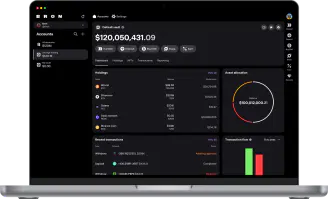



Best Multisig Wallets for Businesses 2026: Choosing a Multi Signature Business Wallet for Your Bitcoin and Crypto Use Case
Top multisig wallets for business in 2026 compared on signing policy, bitcoin and crypto support, recovery and cost, and when MPC is the better pick.
- Author
-
 Dmitry Tokarev
- Published
- Share

A multi signature business wallet exists to solve one problem: no single person, device or password should be able to lose or move the company’s money. It requires several independent keys to approve each payment, so a lost laptop, a departing employee or a phished password stops being a disaster. In 2026 the same goal can also be reached with multi-party computation (MPC), which removes the single secret without handing the team several seed phrases to guard.
This guide explains what multisig wallets for business do well and where they struggle, why MPC has become the modern alternative, and how seven multisignature wallets compare: Casa, Safe, Unchained, BitGo, Squads, Nunchuk and Ledger Enterprise Multisig, each with a verdict and November 2026 prices.
Multi Signature Business Wallet in 2026
- A multisig wallet needs M of N independent keys, for example 2-of-3, to approve a payment, so no one key holder can lose or move funds alone.
- The real goal is no single point of failure: multisig gets there with several full keys, MPC with one key split into shares that never meet.
- Decide by chain and governance: Casa for BTC plus stablecoins, Safe for EVM treasuries, Unchained for BTC-only firms, BitGo for institutions, Squads for Solana.
- The caveat: multisig multiplies the backups to protect and does not stop signers approving a manipulated transfer, as the $1.5 billion Bybit theft showed.
- For multichain treasuries that want detailed approval rules and no seed phrases, MPC wallets are usually the better fit.
- Below: a selection checklist, seven reviews with verdicts, side-by-side tables, setup steps and best practices.
Why Businesses Use a Multisig Wallet Instead of Single-Key Wallets
A single-signature wallet, the model behind most traditional crypto wallets, is controlled by one private key, the secret string of letters and numbers that authorizes every transfer. Whoever holds it can move everything, and if it disappears, nobody can. For a company that is three risks in one: the secret can be lost with a person or device, stolen by an attacker, or misused by an insider.
Shared control removes that single point of failure: the business keeps working when one person or device fails, and nobody can act alone. Multisig is one way to get there; multi-party computation is the other, and some MPC products, such as an MPC wallet designed to be impossible to lose, go further: one setup works across most blockchains, with no seed phrase or single secret that can be lost. We compare the two approaches further down.
Sole control is not only a loss risk. When the Canadian exchange QuadrigaCX collapsed after its founder’s death in December 2018, more than 76,000 clients were owed C$215 million. The Ontario Securities Commission later found that he had run the platform alone since 2016 and that most of the C$169 million shortfall came from his own fraud. A second approver is designed to stop exactly that.
| Risk | One signer | 2-of-3 multisig | 2-of-3 MPC |
|---|---|---|---|
| A device or backup is lost | Funds are gone unless a copy exists | The other two signers still approve | The other two shares still sign, and a replacement share is issued |
| A secret is stolen | The attacker can drain the account | The attacker still needs a second signer | One share is useless alone, and a refresh retires it |
| An insider acts alone | Nothing prevents it | A second person must approve a transaction | One share cannot sign, and the policy engine requires a second approver |
| A signer leaves | Access may leave with them | The others replace that signer | Their share is revoked; address and funds stay put |
This is the four-eyes principle banks have used for decades, often set up as a maker-checker crypto wallet: one person prepares a payment, another approves it.
Verdict: any company holding more than petty cash in digital assets should remove the single secret. The real decision is which technology shares control best for its chains and team.
What Is a Multi-Signature Wallet and How Bitcoin Multisig Works
A multi-signature wallet, also written multi-sig wallet or simply multisig, is an account that needs several independent signatures before funds can move. Its rule is written as M-of-N: N keys exist and any M of them must sign. In a 2-of-3 multisig, any two of three signers can approve, so one can be lost or compromised without losing funds.
Each signer holds a full private key with its own backup, usually a seed phrase: 12 or 24 words that recreate the key on a new device. A 2-of-3 wallet therefore means three seed phrases, each kept in a different place. How the rule is enforced depends on the network:
| Network | How the rule is enforced | Typical products |
|---|---|---|
| Bitcoin | Native script, such as native SegWit multisig (P2WSH) or Taproot; a configuration file lists every cosigner’s public key | Casa, Unchained, Nunchuk, Electrum, Sparrow |
| Ethereum and EVM networks (Ethereum-compatible chains such as Base or Arbitrum) | A smart contract multisig deployed for each account | Safe, Ledger, Casa’s ETH vault |
| Solana | An on-chain program that acts as a shared account | Squads |
| Tron | Native account permissions: the owner or active permission lists several keys, each with a weight, and a signing threshold | BitGo; TRONSCAN permission settings |
Using hardware wallets as signers
In a business setup each signer normally uses a hardware wallet, an offline device that signs without exposing its secret to an internet-connected computer. Devices from two different makers add an extra layer of security against a flaw in one brand. Software wallets such as Electrum and Sparrow, both free desktop wallet apps, coordinate the signers and build each bitcoin transaction for the devices to sign.
Collaborative custody: when a provider holds one key
Many multisig solutions for companies are collaborative: the client holds most keys and the provider holds one, used for recovery or to co-sign within agreed rules. The provider cannot move funds alone but can help the team replace a lost signer. Casa, Unchained, Nunchuk’s paid plans and BitGo work this way.
Verdict: a multisig is several full keys enforced by the chain. That makes the rules transparent, but every signer, backup and network has to be managed on its own.
Where Multisig Struggles: Private Key Sprawl, Blockchain Fragmentation and Blind Signing
Multisig security is strong in theory, but seven weaknesses show up in daily operations:
- More secrets to guard. A 2-of-3 setup has three seed phrases, a 3-of-5 setup five, plus the wallet configuration file of each bitcoin wallet. Lose too many, or every copy of that file, and recovery becomes hard or impossible.
- One network at a time. Bitcoin, EVM networks, Tron and Solana each implement the rule differently, so a team holding BTC, USDT on Tron, USDC on Ethereum and USDC on Solana runs four setups with four sets of signers. Tron matters most for payments: it carries close to half of all USDT (47.6% at the end of June 2026, per Messari), yet among the seven products reviewed below only BitGo supports it.
- Signer changes happen on-chain. On Bitcoin, replacing a departed employee means building a new vault and moving the funds. Contract accounts can swap an owner in place, but each change is a paid transaction.
- Higher fees. Extra signatures and contract calls cost more than a single-signer transfer.
- Visible structure. The multisig structure, owners, thresholds and history sit on the public blockchain, showing anyone how a treasury is controlled.
- Coarse rules. The chain enforces one threshold; limits by amount, destination or time need add-on modules or the provider’s software.
- Blind signing. A threshold does not help if every signer approves the same manipulated transaction. In February 2025 attackers who had compromised a Safe{Wallet} developer’s machine injected code into its web interface, and Bybit’s signers approved a disguised transaction that drained about $1.5 billion from its Ethereum cold vault, roughly 44% of all funds stolen that year according to Chainalysis.
Verdict: the model is sound but held back by operations. Its costs grow with every network, signer and backup, and it still depends on what signers see.
Multisig vs MPC: Why MPC Wallets Win for Most Business Treasuries
Multi-party computation reaches the same goal from the other side. Instead of several full keys, there is one key whose signing power is split into shares when the account is created. A key share is a fragment that is useless on its own; the required shares sign together through a cryptographic protocol, the full key is never assembled, and the network sees one ordinary signature.
| Multisig | MPC | |
|---|---|---|
| What controls the funds | Several full private keys | One key split into shares that never meet |
| Backups to protect | One seed phrase per signer | Shares can be refreshed; many products need no seed phrase |
| Where approval rules live | An on-chain threshold | A policy engine: amounts, destinations, roles, delays |
| Network coverage | A separate setup per network | The same shares and rules on any network with standard signatures |
| Replacing a signer | New vault on Bitcoin, paid change on EVM | New shares are issued; address and funds stay put |
| Fees and privacy | Higher fees; owners and threshold visible | Single-signature fees; looks like any other address or signature |
| Transparency | Anyone can verify the rules on-chain | Depends on provider documentation and open code |
For a typical business, MPC wins on five counts:
- No seed phrases to store. Shares sit in device secure hardware and with recovery parties.
- One policy everywhere. The same approvers, limits and allowlists cover BTC, Ethereum, Solana and Tron.
- Staff changes without moving funds. Shares are re-issued while addresses and balances stay put.
- Finer governance. Rules by amount, asset, destination and initiator, plus time delays, come built in.
- Security and ease of use together. One signature per transfer, lower fees, and nothing on-chain reveals the control structure.
Multisig keeps two real advantages: anyone can verify its rules on-chain, and a do-it-yourself setup has no vendor in the loop. Ask any MPC vendor for audits, open code and a tested exit path. Multisig and MPC can also be combined: BitGo offers both on the same 2-of-3 model, and an MPC signer can be one owner of a Safe.
Best Self-Custody MPC Crypto Wallet Alternatives for Business in 2026
These four platforms use MPC, not multisig, so they are not part of the multisig ranking that follows. They are the usual shortlist for teams that want no single point of failure without managing several keys. They are listed alphabetically; details are as of November 2026.
| Provider | How shares are held | Best for | Main drawback | Entry price |
|---|---|---|---|---|
| Bron | 2-of-3: user device, Bron and Qrypt, an independent recovery partner; no seed phrase | Small teams running a stablecoin treasury on Ethereum, Tron and Solana | No batch signing, scheduled payments, per-customer deposit addresses at scale or SSO; not a licensed custodian | $250 a month for five members. Free if 3 or less users are required |
| Fireblocks | One client share, two Fireblocks shares; Fireblocks cannot sign alone | Payment firms and enterprises automating through an API | Sales-led; one workspace Owner, replaced through support | $999 a month for up to six months, then from $36,000 a year |
| Fordefi | Two-party: the user’s phone and Fordefi’s enclave | Primarily DeFi: trading teams and dApp users on EVM networks and Solana | No fiat rails; price not published | Quote-based |
| Utila | Two-party: the user’s device and Utila | Banks, fintechs and PSPs (payment service providers) wanting wide network coverage and independent recovery | 12-month term; no single sign-on (SSO) | $699 a month billed annually, three users |
Verdict: multisig is best for single-chain treasuries that value on-chain transparency, above all BTC-only holders. MPC is best for multichain businesses that want detailed approval policies and no seed phrases to manage.
How to Choose the Right Multisig Wallet for Your Business
If using a multisig wallet still fits, judge every candidate on eight points:
- Signing policy. The most common multisig configurations are 2-of-3 for small teams and 3-of-5 for larger ones. Avoid N-of-N, where one lost signer freezes everything.
- Who signs. Spread signers across people, devices and locations, and decide whether a provider holds a recovery key.
- Hardware wallet support. Check which devices work, whether brands can be mixed and whether each hardware device shows readable details.
- Recovery and exit. Confirm you can move funds without the provider, through open tools such as Sparrow, Caravan, BitGo’s Wallet Recovery Wizard or the Safe CLI.
- Multisig governance. Look for proposer, approver and viewer roles, spending limits, allowlists and time delays.
- Networks. Match the product to what you hold: Bitcoin only, EVM, Solana, Tron or several.
- Cost. Compare subscriptions, per-transaction fees and gas at your real volume.
- Evidence and support. Look for response times, audit logs, SOC 2 reports and published audits.
Verdict: start from the chains you hold and the approval rules you need; the brand comes last.
Best Multisig Wallets for Businesses in 2026, Reviewed
The order reflects fit for a typical small or mid-sized company; each verdict says who the product suits best.
1. Casa: Best for Companies Holding BTC and Stablecoins
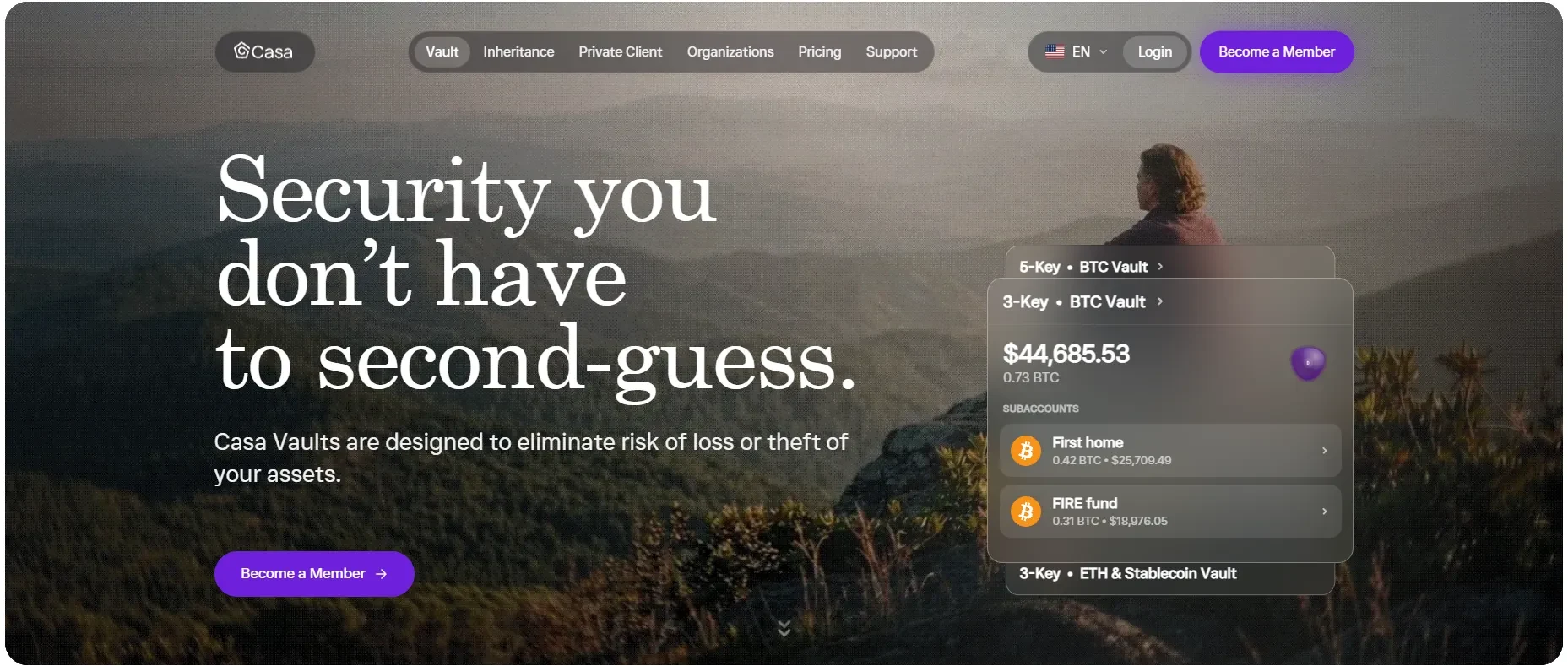
Casa runs collaborative multisig vaults in a polished app. Casa Business costs $2,750 a year: a 3-key vault with a recovery key held by Casa, multi-user access, team signing, view-only roles, dual approval for sensitive changes, a treasury dashboard and four subaccounts. Enterprise and Government plans, priced on request, add 5- or 6-key vaults, API access, audit logs and custom policies.
Vaults hold BTC, ETH, USDC and USDT. The ETH vault is built on a Safe contract, and Casa’s Sovereign Recovery lets clients move funds without Casa, using Sparrow or Electrum for BTC and Safe’s interface for ETH.
Best for: small and mid-sized companies holding BTC plus dollar stablecoins that want guided setup. Weakness: four assets only, stablecoins only on Ethereum, and advanced controls on custom plans.
2. Safe: Best Smart Contract Multisig for EVM Treasuries
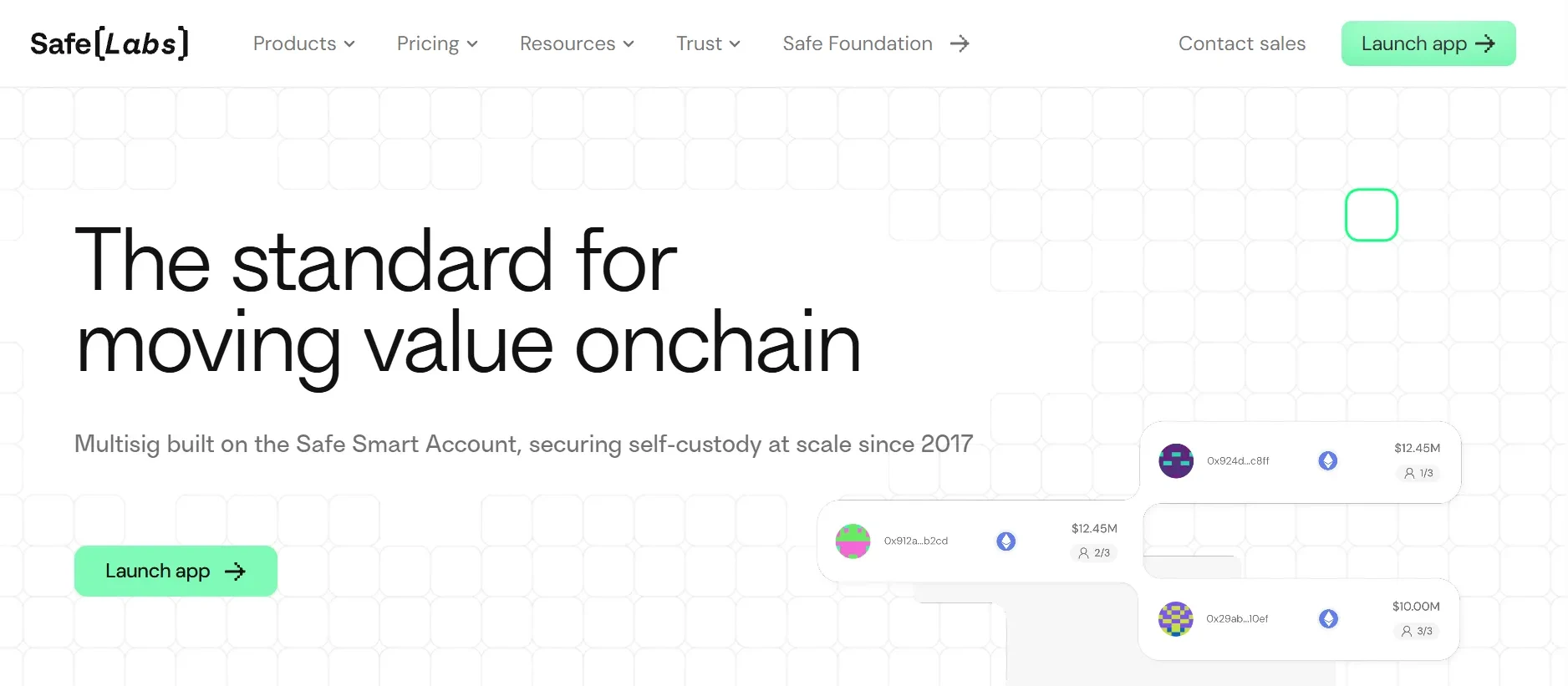
Safe, launched as Gnosis Safe in 2017, is the reference among smart contract wallets on Ethereum, citing more than $60 billion in assets, 40+ networks and 18+ audits. Owners are replaced by threshold without changing the address, and the contracts work through any interface or the open-source CLI.
Safe{Wallet} is free apart from gas. Safe Pro, launched in October 2026, adds the organizational layer: Starter at €189 a month for two accounts and Business from €669 a month for 5 to 20 accounts, with policies, proposers and priority support. Safe Shield checks transactions before signing.
Best for: EVM treasuries, foundations and protocol teams that want rules anyone can verify. Weakness: no Bitcoin, Solana or Tron, and the Bybit attack showed a compromised interface can still fool signers.
3. Unchained: Best Bitcoin Multisig Wallet for Treasury Reserves

Unchained gives businesses, trusts and family offices a 2-of-3 vault: the company holds two keys and Unchained one, which can co-sign if a device is out of reach. Permissions can be set for signers and auditors, a departing employee is swapped out while vault history stays, and the open-source Caravan coordinator lets clients spend without Unchained.
Vaults cost $250 a year each. Signature for Business, at $7,500 a year, adds up to 10 vaults, four hardware devices, dedicated account management, approval quorums and lower trading fees.
Best for: companies holding BTC as a long-term treasury reserve. Weakness: Bitcoin only, and approval quorums sit on the top tier.
4. BitGo: Best for Institutions Needing Multisig and Custody
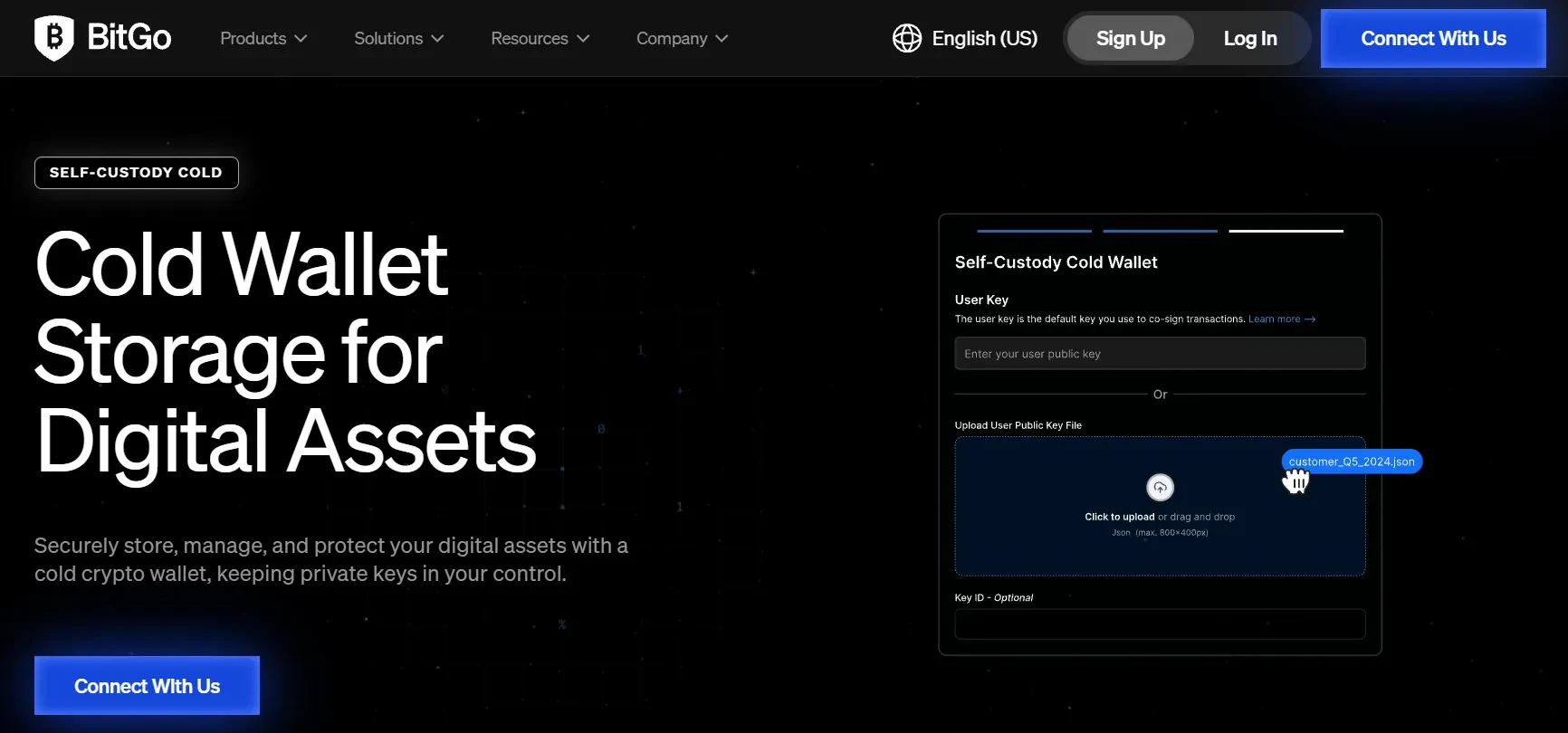
BitGo, founded in 2013, pioneered institutional multi-signature custody. Every account uses three private keys: user, backup and BitGo. In self-custody the client holds the user and backup keys, and BitGo co-signs only after policy checks such as whitelists, velocity limits, roles and multi-user approvals. Its Wallet Recovery Wizard moves funds with the client’s two keys without BitGo. The platform supports 1,700+ assets, including TRX and TRC-20 tokens such as USDT on Tron, and offers MPC as well.
Its trust company became BitGo Bank & Trust, N.A., an OCC-chartered national trust bank, in December 2025, and the group listed on the New York Stock Exchange in January 2026. Pricing is set by contract.
Best for: exchanges, funds and fintechs that want API-driven self-custody with a regulated custody option. Weakness: sales-led, priced for institutions, and its insurance does not cover self-managed accounts.
5. Squads: Best Multisig for Solana Teams
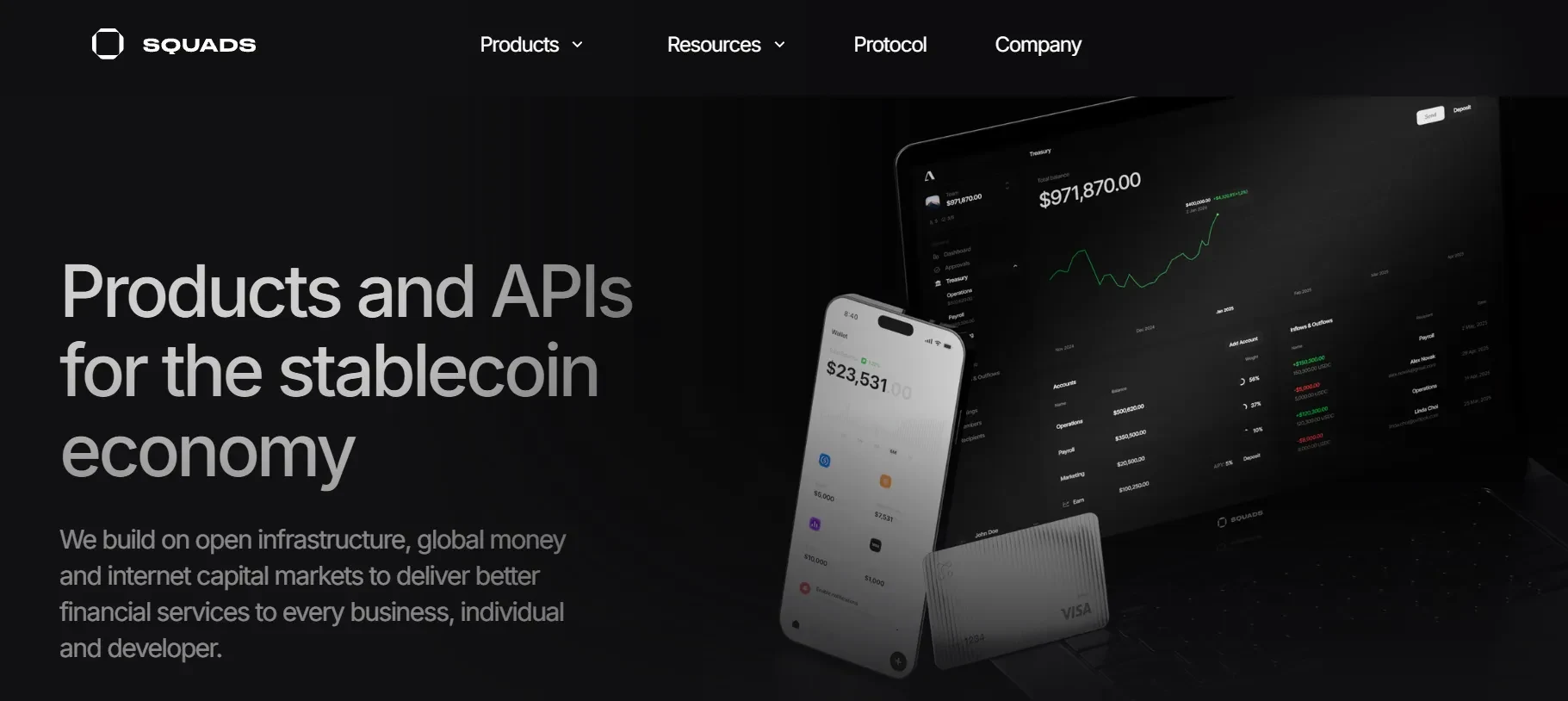
Squads is the leading M-of-N platform on Solana. Its v4 protocol has been immutable since November 2024, has two formal verifications and audits by OtterSec, Certora and Neodyme, and secures more than $10 billion. Basic is free apart from a one-time deployment fee in SOL; Pro, at $49 a month, adds roles, payments and sub-accounts; Enterprise adds 24/7 support. Spending limits and time locks are available too.
Best for: Solana-native companies managing USDC, tokens and program upgrades. Weakness: Solana only, so BTC or EVM holdings need a second product.
6. Nunchuk: Best Collaborative Wallet for Privacy-First BTC Teams
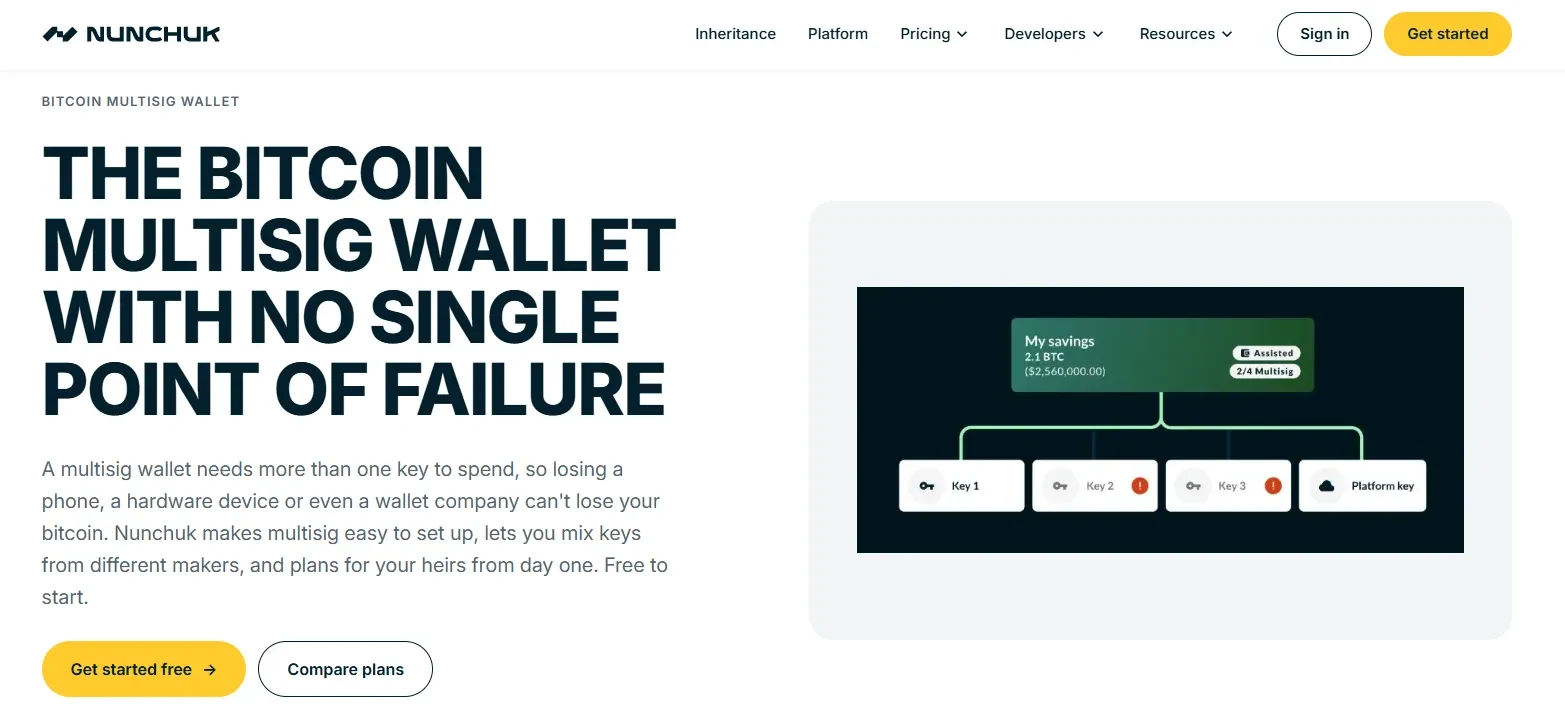
Nunchuk is a Bitcoin-only app with free do-it-yourself vaults and group accounts with encrypted chat, and no KYC. Paid plans add a Nunchuk platform key that co-signs within your rules, such as spending limits and signing delays: Iron Hand ($120 a year, 2-of-3), Honey Badger ($480, 2-of-4 with an inheritance key) and Honey Badger Premier ($2,100, 3-of-5 with roles and access control). It supports devices from more than ten makers and Taproot vaults.
Best for: privacy-minded partners co-managing BTC. Weakness: built mainly for individuals and families, with business roles only on the top plan.
7. Ledger Enterprise Multisig: Best for Hardware-Verified Approvals on EVM
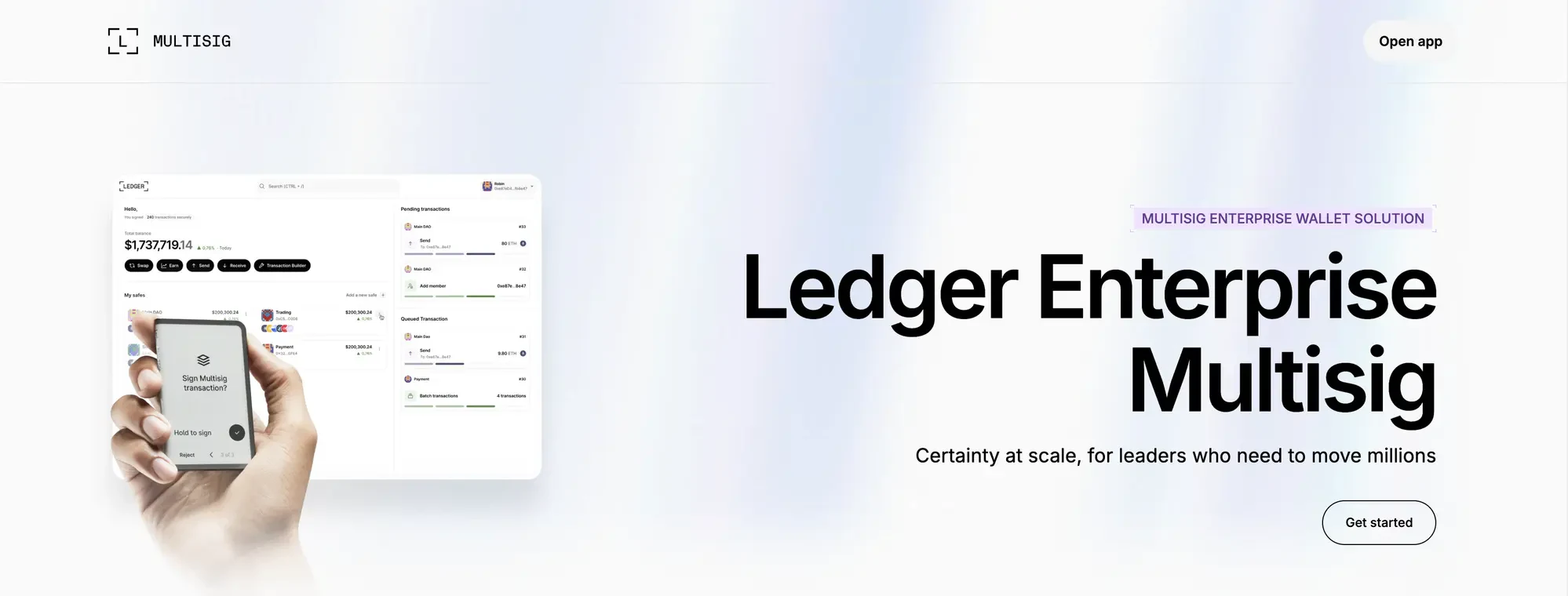
Ledger’s product runs on the Safe protocol, with every approval confirmed on a Ledger signer that shows readable details (Clear Signing) and flags risky contracts (Transaction Check). It covers Ethereum, Arbitrum, Optimism, Polygon, Base and BNB Chain. Ledger charges only on Ethereum: $10 per governance action, or 0.05% of each transfer capped at $5,000.
Best for: EVM teams that want every approval checked on a device screen. Weakness: EVM only, current Ledger devices required, and few rules beyond the threshold.
Compare Multisig Wallets: Features and Pricing in 2026
The table sets out multisig capabilities and published entry prices side by side.
| Product | Networks | Signer model | Business controls | Exit without the provider | Entry price |
|---|---|---|---|---|---|
| Casa | Bitcoin; Ethereum for ETH, USDC, USDT | 3 signers on Business, 5 or 6 on Enterprise; Casa holds 1 | Team signing, view-only roles, dual approval | Sparrow or Electrum; Safe for ETH | $2,750 a year |
| Safe | 40+ EVM networks | Any M-of-N owners | Proposers, spending limits, Safe Pro policies | Any Safe interface or the CLI | Free; Safe Pro from €189 a month |
| Unchained | Bitcoin | 2-of-3; Unchained holds 1 | Signer and auditor permissions; quorums on Signature | Caravan | $250 a year per vault |
| BitGo | 1,700+ assets, including Tron | 2-of-3: user, backup, BitGo | Whitelists, velocity limits, roles, approvals | Wallet Recovery Wizard | By contract |
| Squads | Solana | Any M-of-N members | Roles and sub-accounts (Pro), spending limits, time locks | Open-source, immutable protocol | Free plus SOL deployment fee; Pro $49 a month |
| Nunchuk | Bitcoin | Any M-of-N DIY; 2-of-3 to 3-of-5 assisted | Spending limits, delays; roles on Premier | Open standards, Sparrow | Free DIY; $120 to $2,100 a year |
| Ledger | 6 EVM networks | Safe owners on Ledger devices | Threshold, proposers | Any Safe interface | Ethereum only: $10 per governance action or 0.05% per transfer |
Verdict: Safe and Squads are the cheapest entry points on their chains, Casa is the simplest package for BTC plus stablecoins, and BitGo is the one built around regulated custody.
Top Multisig Wallets by Use Case
- BTC and stablecoins in one app: Casa.
- EVM treasury, foundation or DAO: Safe.
- BTC-only treasury reserve: Unchained.
- Exchange, fund or fintech: BitGo.
- USDT on Tron: BitGo, the only product reviewed here that supports Tron, or an MPC product.
- Solana-native company: Squads.
- Privacy-first partners holding BTC: Nunchuk.
- Hardware-verified approvals on EVM: Ledger Enterprise Multisig.
- Free, do-it-yourself vault: Sparrow or Electrum, if your team can run it.
- Personal multisig for founders: Casa or Nunchuk individual plans, kept apart from company funds.
- Several networks, detailed policies, no seed phrases: an MPC product rather than multisig.
Taken together, these picks come at a price. A company holding BTC and stablecoins on Ethereum, USDT on Tron and USDC on Solana would need three of them: Casa Business at $2,750 a year, BitGo for Tron on a contract, and Squads Pro at $49 a month. That means three sets of signers, backups and rules, and the engineering time to set up and test each one, which most small teams do not have. Most of the MPC platforms above cover all four networks with one set of approvers and limits, are set up in an app or web console rather than by deploying contracts and exchanging public keys, and start at $250 a month, less than those three subscriptions combined. For most businesses, MPC is the simpler product and the cheaper one.
Verdict: match the product to the network first; where a treasury spans several networks, multisig means running several products.
How to Create a Multisig Wallet: A Secure Multisig Setup in Seven Steps
The steps to set up a multisig are the same on any product:
- Write the policy first. List assets, networks, the M-of-N threshold, who proposes, who approves and the limits.
- Pick one product per network from the shortlist above.
- Prepare the signers. Set up each signer on its own hardware wallet, ideally from two makers, and record each seed phrase offline.
- Create the vault. On Bitcoin, import each device’s public key and save the configuration file; on EVM, deploy the Safe contract with owner addresses and a threshold.
- Separate the backups. Keep devices and seed phrases with different people, in different buildings.
- Test before funding. Send a small amount, spend it back with M signers, then rehearse replacing one signer.
- Document recovery. Write down who holds what and how to recover without the provider, and review it yearly.
Verdict: a careful setup takes a day, not an hour; testing and documentation are what save the funds later.
Multisig Wallet Best Practices for Business Crypto Security
When using multisig wallets, wallet security depends as much on habits as on the threshold:
- Verify on the device screen. Treat the web interface as untrusted and confirm destination and amount on the hardware device.
- Simulate before signing wherever your product offers transaction simulation.
- Allowlist and limit. Restrict payments to approved addresses and cap daily amounts.
- Rotate signers when people leave, the same week.
- Keep a small hot wallet for daily payments and the vault for reserves.
- Run a recovery drill at least once a year.
Verdict: these habits enhance security more than a fourth or fifth signer, and they apply equally to MPC.
Frequently Asked Questions
Which multisig wallet is best for a business in 2026?
It depends on the network: Safe for EVM, Casa for BTC with stablecoins, Unchained for BTC-only treasuries, Squads for Solana and BitGo for institutions. Teams on several networks should also compare MPC wallets: one MPC setup covers every network with a single set of approvers and no seed phrases, where this list would mean a separate product, signer set and backups for each network.
Is a multisig wallet safer than a single-signature wallet?
Yes, against lost and stolen keys and insiders acting alone. It does not protect against every signer approving a manipulated transaction, so device verification and simulation still matter.
Is MPC better than multisig for a business?
For most multichain businesses, yes: one set of rules across networks, no stack of seed phrases and signer changes without moving funds. Multisig stays strong where on-chain transparency matters most.
What happens if the multisig provider shuts down?
With open standards you can still move funds. Bitcoin vaults from Casa, Unchained and Nunchuk open in Sparrow or Electrum, Safe accounts work through any Safe interface, and BitGo publishes a recovery tool.
How much does a business multisig wallet cost?
From nothing for do-it-yourself setups to $2,750 a year for Casa Business and $7,500 a year for Unchained’s Signature for Business; BitGo prices by contract. Gas is always extra.
Sources
Provider facts were checked on the providers’ own pages in November 2026. Competitor articles are named without links.
- Casa: Business and Pricing pages; Sovereign Recovery for Ethereum vaults.
- Safe: homepage, Pricing, Teams and Safe Pro announcement (August 2026).
- Unchained: Business Vaults and Pricing pages.
- BitGo: developer documentation on wallet types and the Wallet Recovery Wizard; Custody and Cold Wallet pages.
- Squads: Pricing and Security documentation.
- Nunchuk: Pricing and Platform pages.
- Ledger: Enterprise Multisig fees support article (May 13, 2026) and launch post (October 2025).
- Fireblocks, Utila, Fordefi and Bron: pricing pages and our business wallet assessment (November 2026).
- Bybit: Safe Ecosystem Foundation statement and Sygnia findings, via The Block (February 26, 2025).
- Chainalysis 2025 theft figures, via The Block (December 18, 2025).
- Tron: Account Permission Management in the TRON developer docs; USDT share from Messari’s State of TRON Q2 2026 report, via Crypto Briefing.
- QuadrigaCX: Ontario Securities Commission staff review (April 14, 2020).
Disclaimer:
This article is provided for general informational purposes only and does not constitute financial, investment, accounting, tax, or legal advice. Bron is a self-custodial software wallet. While Bron’s architecture is designed to eliminate single points of failure and reduce certain risks, the use of blockchain technology and self-custodial wallets involves inherent operational, technical, governance, and security risks, including risks related to user configuration, device compromise, social engineering, or software vulnerabilities. Users remain solely responsible for evaluating their own circumstances, security practices, and risk tolerance when using any software to manage digital assets.